“You were listed as missing in action for eleven days.”
The words settled over the courtroom with a weight no one seemed prepared to carry.
My father’s mouth remained slightly open. My mother’s fingers froze against the strand of pearls at her throat. Even the clerk stopped typing.
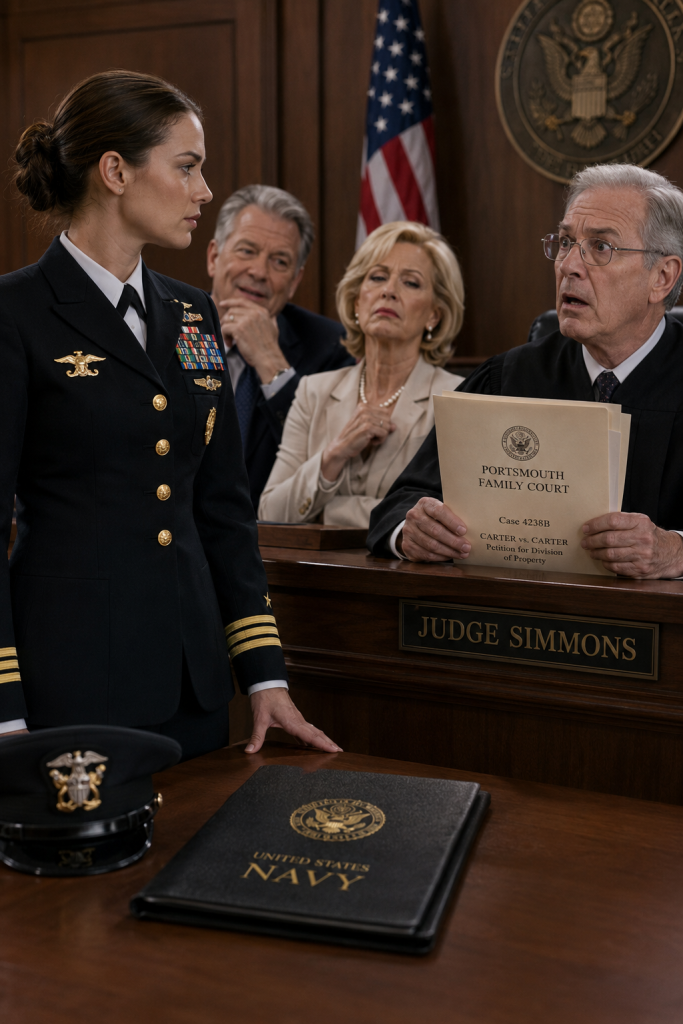
Judge Simmons looked down at the folder, but I could tell he was no longer reading. Whatever he saw there had taken him somewhere else.
I kept my hands at my sides.
“That information isn’t relevant to the property dispute, Your Honor,” I said.
My voice sounded calm, though the mention of those eleven days had tightened something beneath my ribs.
Judge Simmons slowly lifted his eyes.
“No,” he said. “It may not be.”
He paused, studying me with an expression I could not place.
“But it explains why the Department of Defense sent notices to this court in 2016 and again in 2018 concerning your legal residence.”
Dad shifted in his chair.
“What notices?” he asked.
The judge’s attention moved to him.
“Notices stating that Commander Carter was deployed under conditions that prevented her from responding to ordinary civil correspondence. They identified the farmhouse on Briarwood Road as her permanent residence.”
My mother turned toward my father.
“You said there weren’t any records.”
Dad stared straight ahead.
“I said I never saw any.”
The distinction was small, but it opened a thin crack between them.
Judge Simmons drew a page from the file.
“Mr. Carter, your petition states that your daughter ceased maintaining contact with the property in 2013. It also claims that you and your wife paid all taxes, insurance premiums, and maintenance expenses from that year onward.”
“That’s correct,” Dad said.
“No,” I replied.
The word came out more sharply than I intended.
Judge Simmons nodded toward me.
“You’ll have your opportunity, Commander.”
Dad looked over his shoulder, the old impatience flashing across his face.
“She hasn’t been part of this family for years.”
I felt the familiar sting of the sentence, but it did not land where it once would have. Twelve years ago, those words might have cut me open. Now they sounded tired, rehearsed—something he had repeated so often that even he might have forgotten where the truth ended.
Judge Simmons folded his hands.
“This court is not deciding whether Commander Carter has been an attentive daughter. We are determining ownership and financial responsibility for a piece of real estate.”
Dad’s jaw tightened.
“With respect, Your Honor, those things are connected.”
“Legally, they are not.”
Silence returned.
The judge turned toward me.
“Commander Carter, do you possess records showing payment of the property taxes?”
“Yes, sir.”
I opened the leather portfolio I had brought with me and removed copies of twelve years of tax receipts, bank statements, insurance renewals, and electronic transfers. The papers were neatly tabbed by year. Habit. Preparation had kept people alive before. It could certainly keep a house out of the wrong hands.
The bailiff carried the documents to the bench.
Judge Simmons examined the first few pages, then looked toward my father.
“These payments originated from accounts in Commander Carter’s name.”
Dad leaned forward.
“She sent money occasionally. That doesn’t mean she maintained the place.”
“Occasionally?” I asked.
Judge Simmons raised a hand, but he did not stop me.
I pulled another file from the portfolio.
“Property taxes every year. Homeowner’s insurance every year. Roof repair in 2015. Septic work in 2017. Foundation inspection in 2019. Tree removal after the hurricane in 2021.”
My mother’s eyes flickered.
“You paid for the tree removal?”
“Yes.”
“We thought Robert handled it.”
Dad’s face hardened.
“I coordinated it.”
“You called the contractor,” I said. “I paid the invoice.”
His gaze found mine.
“You weren’t here.”
“No. I was in Bahrain.”
A murmur moved through the benches behind us. Judge Simmons looked toward the gallery, and the room quieted.
Dad sat back.
“There. That’s exactly the point. She was always somewhere else.”
I closed the folder carefully.
“Being somewhere else is not the same as abandoning something.”
The sentence was about the farmhouse, but all three of us knew it reached farther.
Mom lowered her eyes.
Judge Simmons continued reviewing the records. His expression grew more severe with every page.
Then he stopped.
“What is this?” he asked.
I followed his gaze.
“A transfer authorization.”
“For nine thousand four hundred dollars?”
“The porch reconstruction.”
Dad’s chair creaked beneath him.
The judge looked toward the photographs attached to my parents’ petition. They showed the farmhouse from several angles: peeling paint, a sagging porch, weeds rising along the fence line.
“Was the porch reconstructed?” he asked.
“I believed it was.”
Judge Simmons slid one of the photographs across his desk.
The image had been taken less than three months earlier.
The porch leaned toward the ground like a tired shoulder.
I stared at it.
For years, my father had emailed me brief updates about the property. Nothing personal. No greetings. No questions about where I was stationed or whether I was safe. Just lists of things requiring money.
Storm damage.
Broken water heater.
Fence repair.
Mold treatment.
I had paid nearly every request because the house belonged to my grandfather and because some part of me believed that maintaining it was the only conversation my father and I still knew how to have.
I looked at him.
“You said the porch had been rebuilt.”
“It was worked on.”
“You sent me an estimate for full reconstruction.”
“Costs changed.”
“You sent photographs.”
“They were progress photographs.”
I remembered them: fresh lumber, new railings, sunlight across clean steps. At the time, I had looked at those images from a cramped room overseas and felt relief that something in my life was being preserved.
Now I studied the photograph in the court file.
The wood in those old emailed pictures had been pale and smooth. The porch before me was gray, warped, and untouched.
Judge Simmons leaned back.
“Mr. Carter, do you have invoices for the reconstruction?”
“Our attorney has the financial file.”
The attorney beside him—a narrow man with silver-framed glasses—began searching through his documents. His movements had lost their earlier certainty.
After a moment, he cleared his throat.
“Your Honor, I have invoices related to general maintenance, but I do not appear to have one specifically identifying a porch reconstruction.”
Dad turned to him.
“What do you mean, you don’t have it?”
“I mean it was not among the documents provided to me.”
Mom looked at Dad again.
This time, he did not meet her eyes.
Judge Simmons placed the page on top of the folder.
“I am going to ask a straightforward question. Where did Commander Carter’s nine thousand four hundred dollars go?”
Dad’s face reddened.
“There were numerous expenses. The house was old. Money was moved around.”
“Into what?”
“Repairs.”
“Which repairs?”
“I’d have to review the records.”
“You filed this petition,” the judge said. “You claimed that you carried the entire financial burden for this property. Yet within the first ten minutes of testimony, your daughter has produced evidence that she paid the taxes, insurance, and several major expenses. We now have reason to question whether at least one of those expenses was ever performed.”
Dad’s attorney whispered something to him.
My mother sat unnaturally still.
I should have felt vindicated. Instead, I felt the slow, disorienting ache of discovering that a memory had been built on false ground.
The money mattered. Of course it did.
But the photographs mattered more.
My father had not simply taken funds. He had constructed evidence for me. He had staged reassurance. He had understood that I wanted to believe the house was cared for, and he had used that belief with precision.
Judge Simmons turned toward me.
“Commander, do you have the photographs your father sent?”
“Not with me.”
“Can you access them?”
“Yes.”
He glanced at the clock.
“We’ll recess for thirty minutes. I want both parties to examine their records. When we return, I expect clear answers concerning these expenditures.”
His gavel struck once.
“All rise.”
The courtroom broke into noise.
I remained standing beside the empty defense table until the judge disappeared through the door behind the bench. My knee had begun to throb, a deep pulse beneath the reinforced joint, but I refused to reach for the cane folded inside my portfolio.
Mom approached first.
Up close, she looked older than she had from across the courtroom. Her makeup was carefully applied, but it could not conceal the exhaustion around her eyes.
“Evelyn,” she said.
I waited.
Her gaze drifted over the medals on my uniform.
“You didn’t tell us.”
“About what?”
“Being missing.”
Dad joined us before she could say more.
“This isn’t the place for theatrics,” he said.
I looked at him.
“I didn’t mention it. The judge did.”
“You knew what wearing that uniform would do.”
“To whom?”
His mouth tightened.
“To the room.”
I almost laughed, but there was nothing amusing in his expression.
“You think I wore this to intimidate you?”
“I think you’ve always known how to make an entrance.”
It was such an ordinary criticism, so perfectly matched to the man who had once accused me of enlisting because I wanted attention.
I leaned closer, lowering my voice.
“I wore it because the clerk told me the petition described me as absent, irresponsible, and unreachable. This uniform is the record of where I was.”
“You could have brought paperwork.”
“I did.”
Dad looked toward the portfolio.
“Then the uniform was unnecessary.”
“Maybe.”
The answer unsettled him more than an argument would have.
I had not worn it solely as evidence. I had worn it because when the summons arrived, I had felt eighteen again—standing in our kitchen while he told me that women who wanted hard lives usually got them.
Putting on the uniform had reminded me that I was no longer trapped in that kitchen.
Mom touched Dad’s sleeve.
“Robert, what happened to the porch money?”
He pulled his arm away.
“Not now.”
“You told me the repairs were finished.”
“And you saw the photographs.”
“So did Evelyn.”
A shadow crossed his face.
“You don’t understand how complicated it was.”
“Then explain it,” I said.
Dad turned toward the corridor.
“Everything will be addressed when court resumes.”
He walked away with his attorney.
Mom remained between us, watching him go.
For one brief second, she looked less like the woman who had sat beside him for forty years and more like someone who had just realized she did not know the road beneath her own feet.
“Did you really pay the taxes?” she asked quietly.
“Every year.”
“He told me he paid them.”
“I have the receipts.”
She pressed her lips together.
I could have filled the silence with accusations. I could have reminded her of every birthday card that never arrived, every deployment she pretended not to understand, every time she had let Dad speak for both of them.
Instead, I opened my phone.
The old emails were stored in an archived folder labeled BRIARWOOD. I had not opened most of them since leaving active service.
There it was.
Porch project. Phase one complete.
Attached were three photographs of new wooden steps and a freshly framed platform.
Mom leaned closer.
“That isn’t the farmhouse.”
I enlarged the image.
At first glance, the structure could have been ours. Same general shape. Same white siding. But near the edge of the photograph stood a brick chimney.
My grandfather’s farmhouse did not have a chimney.
The kitchen stove had always vented through the back wall.
Mom covered her mouth.
“Whose house is that?”
“I don’t know.”
I checked the file information. The photographs had been stripped of location data, but one detail remained in the corner of the final image: the blue edge of a street number plaque.
Only two digits were visible.
One and seven.
Mom reached for the phone.
I instinctively drew it back.
Her hand fell.
“Sorry,” she whispered.
It was the first apology I could remember hearing from her in years, and it was not even for the thing that mattered.
Across the corridor, Dad was speaking urgently to his attorney. His back was toward us.
“Did you know they were filing against me?” I asked.
Mom hesitated.
“I knew Robert wanted the title clarified.”
“That isn’t what I asked.”
She looked down at her wedding ring.
“He said the house was becoming a liability. He said you had stopped responding.”
“I never stopped responding.”
“He told me you had.”
“I sent him money six months ago.”
Her face changed again.
“For what?”
“Electrical rewiring.”
Mom closed her eyes.
“We haven’t had any electrical work done.”
A cold sensation moved through me.
“How often did he tell you I refused to answer?”
“Often enough that I stopped asking.”
There was no defense in her voice. Only shame.
I studied her, uncertain whether I was looking at a participant or another person Dad had managed through selective truths.
Perhaps she had been both.
The courtroom doors opened, and the clerk announced that proceedings would resume in five minutes.
Mom turned toward me.
“Evelyn, there’s something you should know.”
Dad looked over his shoulder.
Whatever she had been about to say disappeared.
He walked toward us.
“Margaret.”
Just her name. Nothing more.
But she stepped away from me.
The old pattern was so practiced that neither of them seemed aware they were performing it.
Dad’s attorney addressed me.
“Commander Carter, my client may be open to discussing a voluntary dismissal.”
Dad glared at him.
“I said no such thing.”
“You indicated that avoiding further inquiry might be—”
“I said I wanted this resolved.”
“It can be resolved,” I said. “Withdraw the petition.”
Dad faced me.
“And the house?”
“Remains mine.”
“Your grandfather never intended for it to sit empty.”
“You don’t know what he intended.”
“I knew him better than you did.”
The words struck harder than I expected.
My grandfather had taught me how to repair a fence, sharpen a blade, and listen for rain before clouds appeared. When my parents fought, he would take me to the farmhouse and give me work that required both hands. He never asked me to explain what was happening at home.
He simply made room for me.
“You knew him longer,” I said. “That isn’t the same thing.”
Dad’s eyes narrowed.
“He changed the will when he was confused.”
Mom flinched.
I had heard that accusation before, but never in court and never with such certainty.
“He was evaluated by a physician before he signed it,” I said.
“A physician you arranged.”
“I was deployed when the will was signed.”
“You always had people willing to do things for you.”
The clerk called us back inside before I could answer.
Judge Simmons entered carrying not one folder, but two.
The second was thin and dark blue.
I noticed it because there was no court label on its cover.
We took our places.
The judge adjusted his glasses.
“Before we continue, I need to disclose something.”
Dad’s attorney became alert.
Judge Simmons rested one hand on the blue folder.
“I knew Commander Carter’s grandfather, Samuel Carter.”
My father stared.
“You knew my father?”
“I did.”
“How?”
“We served together on the Portsmouth Veterans Housing Committee for nearly seven years.”
I had known Granddad volunteered with veterans, but he rarely discussed the details. He believed good work shrank when a person talked too much about doing it.
Judge Simmons continued.
“Our acquaintance does not automatically require my recusal. However, given the nature of this dispute, either party may request that the matter be reassigned.”
Dad looked at his attorney.
The attorney rose.
“Your Honor, may we have a moment?”
“You may.”
They whispered together.
Mom glanced at me, but I had no idea what she was searching for in my face.
Finally, Dad’s attorney spoke.
“My clients do not request reassignment at this time.”
Judge Simmons turned toward me.
“Commander?”
“No request, sir.”
“Very well.”
He opened the blue folder.
“Mr. Carter, during the recess, I asked the clerk to retrieve a sealed document stored with the county records. Your father submitted it shortly before his death.”
Dad went pale.
“What document?”
“A statement concerning the farmhouse.”
My pulse quickened.
Judge Simmons looked at me.
“Commander Carter, were you aware that your grandfather placed a conditional occupancy provision on the property?”
“No, sir.”
Dad leaned toward his attorney.
The judge removed a single page.
“The deed grants legal ownership to Evelyn Carter. That portion is not ambiguous. However, Samuel Carter included a separate directive permitting Robert and Margaret Carter limited stewardship of the property during any period in which Evelyn was deployed or medically unable to manage it.”
Dad seized on the words.
“There. Stewardship. That’s what we’ve been doing.”
Judge Simmons did not look up.
“The provision permitted you to arrange necessary maintenance. It did not transfer ownership. It also required you to maintain complete financial records and return any unused funds.”
Dad said nothing.
The judge continued.
“More importantly, the provision automatically terminated if the stewards sought personal financial benefit from the property or knowingly misrepresented expenses to the owner.”
The courtroom seemed to grow smaller.
Dad’s attorney removed his glasses and rubbed the bridge of his nose.
Judge Simmons set the statement down.
“The court will require a full accounting.”
Dad rose halfway from his seat.
“This is absurd. My father trusted me.”
“Sit down, Mr. Carter.”
The command was quiet, but Dad obeyed.
Judge Simmons turned toward the attorney.
“You will provide bank records, invoices, contractor agreements, and insurance documents covering the entire period identified in the petition.”
The attorney nodded reluctantly.
“Yes, Your Honor.”
“The court will also appoint an independent inspector to assess the condition of the farmhouse and estimate which claimed repairs were actually performed.”
Dad’s face had become rigid.
“How long will that take?”
“That depends upon the completeness of your records.”
“We can resolve this today.”
“No,” the judge said. “You attempted to resolve it today by requesting division of property based on claims that now appear materially inconsistent.”
Dad looked at me.
“This is what you wanted.”
It was not a question.
I met his stare.
“I wanted you to tell the truth.”
“That’s easy for you to say. You left.”
The words echoed through the courtroom.
I heard the clerk’s fingers stop above the keyboard. Judge Simmons watched us, but he did not interrupt.
“I was ordered overseas,” I said.
“You enlisted before anyone ordered you anywhere.”
“Yes.”
“You chose strangers over your family.”
“I chose a life you didn’t approve of.”
“You chose to disappear.”
For one second, the courtroom vanished, and I was back in the convoy after the explosion, dust packed into my mouth, radio static in my ear, Lewis no longer answering.
Eleven days.
The official report used clean language. Isolated. Injured. Communications lost.
It did not describe the nights listening to movement beyond the ruined compound. It did not explain how Lewis had used the last functioning radio battery to transmit my location instead of his own medical status. It did not mention the promise I made while holding pressure against a wound neither of us believed he would survive.
Dad knew none of that.
I had never told him.
But he knew I had been missing.
Someone had notified the family. Someone had called the house and said there was a chance I would not return.
I looked at Mom.
Her face had drained of color.
“Did you know?” I asked.
She did not pretend to misunderstand.
“Yes.”
The answer barely carried.
Dad turned toward her.
“Margaret.”
“You knew I was missing,” I said.
Tears gathered in her eyes.
“We were told there had been an incident.”
“For eleven days?”
She nodded.
“And neither of you ever asked me about it.”
Dad’s expression changed—not into regret, but resistance.
“You made it clear you didn’t want us involved.”
“I sent you my deployment address before I left.”
“You sent a form letter.”
“It was the address I had.”
“You could have called.”
“I did call. Three days after I came back.”
He looked away.
Mom closed her eyes.
I remembered that call. A nurse had helped me sit upright. My voice had been weak and uneven. Dad answered, listened while I said I was alive, and replied, “Your mother is resting.”
Then he told me the hospital charges from before my enlistment were still arriving at the house.
I had spent years convincing myself that perhaps he had been in shock.
Now, watching him, I understood something colder.
He had been angry that my survival did not return me to the daughter he wanted.
Judge Simmons spoke gently.
“Commander Carter, would you like a recess?”
“No, sir.”
My throat tightened, but I remained standing.
“I’d like to continue.”
He studied me before nodding.
“Very well.”
The judge scheduled the inspection and financial review for the following month. Until then, neither party could sell, lease, alter, or enter into contracts involving the farmhouse without court approval.
When the hearing ended, Dad left without looking at me.
His attorney followed, carrying a box that seemed heavier than it had that morning.
Mom stayed behind.
The gallery emptied around us. The janitor who had greeted me earlier appeared near the doors, waiting patiently with a cart, but he made no move to hurry us.
I began returning the papers to my portfolio.
“Evelyn,” Mom said.
I kept sorting.
“There was a reason we didn’t call again.”
I stopped.
She sat in the chair my father had vacated, both hands folded tightly over her purse.
“Your father received a second notification after you were found.”
“What notification?”
She looked toward the judge’s closed chamber door.
“One that said you had refused family contact.”
“I never refused contact.”
“I know that now.”
I stared at her.
“What exactly did it say?”
“I never saw the full letter. Robert read part of it to me.”
“Of course he did.”
The bitterness escaped before I could contain it.
Mom accepted it without protest.
“He said the Navy had advised us not to contact you because you had identified someone else as your next of kin.”
I thought of Lewis.
Before the convoy, we had both listed each other as emergency contacts because neither of us trusted our families to make fast decisions. After his death, I changed mine.
But not to my parents.
I had chosen Granddad.
“That wasn’t the same as refusing contact,” I said.
“I understand.”
“Did Granddad know I was missing?”
“Yes.”
The room tilted slightly.
“What did he do?”
“He drove to the base every day for information. They wouldn’t tell him much, but he kept going.”
That sounded like him.
Persistent without spectacle.
“He asked us to come with him,” Mom continued. “Robert refused.”
“Why?”
“He said there was nothing we could do.”
“And you?”
Her eyes lowered.
“I stayed with your father.”
The answer held no excuse.
I closed the portfolio.
“Why are you telling me this now?”
“Because after your grandfather died, Robert found something among his papers.”
“What?”
“A letter addressed to you.”
My hand tightened around the leather handle.
“Where is it?”
“I don’t know.”
“You just said he found it.”
“He did. I saw the envelope. Your name was written across the front.”
“What happened to it?”
“Robert took it into his study. When I asked later, he said it contained nothing important.”
A humorless breath left me.
“And you believed him?”
“No,” she said.
The firmness surprised me.
“I didn’t believe him. I chose not to challenge him.”
There was a painful difference between the two, and perhaps she had spent years learning it.
The janitor turned his cart away, giving us privacy.
Mom opened her purse and removed a small brass key.
“I went into the study last night.”
She placed it on the table between us.
It was old, tarnished at the edges, with a narrow oval head.
“I found this taped beneath the bottom drawer of his desk.”
I did not touch it.
“What does it open?”
“I hoped you would know.”
I looked closer.
Three tiny letters had been etched into the metal.
S. C. C.
Samuel Charles Carter.
My grandfather’s initials.
A memory stirred.
When I was ten, Granddad had shown me a cedar box hidden beneath a loose floorboard in the farmhouse pantry. He called it his storm box. It held cash, copies of important papers, and an old silver watch.
“If the roof blows away,” he had said, “we still know who we are.”
Years later, after he died, I searched beneath that floorboard.
The box was gone.
I picked up the key.
“Did Dad know you took it?”
“No.”
“What else was in the drawer?”
“Receipts. Bank envelopes. A photograph of a house I didn’t recognize.”
My thoughts returned to the false porch pictures.
“Did the house have a brick chimney?”
Mom stared at me.
“Yes.”
The answer sent a quiet current through the room.
“Where was it?”
“I don’t know. There was no address.”
“Was anyone in the photograph?”
She hesitated.
“A woman stood near the porch.”
“What woman?”
“I couldn’t see her face clearly.”
I waited.
Mom looked toward the courtroom doors, as though expecting Dad to return.
“She was holding a little girl’s hand.”
Something in her expression told me the detail frightened her, though I did not yet understand why.
“Who were they?”
“I don’t know.”
“You recognized someone.”
“No.”
“Mom.”
It was the first time I had called her that in years.
The word changed her face.
She reached into her purse again and removed a folded sheet of paper.
“I copied the number written on the back.”
She slid it toward me.
17 Briar Glen Lane.
The street number matched the sliver visible in the porch photograph.
Beneath the address was a date from fourteen years earlier, written in my father’s precise handwriting.
And below it, a name.
Anna Carter.
I read it twice.
“Who is Anna?”
Mom’s eyes filled again, but this time she did not look ashamed.
She looked afraid.
“I was hoping you could tell me.”
Outside, thunder rolled over Portsmouth, low and distant. Rain began tapping against the courthouse windows, each drop sharp against the glass.
I folded the paper and placed it beside the brass key.
My father had taken money intended for Granddad’s farmhouse and used photographs from another house to account for it.
A house on Briar Glen Lane.
A house connected to a woman and a child.
A house labeled with the Carter name.
Judge Simmons’s chamber door opened behind us.
He stepped into the courtroom without his robe, carrying the thin blue folder.
“I thought you had both left,” he said.
Mom quickly wiped her eyes.
I rose.
“Your Honor, may I ask you something about my grandfather?”
He looked at the key in my hand.
For the second time that day, his composure slipped.
“Where did you get that?”
“My mother found it.”
Judge Simmons came closer, his gaze fixed on the initials.
“I haven’t seen that key in nearly twenty years.”
“You know what it opens?”
He looked toward my mother, then back at me.
“Yes.”
The rain strengthened outside.
Judge Simmons lowered his voice.
“But before I tell you, Commander Carter, you need to understand that the farmhouse was never the only property your grandfather placed in trust.”