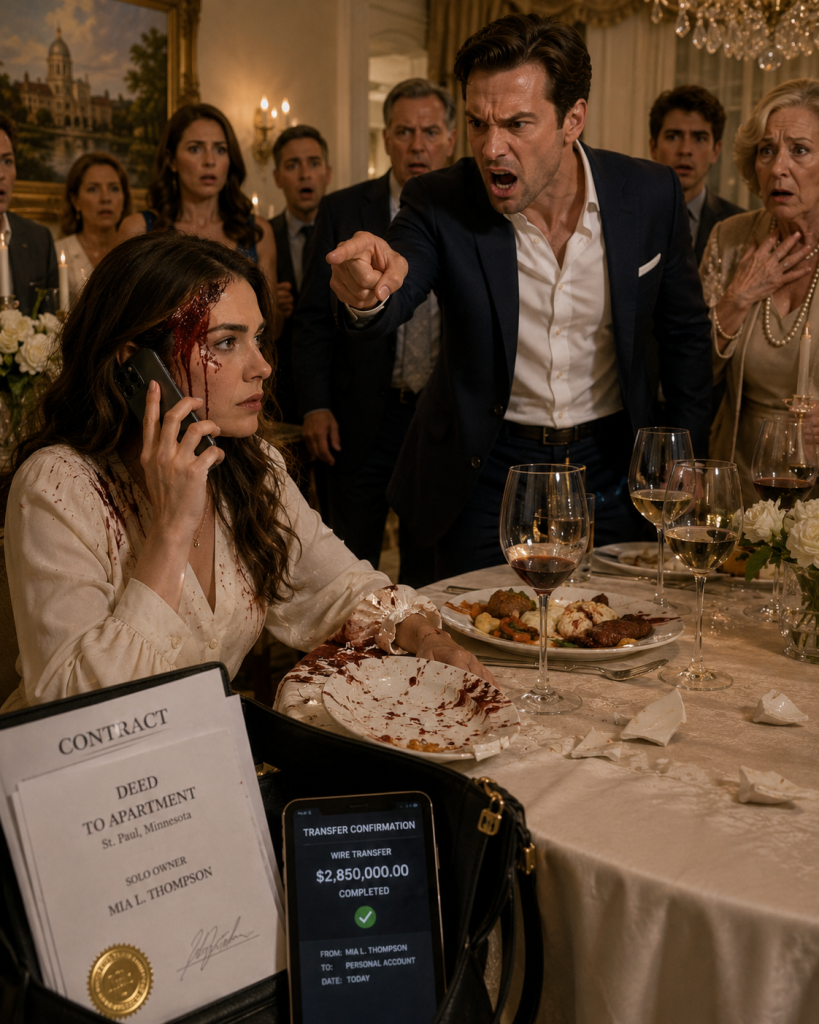
The small black device beside my handbag was no bigger than a lipstick tube.
For one terrible second, nobody moved.
Then Genesis’s face drained of color.
It was strange, almost unreal, seeing the woman who had spent an entire evening speaking about my life as if it were furniture suddenly lose control of her own expression. Her fingers hovered in the air where the carving knife had been. Her eyes fixed on the object by my bag, widening not with confusion, but recognition.
Jackson saw her reaction and his anger faltered.
“Elaine,” he said.
My name came out low, warning and pleading at the same time.
I kept the phone pressed to my ear.
“Yes,” I said into it, my voice steadier than I felt. “I’m at 1482 Briar Hollow Road in Hidden Hills. I’m bleeding from a head injury. My husband threw a plate at me during dinner.”
A woman on the other end of the line asked if I was somewhere safe.
I looked around the dining room.
Twenty adults. Crystal glasses. Gold-rimmed plates. A chandelier glittering above us as if this were a normal family gathering and not the moment my marriage finally cracked open for everyone to see.
“No,” I said. “I’m not sure.”
Jackson pushed his chair back. The scrape of wood against marble made several people flinch.
“Don’t be dramatic,” he snapped, but the words didn’t carry their usual force. His gaze kept sliding back to the little black recorder.
Genesis recovered first.
“Jackson, sit down,” she said sharply.
He froze.
That was the first time I noticed it—not the first time it had happened, only the first time I truly understood what I was seeing. Jackson could tower over me, shout until veins stood out in his neck, throw things, accuse and belittle and demand. But when Genesis spoke in that clipped tone, he became a boy waiting to be punished.
His brother, Marcus, stood at the far end of the table. “Mom,” he said quietly, “what is that?”
Genesis turned on him with a look so cold that he stopped speaking.
I lowered myself slowly back into my chair because the room had tilted again. Blood trickled along my cheekbone and into the corner of my mouth. It tasted metallic. My hands were shaking now that the first hard wave of adrenaline had begun to fade.
The dispatcher told me to stay on the line.
“I am,” I whispered.
Jackson’s father, Arthur, finally looked up from his plate. He was a thin, gray man with careful manners and the soft, absent voice of someone who had spent years learning not to be noticed.
“Elaine,” he said, barely above a murmur. “You need a towel.”
For some reason, that almost broke me.
Not the plate. Not the demand for my apartment. Not Genesis’s cold entitlement or Jackson’s public rage. But Arthur offering a towel as if the problem were a spilled drink.
I laughed once, a small, broken sound.
Genesis’s eyes narrowed. “There is no need to turn a family disagreement into a criminal matter.”
“A criminal matter?” Marcus said. “Mom, she’s bleeding.”
“It was an accident,” Jackson said quickly.
Every head turned toward him.
The lie landed with a dull thud in the room.
My fingers tightened around the phone.
“An accident?” I repeated.
Jackson swallowed. “You moved.”
A cousin near the sideboard made a faint sound of disbelief. His wife touched his sleeve, warning him to stay quiet.
The silence that followed was different from the first silence. That earlier one had been cowardly, practiced, automatic. This one was uncomfortable. Restless. People were beginning to understand that the story they told themselves about their family was not going to survive the evening intact.
The dispatcher asked me whether the person who hurt me still had access to anything that could be used as a weapon.
I looked at the carving knife on the floor, lying beside Genesis’s chair.
“Yes,” I said. “But no one is holding it.”
Genesis’s mouth tightened.
“Tell them,” she said, “that you are confused. Tell them we are handling this privately.”
I stared at her.
For years, I had tried to understand Genesis Vale.
When Jackson and I were first engaged, I believed she disliked me because I was new. Because I had not been raised in their world of catered charity luncheons, silent grudges, and inherited furniture. I mistook her sharpness for protectiveness. I told myself that mothers sometimes resented daughters-in-law because love felt like competition.
Later, I told myself she was lonely. Then that she was difficult. Then that she was old-fashioned. Then that perhaps I was too sensitive.
But sitting there with blood cooling on my skin, I finally saw the truth clearly.
Genesis did not dislike me because I had taken her son.
She disliked me because she had failed to take me.
She had mistaken kindness for weakness. Patience for permission. Marriage for surrender.
And tonight, she had overplayed her hand.
“No,” I said.
Her expression hardened.
The word seemed to land more heavily than anything else I had said all evening.
No.
One syllable. A locked door. A line drawn in ink.
Jackson stepped toward me.
Marcus moved before I did, placing himself between us. He wasn’t a large man like Jackson, but there was something firm in his shoulders, something decided.
“Back up,” Marcus said.
Jackson stared at him. “Are you kidding me?”
“No,” Marcus replied. “I’m not.”
I had never heard Marcus speak to his brother like that. He was usually the family comedian, always smoothing things over with a joke, always stepping away from conflict before it had a chance to stick to him. But now his face was pale, and his eyes kept moving between me and the recorder beside my bag.
Jackson gave a bitter laugh. “So that’s how it is? She plays victim, and everyone suddenly turns on me?”
“No one turned anything,” Marcus said. “We watched you throw a plate.”
Jackson’s jaw worked.
Aunt Sylvia, Genesis’s sister, placed both hands on the table. Her rings flashed under the chandelier. “I think everyone needs to calm down.”
“That’s what you said when he grabbed her arm last Thanksgiving,” Marcus said.
The room went still again.
I felt my breath catch.
Jackson turned slowly toward him. “What did you just say?”
Marcus’s voice was quiet, but it did not waver. “I said that’s what she said last Thanksgiving. And at Dad’s birthday. And at the charity dinner when Elaine disappeared into the bathroom for twenty minutes and came out with red eyes.”
A strange sound filled the room. It took me a moment to realize it came from me.
Not quite a sob. Not quite relief.
Someone had seen.
All this time, someone had seen.
Genesis rose from her chair. “Enough.”
But the word no longer had the same power.
Sirens sounded faintly in the distance.
Jackson heard them too. His face changed again, this time with real fear. Not panic exactly, but calculation. He began looking around the room as if searching for the fastest way to rebuild the old order before strangers arrived and asked questions no one could control.
Then his eyes dropped once more to the recorder.
“What is that, Elaine?”
I did not answer.
He took a step toward the table.
Marcus blocked him again. “Don’t.”
Jackson’s voice dropped. “I’m asking my wife a question.”
“She doesn’t owe you an answer right now,” Marcus said.
Genesis’s breathing had become shallow. She gripped the back of her chair with both hands.
Arthur looked at her then, really looked at her, and something in his face folded inward. It was not shock. It was recognition mixed with dread.
He knew too.
Of course he knew.
Maybe not everything, but enough.
The dispatcher told me officers were close. She asked whether I could move toward the front of the house.
Marcus reached for a cloth napkin, then hesitated, glancing at me for permission. I nodded. He handed it to me carefully, avoiding my blood, as though even in that small gesture he wanted to make clear I still had control over my own body.
I pressed it to my temple and stood.
The room shifted, but I stayed upright.
“I’m going outside,” I said.
Jackson gave a humorless laugh. “You’re really going to do this? You’re going to ruin me because of one mistake?”
“One?” Marcus said under his breath.
I looked at Jackson then, not as the man who had once brought me coffee in bed on Sunday mornings, not as the husband who knew exactly how I took my tea, not as the person I had defended to friends when they asked why he never seemed to keep a job for long.
I looked at him as someone I had been slowly losing for years.
Or perhaps as someone I had slowly been seeing.
“You ruined yourself,” I said.
His eyes flashed. “You think you’re so much better than me.”
“No,” I replied. “I think I’m tired.”
That was the truth beneath everything.
Beneath the fear. Beneath the anger. Beneath the humiliation of standing in front of his relatives with blood on my face.
I was tired.
Tired of shrinking rooms to fit his temper. Tired of checking his mood before speaking. Tired of making myself smaller so he could feel large. Tired of pretending love could survive without respect.
I walked toward the front hall.
A few relatives moved aside. No one tried to stop me.
Behind me, Genesis spoke in a low voice. “Jackson, do not say another word.”
For once, I agreed with her.
The front doors opened before I reached them. Two officers stepped inside, followed by paramedics carrying a medical kit. Cold night air rushed into the house, smelling faintly of eucalyptus and rain on pavement.
The sight of uniforms changed everything.
Voices overlapped.
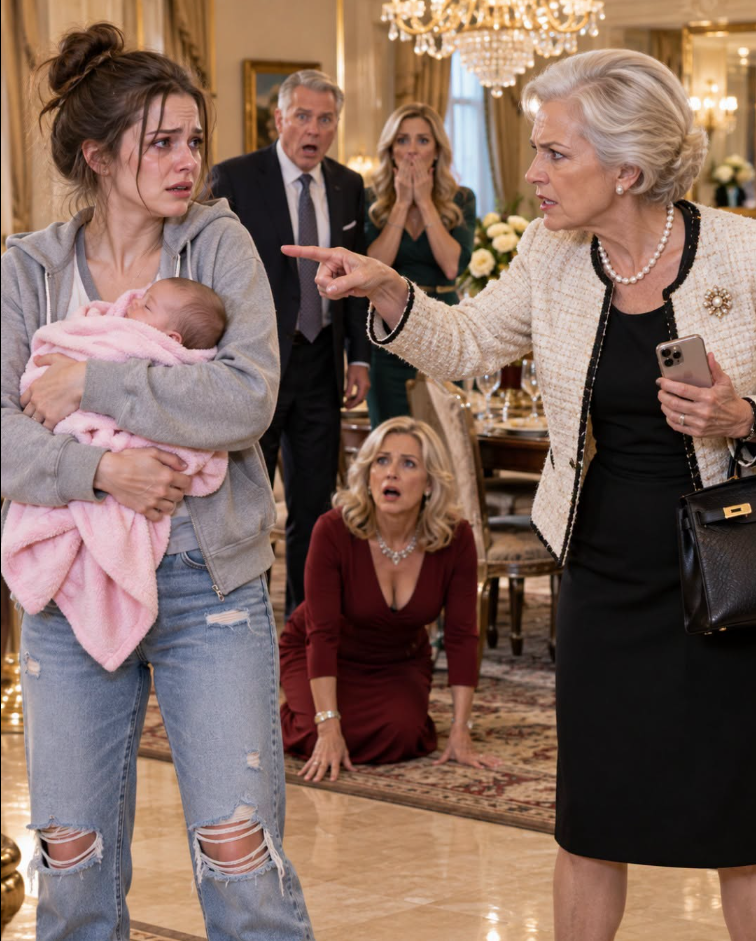
Genesis began explaining before anyone asked her a question. “There has been a misunderstanding. My daughter-in-law became upset during dinner and—”
“She was hit with a plate,” Marcus said.
Genesis stared at him as if he had struck her.
One officer, a woman with calm eyes and dark hair pulled tightly back, lifted a hand. “One person at a time.”
The other officer approached me. “Ma’am, are you Elaine Vale?”
I hesitated at the name.
Vale.
Jackson’s name. His family’s name. A name I had worn like a coat in bad weather, believing it protected me. Tonight, it felt soaked through and heavy.
“Yes,” I said.
The paramedic guided me to a bench in the foyer. She was gentle, efficient, and blessedly direct.
“I’m going to look at the cut,” she said. “You may need stitches.”
Jackson stood in the dining room entrance with his arms crossed, trying to look offended rather than frightened. But his eyes betrayed him. They kept flicking toward the table, toward my handbag, toward the recorder.
The female officer noticed.
“What is that device?” she asked.
No one answered.
I closed my eyes briefly.
This was the point of no return.
Months earlier, I had bought the recorder after a conversation with my attorney, Naomi Patel. Not because I wanted drama. Not because I had some elaborate plan. I bought it because Jackson had developed a terrifying talent for denying things immediately after saying them.
He had called me unstable, then insisted he had never said it.
He had threatened to drain our joint account, then laughed when I repeated the words.
He had told me his mother deserved my apartment more than I did, then acted wounded when I said I felt unsafe.
I began recording conversations in my own home after Naomi told me, carefully and professionally, that if I was preparing to separate, documentation mattered. She also told me to understand the recording laws in my state and wherever I was recording. I did. I learned more legal language in three months than I had in my entire life.
But tonight I had not planned to record anything at dinner.
I had brought the device because I planned to meet Naomi in the morning and hand over everything I had already collected. It was in my bag along with the folder Jackson had never found.
The folder was what Genesis had seen.
Not the recorder.
The edge of it had slipped from my handbag when I pulled out my phone. A plain manila folder, marked with a blue tab.
ST. PAUL PROPERTY — TRANSFER ATTEMPT.
That was what had wiped the rage off Jackson’s face.
Not fear of the police.
Fear of what I had discovered.
I opened my eyes.
“It’s mine,” I said. “A recorder. But it wasn’t running tonight.”
Jackson exhaled sharply, relief flashing across his features before he could hide it.
Genesis’s shoulders lowered a fraction.
Then I reached into my handbag with slow, careful fingers and pulled out the folder.
“This,” I said, “is what they’re worried about.”
Genesis made a small sound.
Arthur closed his eyes.
The officer took the folder but did not open it immediately. “What is it?”
“Documents related to my apartment,” I said. “Someone tried to initiate a transfer of ownership using my information.”
Jackson barked out a laugh. “That’s insane.”
But he looked at his mother when he said it.
Not at me.
The female officer noticed that too.
I turned toward Genesis. “You knew the notary’s name.”
Her face became perfectly still.
It was a gift of hers, that stillness. She could disappear behind it whenever emotion threatened to expose her. I had seen it at bridal showers, hospital visits, dinners where Jackson drank too much and said too little afterward. A marble mask with pearl earrings.
“I don’t know what you’re talking about,” she said.
“Yes, you do,” I replied. “You mentioned her tonight.”
Marcus frowned. “Who?”
“Carol Whitcomb,” I said.
Genesis’s lips parted, then closed.
It had been one sentence. One tiny slip, buried in the middle of her long performance about aging, sacrifice, and family duty.
She had said, Carol said these things are never as complicated as people make them sound.
At the time, everyone assumed Carol was a friend.
But I knew the name because Carol Whitcomb had notarized a document I had never signed.
The paramedic paused with gauze in her hand. “Ma’am, keep pressure here.”
I obeyed, though my fingers felt numb.
The officer opened the folder and scanned the first page. Her face gave nothing away, but her posture changed slightly.
Jackson shifted. “That has nothing to do with tonight.”
“It has everything to do with tonight,” I said.
His voice hardened. “Elaine.”
The warning in it was familiar. It had worked on me for years. Lower your voice. Change the subject. Smile. Don’t embarrass me.
But the warning had no place left to land.
I looked at the officer. “Three weeks ago, I received a notice from my lender about a request for payoff information on my apartment. I never requested it. When I called, they said someone claiming to represent me had asked about a transfer. Then I found out a quitclaim deed had been drafted with my name on it.”
Genesis sat down slowly, as if her legs no longer trusted her.
Jackson shook his head. “You’re confused.”
“No,” I said. “For the first time in years, I am very clear.”
The officer asked if I had filed a report.
“I met with an attorney,” I said. “We were preparing everything.”
Jackson laughed again, but it sounded thin. “Preparing? So you came here looking for a fight.”
“I came here because you told me it was your father’s birthday dinner.”
Arthur looked down.
That, more than anything, confirmed what I had suspected. There was no birthday cake. No gifts. No casual celebration. His birthday was not for another month.
It had been a pretext.
Marcus stared at his father. “Dad?”
Arthur rubbed one trembling hand over his mouth. “I didn’t know about the plate.”
It was the wrong answer.
Marcus stepped back as if struck by it.
“You didn’t know about the plate,” he repeated.
Arthur said nothing.
The female officer turned toward Jackson. “Sir, I need you to step outside with my partner.”
Jackson’s face tightened. “I’m not leaving my own parents’ house.”
“You’re not being asked,” she said.
For a moment, I thought he would refuse.
Then he looked at Genesis.
She gave the smallest shake of her head.
Careful, it said.
He went.
The room seemed to exhale after he passed through the front doors.
I had expected to feel triumph when that moment came. Some clean, dramatic surge of victory. Instead I felt hollow and cold. The paramedic touched my shoulder and told me to breathe slowly. I realized I had been holding my breath.
Marcus crouched near me, not too close.
“Elaine,” he said. “I’m sorry.”
I looked at him.
His eyes were wet.
“I should have said something sooner,” he continued. “I saw things. I told myself it wasn’t my marriage. I told myself you were private, and Jackson was under pressure, and Mom would make everything worse if I interfered.”
He swallowed.
“All excuses,” he said. “I’m sorry.”
A month ago, I might have comforted him. I might have told him it was okay because I had spent years taking other people’s guilt and polishing it into something easier for them to carry.
But tonight I could not.
“Thank you for saying something now,” I said.
He nodded once, accepting that it was all I had to give.
Across the foyer, Genesis was speaking quietly to the female officer, who had stayed inside to take initial statements. Her voice had regained some of its smoothness.
“Elaine has been under strain,” Genesis said. “Her work is very demanding. She and Jackson have had financial disagreements, as many couples do.”
“I own my apartment separately,” I said without looking at her. “There is no marital dispute about it.”
Genesis turned her head slowly. “Family property is never truly separate.”
The officer looked up.
Even Genesis seemed to realize she had said too much.
Aunt Sylvia sank into a chair in the hallway. Someone in the dining room began crying softly. The younger cousins had gathered near the kitchen entrance, whispering. The children were nowhere in sight, and I was grateful for that small mercy.
The paramedic cleaned the cut at my temple. The sting brought tears to my eyes, but I blinked them away.
“You likely need stitches,” she said. “We should take you in.”
I nodded.
The officer asked whether I wanted to make a statement at the hospital.
“Yes,” I said.
Genesis’s gaze snapped to me.
It was almost impressive, how deeply she had believed I would still protect them. Even after the plate. Even after the blood. Even after the folder.
To Genesis, my refusal to cooperate was not self-preservation. It was betrayal.
The female officer placed the documents back in the folder and handed it to me. “Bring this with you. It may be relevant to a separate investigation.”
Jackson stood outside by the patrol car, speaking with the other officer. Through the glass panels beside the front door, I could see his profile. Hands moving. Shoulders tense. He was performing now, no doubt. Explaining. Minimizing. Recasting the scene into something more flattering.
I had seen him do it with unpaid contractors, disappointed investors, friends he had borrowed money from and never repaid.
He could be charming when cornered.
That charm had been the first thing I loved.
Or thought I loved.
When I met Jackson, he was all warmth and ambition. He said I made him feel steady. He admired my designs, asked thoughtful questions about load-bearing walls and zoning restrictions, brought me pastries from a bakery near his office even after that office closed and he pretended for two weeks he still had meetings there.
There had been softness once.
I needed to believe that.
Not because it excused him, but because I needed my own story to make sense. I needed to know I had not walked willingly into cruelty with open eyes. I had loved the version of him he showed me, and maybe he had loved me too, in the incomplete way people love what shelters them.
But love without accountability turns into appetite.
And Jackson had been hungry for a long time.
The paramedics helped me stand.
As we moved toward the door, Arthur stepped into my path.
For a moment, the officer stiffened.
But Arthur only held out something small and silver.
My apartment keys.
I stared at them.
They had been missing for two days.
“I found them in Genesis’s desk,” he said.
The words were so quiet I almost missed them.
Genesis made a sharp movement behind him. “Arthur.”
He did not turn around.
His hand shook as he held the keys out to me.
I took them.
“Why were they there?” I asked.
His face crumpled with shame. “I don’t know.”
But he did.
Not all of it, perhaps. But enough.
Genesis stepped closer. “Arthur is confused.”
“No,” Arthur said.
The entire foyer went silent.
He seemed surprised by his own voice. He straightened a little, though it clearly cost him something.
“No,” he repeated. “I am not confused.”
Genesis stared at him, and for the first time since I had known them, I saw fear pass across her face that had nothing to do with police or paperwork.
It was the fear of losing control over someone she had controlled for decades.
Arthur looked at me. “I’m sorry, Elaine.”
I could not answer him.
The paramedics guided me outside.
The night had turned misty. The grand houses of Briar Hollow Road sat behind iron gates and manicured hedges, their windows glowing softly, hiding whatever sorrows lived inside them. Somewhere down the street, sprinklers ticked across a lawn. A dog barked once and fell silent.
Jackson saw me and stopped talking.
For a brief moment, we were alone inside the noise of everything else.
He looked younger in the porch light. Tired. Furious. Afraid.
“Elaine,” he said.
The officer beside him told him not to approach.
Jackson ignored him with his eyes, not his feet.
“Don’t do this,” he said. “We can fix it.”
I looked at the gauze in my hand, red blooming through white.
“No,” I said. “We can’t.”
His face twisted. “After everything I did for you?”
The old reflex rose in me—explain, defend, correct the record.
I let it pass.
That was growth, I realized. Not a grand transformation. Not an instant becoming. Just the small, quiet decision not to step into the same trap because someone had opened it.
The paramedic helped me into the ambulance.
As the doors closed, I saw Marcus standing on the porch. Arthur beside him. Genesis behind them, half in shadow.
She was not looking at Jackson.
She was looking at me.
And in her face, beneath the anger and panic, I saw something else.
Not remorse.
Recognition.
She had underestimated me, yes.
But I had underestimated her too.
At the hospital, time became fluorescent and fragmented.
A nurse asked questions. A doctor examined the cut and told me I needed four stitches. Someone brought me a clean towel and a paper cup of water. The police officer returned to take my statement in a small room with pale blue walls and a poster about concussion symptoms.
I answered everything as clearly as I could.
Yes, Jackson threw the plate.
Yes, others witnessed it.
Yes, there had been prior incidents that frightened me, though I struggled to describe them because so many had left no visible mark.
How do you explain a marriage that bruises the air around you?
How do you make someone understand the weight of a look across a room, the punishment of silence, the way your own home can become a place where you measure every cabinet door by how loudly it closes?
I did my best.
When the officer asked about the property documents, I gave her the folder.
“There’s more,” I said.
She waited.
“My attorney has copies of recordings, emails, bank statements, and messages. I was planning to file for divorce.”
Saying it aloud felt less like a confession than a door opening.
Divorce.
The word had terrified me for months. It seemed enormous, like a storm system on the horizon. But spoken in that small hospital room, it became practical. Painful, yes. Complicated, yes. But survivable.
The officer took notes.
“Did your husband know?” she asked.
“No,” I said. “I don’t think so.”
But even as I said it, I remembered the way Jackson’s eyes had dropped to the folder.
Maybe he had known something.
Maybe he had suspected.
Maybe that was why tonight had happened now.
After the officer left, I borrowed a charger from the nurse’s station and called Naomi.
She answered on the second ring, her voice thick with sleep but instantly alert when she heard mine.
“Elaine? What happened?”
I told her.
Not all of it. Not yet. Just enough.
There was a pause, then the rustle of movement.
“Are you safe right now?” she asked.
“Yes. I’m at the hospital.”
“Good. Do not go home alone. Do not speak to Jackson without counsel. Do not agree to meet anyone from his family privately. I’ll contact you first thing in the morning.”
“Naomi,” I said. “They had my keys.”
Her silence sharpened.
“Who had your keys?”
“Arthur gave them back. He said they were in Genesis’s desk.”
“Elaine,” she said carefully, “has anyone been inside your apartment without your permission?”
I thought of the kitchen drawer that had been slightly open when I came home last week. The faint scent of Genesis’s perfume near my coat closet. The feeling I had dismissed as paranoia because Jackson always said I made mysteries out of dust.
“I don’t know,” I whispered.
“Then you are not going there tonight.”
“I need clothes. My laptop. My work files.”
“No,” Naomi said firmly. “We’ll arrange it safely. Stay with someone you trust.”
The sad, embarrassing truth was that I had let my world get very small.
Jackson disliked my friends. Not openly at first. He simply found faults in them. Leah was too loud. Monica was jealous. Priya filled my head with negative ideas. My colleagues were pretentious. My neighbors were nosy.
Little by little, loving him became easier when fewer people were around to witness what it cost.
But there was one person he had never managed to remove entirely.
My sister.
I called Claire from the hospital hallway after the stitches were done.
She answered with the panicked breath of someone who had been sleeping beside her phone.
“Elaine?”
At the sound of her voice, I began crying.
Not gracefully. Not quietly. The tears came from somewhere old and exhausted, and I pressed one hand against the wall to keep myself upright.
Claire did not ask me to calm down.
She waited.
When I could speak, I told her where I was.
“I’m coming,” she said.
“It’s late.”
“I’m coming,” she repeated.
Forty minutes later, she walked into the emergency department wearing leggings, a raincoat over pajamas, and the expression she used to have in high school when someone hurt me and she was ready to make it the entire city’s problem.
She stopped when she saw my face.
“Oh, Ellie.”
That childhood nickname undid me all over again.
She wrapped her arms around me carefully, avoiding the bandage at my temple, and I held on to her like I was twenty-two again and our parents had just died and she was the only solid thing left in the world.
“I’m sorry,” I said into her shoulder.
She pulled back. “No. Absolutely not. We are not doing that tonight.”
“I should have told you.”
“Yes,” she said, wiping under her eyes. “You should have. And tomorrow I will be furious about that. Tonight I’m just glad you called.”
That was Claire. Honest enough to hurt, loyal enough to stay.
She drove me to her house in Pasadena just before dawn. The city was washed in gray light, palm trees black against the sky. I sat in the passenger seat with a hospital discharge packet in my lap and watched Los Angeles wake as if nothing in the world had changed.
Claire did not ask many questions on the drive.
She handed me a bottle of water. Turned down the radio. Let silence do its work.
At her house, she gave me the guest room, one of her soft old T-shirts, and strict instructions not to check my messages until I had slept.
I tried.
But sleep came in broken pieces.
Every time I closed my eyes, I heard the plate crack again. Saw Genesis’s knife fall. Saw Arthur holding my keys in his trembling hand.
At nine in the morning, I woke to sunlight across the ceiling and forty-three missed calls.
Jackson.
Genesis.
Unknown numbers.
Two from Marcus.
One voicemail from Arthur.
My stomach tightened.
Claire found me sitting on the edge of the bed with the phone in my hand.
“Don’t listen alone,” she said.
So we sat together at the kitchen table while her coffee maker hissed and her old golden retriever, Mabel, pressed her warm body against my legs.
I played Marcus’s message first.
“Elaine, it’s Marcus. I know you may not want to talk, and I understand. I gave my statement. I told them what happened. Some others did too. Not everyone, but enough. I also…” He paused. “I also found something after you left. I don’t want to leave it in the house. Call me when you can. Or have your attorney call me. I’m sorry.”
Claire looked at me.
“What does that mean?” she asked.
“I don’t know.”
Then Arthur’s voicemail.
For several seconds, there was only breathing.
Then his voice, smaller than I had ever heard it.
“Elaine. This is Arthur. I wanted you to know… I should have stopped this long ago. Not just last night. Long ago. Genesis has a safe in her study. Behind the portrait of her father. The code is Jackson’s birthday.” A shaky inhale. “I don’t know what is inside now, but I saw your name on papers two weeks ago. I’m sorry. I’m so sorry.”
The message ended.
Claire’s coffee mug stopped halfway to her mouth.
“Elaine,” she said slowly. “What kind of papers?”
I stared at the phone.
My heart had begun beating hard again.
Before I could answer, Naomi called.
I put her on speaker and told her about the voicemails. She was silent for a moment, then asked me to forward both to her immediately.
“Do not contact Marcus directly yet,” she said. “I’ll reach out. As for the safe, that is not something you handle yourself. If there are documents connected to a suspected property fraud, law enforcement needs to know.”
“Fraud,” Claire repeated, as if naming it made the room colder.
Naomi continued, “Elaine, there’s something else. I reviewed the scanned deed again after your call. The notary stamp is real, but the signature page has inconsistencies. The witness name caught my attention.”
“What witness name?”
“Lydia Crane.”
I frowned. “I don’t know anyone named Lydia Crane.”
“I didn’t think you did,” Naomi said. “But I searched my own case notes. That name appeared in another matter I consulted on last year. Different family. Similar attempted transfer. Elderly parent pressured to sign over property. Same notary.”
Claire leaned forward. “So this has happened before?”
“I can’t discuss another client’s confidential matter,” Naomi said. “But I can say this may not be only about your apartment.”
A chill moved through me.
Genesis had not seemed desperate last night. Entitled, yes. Angry, yes. But beneath it all there had been confidence, as if the result had been decided before I arrived.
Maybe it had.
Maybe my apartment was not her first attempt.
Maybe it was simply the first time someone had said no in a room full of witnesses.
Naomi’s voice softened. “Elaine, I know this is overwhelming. For today, focus on safety and medical follow-up. I’m filing the emergency petition we discussed. I’ll also coordinate with the officer assigned to the property issue.”
“What happens to Jackson?” I asked.
“That depends on the police report, witness statements, and charging decision. You do not need to manage that.”
I looked at Claire’s kitchen window. Outside, the lemon tree in her yard swayed gently in the morning breeze.
For years, I had managed everything.
Jackson’s moods. Genesis’s expectations. Bills he forgot. Apologies he owed. Stories he changed. Rooms he emptied of warmth.
The idea that something could happen without me managing it felt almost impossible.
After the call, Claire made toast I barely ate. Then she sat across from me with her hands folded.
“I need to ask you something,” she said.
I braced myself.
“Are you going back to him?”
The question was quiet. Not accusing. Not dramatic.
Still, it hurt.
“No,” I said.
She closed her eyes in relief.
“I’m not,” I repeated, more to myself than to her.
The words settled between us.
No thunder. No music. No sweeping certainty.
Just a decision.
By afternoon, Naomi had arranged for an officer to accompany Claire and me to my apartment so I could collect essentials and check whether anything had been disturbed. Walking into my own building with someone in uniform felt humiliating at first. Then the feeling shifted.
I was not being escorted because I had done something wrong.
I was being protected because someone else had.
My apartment sat on the fourth floor of a brick building in St. Paul, though I kept it as a work residence and rental space depending on projects. It was not large, not glamorous in the way Genesis valued, but it was mine. Sunlight filled the living room through tall windows. My drafting table stood near the east wall. Books leaned in uneven stacks on the shelves. A blue ceramic bowl Claire had made in college sat by the door, where I dropped my keys every time I came in.
Except the bowl was empty.
Of course it was.
I unlocked the door with the keys Arthur returned and stepped inside.
At first, everything looked normal.
Then Claire said, “Ellie.”
She pointed to the bookshelf.
A framed photo had been moved. Not much—just a few inches. Behind it, the wall safe I had installed two years earlier stood closed, but the tiny scratch near the keypad was new.
My throat tightened.
Only three people knew that safe existed.
Me.
Claire.
And Jackson.
The officer photographed it. I opened the safe with trembling fingers.
My passport was there. My birth certificate. Insurance paperwork. A velvet pouch with my mother’s wedding ring.
But the envelope containing the original property deed was gone.
In its place was a sheet of folded paper.
Not a legal document. Not a threat.
A note.
Written in Genesis’s elegant hand.
Elaine,
You have always misunderstood what family requires.
G.
Claire read it over my shoulder and whispered a word she almost never used.
The officer bagged the note.
I stood in the middle of my apartment, surrounded by the life I had built before Jackson, and felt something inside me harden—not into bitterness, but into clarity.
Genesis had been here.
Or someone had come for her.
Either way, the polite fiction was over.
This was not an emotional dispute. It was not a misunderstanding. It was not a difficult mother-in-law pushing boundaries.
It was a plan.
And I had interrupted it.
We collected my laptop, medication, documents, and clothes. Before leaving, I paused by the window.
The city below moved in miniature. Cars. Pedestrians. A cyclist waiting at a red light. Ordinary lives continuing beneath an extraordinary day.
I remembered buying the apartment. I had been thirty-one, terrified of the mortgage, proud in a way I could barely admit out loud. I painted the bedroom myself and slept on a mattress on the floor for six months. I learned the sounds of the pipes, the stubborn window latch, the way winter light turned the walls pale gold.
This place had held me before Jackson.
It would hold me after him.
Back at Claire’s house that evening, Naomi called again.
Her voice was different this time. Controlled, but tight.
“Elaine, Marcus’s attorney contacted me.”
“Marcus has an attorney?”
“He does now.”
Claire and I exchanged a look.
Naomi continued, “He found documents in Genesis’s study after officers left. He did not remove originals, but he photographed several items before securing the room. He has turned the photographs over through counsel.”
“What items?”
“A list of properties,” Naomi said. “Names. Addresses. Estimated values.”
My skin prickled.
“My apartment?”
“Yes.”
I closed my eyes.
“And others?”
“Yes.”
“How many?”
Naomi paused.
“At least nine.”
Claire stood and walked away from the table, one hand over her mouth.
I sat very still.
Nine.
Nine homes. Nine sets of signatures. Nine stories. Nine people who may have been pressured, tricked, or cornered into giving up what belonged to them.
“Were they family?” I asked.
“Some appear to be connected to friends, church members, extended relatives, business acquaintances. I don’t have the full picture.”
“And Genesis?”
“Her name appears in notes on several pages.”
My mind went back to every luncheon she hosted, every grieving widow she “helped,” every cousin who sold a house quickly after a death in the family, every elderly friend she praised for being sensible about downsizing.
Genesis did not shout like Jackson.
She did not throw plates.
She carved.
Slowly. Patiently. At the joints.
Naomi said, “There’s one more thing.”
I gripped the edge of the table.
“The note in your safe may become important, but the missing deed matters more. Do you have any idea where else an original or certified copy might be?”
“My lender has records. The county recorder.”
“Yes, but I mean personally.”
I thought of my files. My office. Safe deposit box? No, I never opened one. My old storage cabinet?
Then I remembered.
“My father’s desk,” I said.
Claire turned back toward me.
After our parents died, Claire and I divided their belongings slowly, sometimes with tenderness, sometimes with arguments, sometimes by avoiding the boxes entirely. I had taken Dad’s old walnut writing desk because I could not bear to see it sold. One drawer stuck unless pulled at the exact angle. Inside was a hidden compartment where he used to keep emergency cash and old letters from our mother.
When I bought the apartment, I placed a certified copy of the deed there as a sentimental gesture more than a practical one. Dad had always believed important papers belonged in important furniture.
“The desk is in my office storage unit,” I said.
“Good,” Naomi replied. “Tomorrow, we retrieve it carefully.”
But tomorrow did not wait.
At 11:17 that night, Claire’s doorbell rang.
Mabel barked once, then began growling low in her throat.
Claire looked at me from across the living room.
Neither of us moved.
The bell rang again.
Then my phone buzzed.
A text from Marcus.
I’m outside. I know I shouldn’t have come, but there’s something you need to hear tonight. It’s about Jackson. He isn’t Genesis’s only son.
I stared at the message until the words blurred.
Claire whispered, “What does that mean?”
Outside, through the narrow window beside the front door, I could see Marcus standing under the porch light, rain darkening the shoulders of his coat.
He was not alone.
Beside him stood a woman I had never seen before, holding a worn leather folder against her chest like it was the only thing keeping her upright.
Then another text arrived.
From an unknown number.
Check your father’s desk before Genesis does.
The black leather folder beside my handbag looked impossibly small for something that could silence an entire room.
For one suspended second, no one moved.
Not Jackson, whose furious breathing had turned shallow.
Not Genesis, whose fingers hovered over the air where the carving knife had been a heartbeat earlier.
Not the cousins pressed against the walls like portraits of guilt.
Even the old grandfather clock near the hallway seemed to hesitate before it ticked again.
I kept the phone against my ear, my eyes fixed on Jackson’s face as the dispatcher asked me questions in a steady, practiced voice.
“Yes,” I said quietly. “I’m bleeding, but I’m conscious. The address is 1847 Westridge Lane, Hidden Hills. There are approximately twenty people in the house. No, there are no children in the room now.”
Jackson’s gaze remained locked on the folder.
He knew it.
Of course he did.
For months, he had searched for it.
He had checked my desk drawers when he thought I was asleep. He had gone through my glove compartment, my laundry baskets, the old file boxes in the storage closet. He had asked casual questions with forced smiles, pretending curiosity when what he really felt was panic.
“Where do you keep your client documents these days?”
“Are you still doing those boring building inspections?”
“You always were so secretive about paperwork, Maren.”
Maren.
My own name in his mouth had become something sharp over the years. A warning. A correction. A door closing.
But tonight, for the first time in a long time, hearing him say nothing felt like power returning to my body one breath at a time.
The dispatcher told me help was on the way.
“Thank you,” I said, then lowered the phone but did not hang up. I placed it faceup on the table so the open line could hear everything.
Genesis’s eyes flicked toward it.
Then toward me.
Then back to the folder.
“What is that?” she asked, her voice thin enough to tear.
I looked down at the blood drying along the back of my hand. A red thumbprint marked the edge of the folder where I had pulled it out by accident when reaching for my phone. The sight should have frightened me. Instead, it steadied me.
Jackson swallowed. “Maren, don’t.”
The softness in his voice startled the room more than his shouting had.
That was when I understood something else.
He was not afraid of the police.
He was afraid of what the folder proved.
I opened it.
Inside were copies of bank records, emails, property documents, loan agreements, and photographs. At the very top sat a letter with the letterhead of Bishop & Vale, the law firm my late father had once used for his business affairs.
But beneath that letter was the document Jackson feared most.
An insurance investigation report.
His failed business ideas had not failed from bad timing.
His partners had not betrayed him.
His terrible luck had worn his signature.
I slid the first page onto the table. It glided across the white linen, stopping beside Genesis’s wineglass.
“This,” I said, “is why you needed my apartment.”
No one spoke.
A siren wailed in the distance, faint at first, then growing stronger.
Jackson took one step toward me.
His brother, Eli, stood.
“Don’t,” Eli said.
It was only one word, but it landed with more weight than anything he had said all night.
Jackson turned on him, eyes flashing. “Stay out of this.”
Eli did not move. He looked younger than Jackson, though he was only two years behind him. He had the tired face of a man who had spent his whole life watching storms gather and pretending they were weather.
“No,” Eli said. “I don’t think I will.”
Genesis inhaled sharply. “Elias.”
But he kept his eyes on his brother.
I had always thought Eli disliked me. At family gatherings, he spoke little and left early. When Jackson mocked my work or interrupted my stories, Eli would look away, jaw tight, as if embarrassed by the conversation itself. I had mistaken his silence for agreement.
Now I saw something else in his expression.
Shame.
Eli turned toward me. “Maren, I’m sorry.”
Jackson laughed once, bitter and loud. “For what? For being dramatic? She’s always dramatic. Look at her, making a theater out of a family disagreement.”
The sirens grew louder.
“Family disagreement?” I repeated.
I gestured to my temple, where blood had begun to cool against my skin.
His mouth opened, but no answer came.
Genesis found her voice again. “This is unnecessary. We can handle this privately.”
“Privately?” I said.
The word came out so calm that several relatives looked at me as though they had expected screaming and found something more unsettling.
I picked up the report.
“For three years, Jackson used my name to apply for credit lines tied to his business. He forged my signature. He used my apartment as implied collateral without my knowledge. When one lender started asking questions, he told them I had agreed to sell the property.”
Jackson’s cousin Vivian pressed a hand to her mouth.
His father stared at the tablecloth.
Genesis’s face had gone pale, but her eyes were not surprised.
That hurt more than I wanted it to.
“You knew,” I said.
It was not a question.
Genesis’s lips parted.
Jackson snapped, “She didn’t know anything.”
But Genesis had already betrayed herself. Her gaze had dropped, just once, to the floor where the carving knife lay beside a broken plate shard.
I remembered every dinner invitation I had declined. Every unexpected visit. Every time Genesis had said, “It would be easier if we all combined resources.” Every time she had touched the wall of my apartment and said, “Such a waste for one woman to have all this space.”
The truth had been standing beside me for months, wearing pearls and a pleasant smile.
The first officer entered with one hand near his radio and the other raised in a calming gesture. Two more followed. Behind them came paramedics carrying a medical bag.
The house, so full of expensive furniture and old family pride, suddenly looked like a stage after the actors forgot their lines.
“I’m Officer Patel,” the first officer said. His gaze moved from my bleeding temple to the shattered plate, then to the silent guests. “Who called?”
“I did,” I said.
Jackson immediately lifted both hands, palms out, transforming so quickly into a harmless man that I almost admired the performance.
“There’s been a misunderstanding,” he said. “My wife got emotional. The plate slipped.”
Eli stepped forward before I could speak.
“No,” he said. “He threw it.”
The room seemed to breathe in all at once.
Genesis turned slowly toward her younger son.
“Elias,” she whispered, and there was warning in his name.
Eli looked at her. His eyes were wet.
“I’ve been quiet my whole life,” he said. “I’m done.”
The paramedic guided me into a chair away from the table and began cleaning the cut near my temple. The sting brought tears to my eyes, but I did not look away from Eli. Something in me needed to hear what he had carried.
Officer Patel asked the room who had witnessed the assault.
For a moment, silence returned.
Then Vivian raised her hand.
Then her husband.
Then an aunt near the china cabinet.
Then Jackson’s father, whose hand trembled so badly he had to rest it against the table.
One by one, the hands went up.
Not all of them.
But enough.
Jackson stared around the room as though the walls themselves had betrayed him.
“You people are unbelievable,” he said. “After everything I’ve done for this family—”
“You’ve done nothing but take,” Eli said softly.
Genesis made a small wounded sound. “This is not the place.”
Eli turned to her fully. “Then where is the place, Mom? Because it wasn’t at Thanksgiving when he screamed at Dad. It wasn’t at Aunt Paula’s funeral when he cornered Maren about money. It wasn’t last spring when you asked me to co-sign a loan and told me not to tell my wife.”
Genesis’s eyes flashed. “I protected this family.”
“No,” Eli said. “You protected Jackson from the consequences of hurting it.”
The words settled over the dining room, quiet and undeniable.
Officer Patel separated people for statements. A second officer asked Jackson to step into the hallway. Jackson refused at first. Then his eyes flicked toward the open folder, and he seemed to understand that every performance now had an audience.
As he passed me, he leaned close enough that only I could hear.
“You’ll regret this.”
For the first time, the words did not enter me.
They stopped at the edge of who I had become and fell away.
“No,” I said quietly. “I won’t.”
The paramedic placed a bandage at my temple. “You need stitches. We should take you in.”
I nodded.
As I stood, the room blurred slightly. Eli stepped toward me, but stopped before touching my arm.
“May I?” he asked.
The question undid me more than the injury had.
For years, Jackson had taken my space, my money, my quiet, my sleep, my certainty. A simple request for permission felt like a door opening onto air.
I nodded.
Eli steadied me gently by the elbow.
Genesis watched us from the far end of the table. She looked older suddenly, her carefully arranged hair loosening at one side, her face no longer composed but exposed.
“Maren,” she said.
I paused.
Her mouth worked around words that did not come easily.
“You don’t understand what it is to be a mother.”
The room tightened.
I looked at her, really looked at her. Not as the woman who had belittled me. Not as the queen of that polished dining room. But as someone who had mistaken control for love until the difference vanished.
“You’re right,” I said. “I don’t. But I know what it is to be a daughter.”
For one instant, her expression changed.
Something like recognition moved through it.
Then it was gone.
Outside, the night air touched my face, cool and clean. The ambulance lights flashed red against the hedges, painting the white roses in pulses of color. Hidden Hills looked peaceful from the curb, as if nothing terrible could happen behind its gates.
But I had learned that some houses did not need locked doors to become cages.
As the paramedic helped me into the ambulance, I turned back once.
Jackson stood near the entryway with an officer beside him. His face was no longer red with rage. It was drained, bewildered, almost boyish in its disbelief.
Genesis stood behind him.
Not touching him.
Not defending him.
Just watching as the life she had built around denial began to come apart.
And in my lap, beneath my bloodstained hand, the black folder remained closed.
But not finished.
At the hospital, the lights were too bright.
Everything smelled of antiseptic and warm plastic. A nurse named Carolyn cleaned the wound more thoroughly while asking questions in a voice that managed to be kind without pity. I answered what I could. My name. My date of birth. Whether I had lost consciousness. Whether I felt safe going home.
At that question, I almost said yes.
Reflex.
Habit.
The answer a woman learns to give when she does not want to explain the private architecture of fear.
But the word caught in my throat.
Carolyn waited.
“No,” I said at last. “Not if he can get in.”
She nodded as if that answer was not a failure, but a fact. “Then we’ll help you make a plan.”
A plan.
The word sounded almost luxurious.
For years, I had lived by reactions. Calm him down. Avoid the subject. Move the money. Hide the documents. Smile through dinner. Leave before dessert. Delete the message. Save the screenshot. Pretend the bruise on my spirit was not spreading.
Now other people entered the room and called those fragments by their real names.
Evidence.
Protection.
Support.
The social worker, Nadia, arrived near midnight wearing blue flats and carrying a folder of her own. She had gentle eyes and the directness of someone who knew that kindness worked best when it came with action.
“You don’t have to decide your whole life tonight,” she said, sitting beside my bed. “Just the next safe step.”
I looked at the hospital curtain, at the stitched line near my temple reflected faintly in the dark window.
“My apartment,” I said. “I don’t know if he has keys.”
“We can arrange an officer escort if you need essentials. We can talk about changing locks, a protective order, emergency contacts.”
Protective order.
The phrase should have sounded frightening.
Instead, it sounded like a boundary with paperwork.
I breathed in slowly.
Then I remembered the other envelope inside the black folder. The one Jackson had not seen clearly. The one I had almost forgotten in the chaos.
My father’s letter.
Not the one from the law firm.
The personal one.
I had found it six months earlier inside a sealed storage box after my aunt’s death. It was addressed to me in my father’s square handwriting, but I had not opened it until the week Jackson began pressuring me to add him to my property title.
My father had died when I was twenty-three. A heart attack, sudden and merciless, in the middle of renovating an old community theater on Selby Avenue. He had been an architect too, though he called himself “a builder of places where people remember who they are.”
The letter had begun simply.
My dearest Maren,
If you are reading this, then something I hoped would stay buried has found its way back to you.
At first, I thought it concerned his estate.
It did not.
It concerned Genesis.
I closed my eyes in the hospital bed, hearing again the sentence that had unsettled everything I thought I knew.
Before she married into the Vale family, Genesis worked for me.
Not as an assistant, as the public records later suggested.
As a junior designer.
And she had been brilliant.
The letter explained that Genesis had once created a concept for a women’s housing project after leaving a difficult marriage at nineteen, before Jackson’s father, before the pearls, before Hidden Hills. My father had admired her talent. He had also discovered that she had quietly altered funding documents, redirecting a portion of a grant toward her own debts. He could have reported her. Instead, at the request of my mother, who believed a young woman deserved one chance to rebuild, he allowed Genesis to repay the amount privately and leave the firm.
My father had kept the documents sealed.
Not for revenge.
For protection.
If Genesis ever tries to entangle you financially, the letter said, contact Bishop & Vale. Do not confront her alone. Some people spend their lives outrunning shame. When cornered, they do not always choose truth.
I had spent months wondering whether to act on it.
Tonight, Genesis had answered for me.
Nadia noticed my expression. “What are you thinking?”
“That this started before me,” I said.
Her eyes softened. “It often does.”
The stitches pulled when I frowned. “I don’t want my life to become about punishing them.”
“It doesn’t have to,” she said. “Justice and revenge are not the same thing.”
I looked at her then.
No one had ever said it that plainly.
By morning, my best friend Lena arrived with coffee, an overnight bag, and the expression of a woman prepared to fight a bear in a parking lot.
She stopped at the doorway when she saw my bandage.
The coffee cups trembled in her hands.
“Oh, Maren.”
I tried to smile. “It looks worse than it is.”
“No,” she said, setting everything down carefully. “We are not doing that anymore.”
The firmness in her voice cracked something open. I laughed once, but it turned into tears so quickly I covered my face with both hands.
Lena crossed the room and wrapped her arms around me without asking for explanations. She smelled like rain, wool, and the lavender soap she always bought in bulk because it was “financially responsible elegance.”
“I should have told you everything,” I whispered.
“You told me enough,” she said. “I should have listened harder.”
I pulled back. “You did listen.”
“I noticed the way you stopped wearing lipstick because he said red made you look attention-seeking. I noticed you apologized before answering normal questions. I noticed you stopped inviting people over.” Her eyes filled. “I told myself you would tell me when you were ready. Maybe that was respectful. Maybe it was cowardly. I don’t know.”
I held her hand.
“We’re here now,” I said.
She nodded, wiping her cheek with the back of her wrist. “Then we start here.”
And we did.
The following days unfolded with a strange mixture of terror and relief. Locks were changed. Statements were filed. A protective order was granted. The police collected photographs of the dining room and the broken plate. The hospital records became part of the case. The financial documents went to an attorney named Claire Anand, who wore charcoal suits and had the calm intensity of a lighthouse.
Claire reviewed the papers in silence, turning each page with measured care.
When she reached Jackson’s forged signatures, her eyebrows drew together.
When she reached the emails between Genesis and a private lender, she stopped entirely.
“This is significant,” she said.
Lena leaned forward beside me. “Significant like complicated, or significant like somebody finally gets held accountable?”
Claire’s mouth twitched. “Potentially both.”
She tapped one email with her pen.
Genesis had written: Maren is resistant, but Jackson will handle her. Once the apartment is transferred, monthly support begins immediately.
I stared at the sentence until it blurred.
Jackson will handle her.
Three words. A whole marriage.
Claire looked up. “Maren, you have grounds for divorce, protective measures, civil claims regarding fraud, and referral for criminal investigation. The apartment is yours. Based on what I see, they had no lawful claim to it.”
I exhaled so deeply my shoulders hurt.
“But there’s something else,” Claire continued.
She pulled out my father’s letter.
“I contacted Bishop & Vale, as your father instructed. Their archived file includes records connected to Genesis’s employment at your father’s firm. Nothing in that file gives her claim over your property, but it may explain why she targeted you.”
My fingers went cold.
“What do you mean?”
Claire hesitated, choosing her words.
“Your apartment building was part of a redevelopment package your father worked on before he died. The original concept was adapted from a proposal Genesis created decades ago.”
Lena blinked. “So she thought the apartment was hers because she once drew something like it?”
“Not legally,” Claire said. “But emotionally? Perhaps. The building became successful. Your father purchased one unit for you through a trust. Genesis may have viewed that as a life she was denied.”
I sat back.
The anger I expected did not come.
Instead, a weary sadness moved through me.
Genesis had not just wanted my apartment.
She had wanted a version of herself that had never come true.
And Jackson, raised inside the echo of her disappointments, had learned to treat other people’s lives as debts owed to him.
That realization did not excuse anything.
But it explained the shape of the shadow.
Weeks passed.
The case moved forward, slow but steady. Jackson was charged in connection with the assault, and the financial fraud investigation expanded. His attorney tried to paint the dinner as a misunderstanding, then as a marital dispute, then as a tragic overreaction caused by stress.
But witnesses had spoken.
Not loudly.
Not perfectly.
But enough.
Eli’s statement mattered most.
He came to my attorney’s office one gray afternoon in October, wearing a navy sweater and carrying a cardboard box. I saw him through the glass conference room wall before he saw me. He looked at the floor, then at the box, then closed his eyes as though gathering courage from somewhere deep and old.
When Claire brought him in, he did not sit until I said he could.
“I brought these,” he said, placing the box on the table. “Copies of messages. Bank transfers. Some recordings of Jackson talking about getting you to sign documents.”
My pulse quickened.
Lena, who had appointed herself my unofficial emotional bodyguard, folded her arms. “And you waited until now?”
“Lena,” I said softly.
“No, she’s right,” Eli said. “I did wait.”
He sat down, hands clasped.
“I told myself it wasn’t my business. Then I told myself Maren was strong and could handle him. Then I told myself if I spoke up, my mother would fall apart.” He looked at me. “Every excuse sounded reasonable when I was afraid.”
There was no self-pity in his voice. Only truth.
I studied him across the table.
“Why now?”
He reached into the box and pulled out a small photograph.
It was old, the colors faded warm with age. My father stood in front of a half-built model, smiling beside a young woman with dark hair, bright eyes, and a pencil tucked behind one ear.
Genesis.
Not the Genesis I knew.
This girl wore rolled sleeves and paint on her fingers. She looked alive.
“After that night,” Eli said, “I went through my mother’s office. I wanted to understand. I found this in a locked drawer with letters from your father.”
My throat tightened.
Claire leaned forward. “What kind of letters?”
“Professional mostly. A few personal, but not romantic. He encouraged her work. He tried to get her into a design program. After she left the firm, he wrote one last letter saying he hoped she would not let one mistake become her whole future.”
Eli’s mouth trembled.
“She kept that letter for thirty years.”
The room grew quiet.
I touched the edge of the photograph.
Genesis had not always been cruel.
That did not make her safe.
But it made her human, and somehow that was harder.
“There’s more,” Eli said.
He pulled out a folded sheet of graph paper, yellowed at the edges. On it was a sketch of a building courtyard. Curved benches. Raised gardens. Wide windows. A central archway with vines growing up both sides.
My breath caught.
I knew that courtyard.
It was the courtyard of my apartment building.
But in Genesis’s sketch, written in neat block letters at the bottom, was a title:
Harbor House — transitional homes for women starting over.
I looked at Claire.
She nodded slowly, already understanding.
My father had not stolen Genesis’s dream.
He had preserved part of it.
But somewhere along the way, the purpose had been lost. The building became luxury units after investors changed the scope. My father had bought one for me before he could do anything else with it. Genesis had watched from a distance, believing the world had taken her only beautiful idea and handed it to another woman.
I sat there with the sketch beneath my fingertips, and something inside me shifted.
For months, I had thought the apartment represented safety because it belonged to me.
Now I saw another possibility.
Maybe safety was not only something you kept.
Maybe it was something you built outward.
The divorce finalized in early spring.
There was no dramatic courtroom speech. No thunderclap. No single moment where all wounds vanished. Jackson accepted a plea agreement in the assault case and faced consequences through the court. The fraud case continued separately, with restitution proceedings and restrictions that prevented him from contacting me or accessing my accounts.
Genesis was not charged for everything people suspected she had encouraged, but the investigation exposed enough to unravel her control. Her social circle shrank. Her relatives stopped pretending not to see. For a woman who had lived on appearances, truth became its own sentence.
I did not attend Jackson’s final hearing.
Instead, I went to my apartment.
The building stood on a quiet street in St. Paul, where early sunlight touched the brick like a blessing. In the courtyard, snowmelt dripped from bare branches. Someone had left a blue ceramic planter near the entrance, empty and waiting.
My key turned easily in the new lock.
Inside, everything was where I had left it, but I was not.
For a long time, I stood in the living room and listened.
No footsteps behind me.
No voice asking why the mail was on the table.
No accusation hiding inside an ordinary question.
Just the hum of the refrigerator, the distant rush of traffic, and my own breathing.
Lena arrived with cinnamon rolls and a toolbox.
“You brought pastries and a drill,” I said.
“I contain multitudes.”
We spent the day changing light fixtures, rearranging furniture, and taking down the framed print Jackson had always hated because he said it made the room look “too independent.” It was an abstract painting of a woman standing beneath a yellow sky.
I hung it directly across from the front door.
By late afternoon, Eli came by.
Lena opened the door and gave him a look that could have stripped paint. “You have fifteen minutes and I’m staying in earshot.”
He nodded solemnly. “That’s fair.”
I almost smiled.
Eli stood in the entryway holding a long cardboard tube.
“What is it?” I asked.
“A copy of the Harbor House sketch. I had it professionally scanned. The original is with the attorneys.”
He handed it to me carefully.
“I thought you should have it.”
I unrolled the paper across my dining table. Seeing the drawing in full size made my chest ache. There were notes in the margins about sunlight, privacy, shared kitchens, child-friendly corners, dignity in small spaces.
Dignity.
Genesis had written that word three times.
“She understood something once,” I said.
Eli nodded. “I think she did.”
“Does she still?”
His face tightened.
“I don’t know.”
That honesty mattered.
He glanced around my apartment. “Maren, I’m not here to ask forgiveness.”
I looked at him.
“I’m here to say I’m going to earn a different life than the one I learned. Whether or not you ever want to see me again.”
Lena’s posture softened by one degree from the kitchen.
I rolled the sketch gently.
“That’s a good start,” I said.
He nodded, accepting the smallness of it.
At the door, he paused.
“My mother wants to write to you.”
I stiffened.
“She won’t send anything unless you agree,” he added quickly. “I told her that.”
I looked at the hallway, at the brass number on my door, at the threshold no one crossed now without permission.
“Not yet,” I said.
Eli nodded again. “I’ll tell her.”
After he left, Lena leaned against the counter.
“You okay?”
I looked at the sketch.
“I think so.”
“That sounded like a dangerous amount of maturity.”
I laughed, and this time it did not turn into tears.
The idea for Harbor House returned to me at inconvenient moments.
While brushing my teeth.
While reviewing roofline plans at work.
While standing in line at the grocery store behind a mother counting coins with one hand and holding a sleepy toddler with the other.
At first, I dismissed it.
I had enough to rebuild. Enough paperwork, enough healing, enough nights waking from dreams where plates shattered in other rooms.
But the sketch kept calling.
Not as a demand.
As an invitation.
I began researching housing nonprofits. I met with community organizers, legal advocates, architects who specialized in adaptive reuse, and women who had left homes with less than I had carried out of Genesis’s dining room. Their stories were not identical, but many shared the same quiet thread: what saved them first was not courage, but a door that locked from the inside.
One evening, I stood in my office after everyone had gone home, staring at the Harbor House sketch pinned beside my drafting table.
My boss, Priya, stopped in the doorway.
“You’ve been looking at that for a month,” she said.
I turned. “It was never built the way it was meant to be.”
Priya stepped closer and studied it. “Then build it.”
I laughed. “That’s not exactly a small suggestion.”
“Neither are you.”
The words stayed with me.
So I made calls.
Claire helped establish a nonprofit trust. Lena organized a fundraiser before I had fully agreed to be involved, calling it “a small gathering” and then inviting half the city. Priya introduced me to a developer with a vacant brick building two blocks from a transit line. Eli, true to his word, contributed documents showing that Genesis’s original concept predated the luxury redevelopment, giving us historical grounding for grant applications.
The unexpected part was Genesis.
Her letter arrived in late summer, after I finally gave Eli permission to forward it.
It sat unopened on my kitchen table for three days.
On the fourth, I made tea, opened the window, and read it in morning light.
Maren,
I have written this letter many times and destroyed every version that tried to make me look better than I was.
I knew Jackson was pressuring you. I knew about some of the financial manipulation. I told myself I was protecting my son, but the truth is uglier and simpler. I wanted what you had because I believed it should have been mine.
Years before you were born, I designed a place called Harbor House. Your father believed in it. I did too. Then I made choices that cost me his trust, and instead of facing what I had done, I turned my shame into resentment.
When I saw you living in that building, independent and respected, I did not see a woman who had earned her home. I saw a verdict against my younger self.
That was my failure. Not yours.
I cannot undo what happened at my table. I cannot ask you to carry my regret. I am writing only to tell the truth plainly: you owed me nothing. You owe me nothing now.
Elias told me you are exploring the Harbor House concept again. Enclosed is a cashier’s check. It is not payment for forgiveness. It is money I should have repaid to the future I abandoned.
Use it or burn it. I leave that choice to you.
Genesis Vale
I read the letter twice.
Then a third time.
The check enclosed was for $48,000.
The exact amount, adjusted over years, that she had taken from my father’s grant fund.
I called Claire first.
Then Lena.
Lena arrived twenty minutes later with her hair still wet and one earring missing.
“Do we trust it?” she asked.
“No.”
“Do we use it?”
I looked at the Harbor House sketch on the wall.
“Yes,” I said. “But not in her name.”
Lena smiled slowly. “In whose?”
I thought of my father kneeling beside models at the kitchen table. My mother leaving soup outside a neighbor’s door without asking for thanks. The nurse who waited for my real answer. The social worker who said I only needed the next safe step. Eli, standing in the dining room and finally telling the truth.
And I thought of myself, bleeding but standing.
“In everyone’s,” I said.
The first Harbor House opened eighteen months later.
Not in the original luxury building. That part of the story belonged to the past. Instead, we restored a former convent with tall windows, worn maple floors, and a garden hidden behind a brick wall. The sisters who had once lived there left behind rosebushes that bloomed with stubborn abundance, even after years of neglect.
We created twelve transitional apartments, a shared kitchen, counseling rooms, a children’s reading nook shaped like a little lighthouse, and a courtyard with curved benches based on Genesis’s old sketch.
On opening day, the sky threatened rain.
People gathered beneath white tents while volunteers carried trays of coffee and muffins. Lena moved through the crowd with a clipboard, issuing instructions with the authority of a general and the smile of a proud sister. Priya stood near the entrance, pointing out architectural details to donors who looked impressed and slightly afraid of her precision.
Eli came with his wife and their daughter, a shy seven-year-old who handed me a drawing of the building covered in purple flowers.
“Daddy says you made a safe house,” she whispered.
I knelt to her height. “A lot of people made it.”
“But you started it?”
I looked at the open doors, the warm light inside, the women standing near the garden gate with expressions I recognized too well. Hope mixed with caution. Relief afraid to become too large.
“I said yes to it,” I told her.
She considered that, then nodded as if yes were a kind of magic.
Genesis did not attend.
But just before the ribbon cutting, a delivery arrived.
No note.
Only a small potted rosemary plant and a folded copy of the original Harbor House sketch. At the bottom, beneath Genesis’s old title, someone had written in careful handwriting:
For those beginning again.
I knew her handwriting now.
I touched the words once, then handed the plant to Lena.
“Put it in the courtyard,” I said.
Lena searched my face. “You sure?”
“Yes.”
“Is that forgiveness?”
I watched Eli lift his daughter onto his shoulders so she could see over the crowd.
“No,” I said. “It’s peace.”
Lena nodded as though she understood the difference.
When it was time to speak, I stood at the small podium with the ribbon behind me and the building rising warm and solid at my back. My scar had faded to a pale line hidden mostly by my hair, but I knew exactly where it was. I did not cover it anymore.
I looked at the faces before me.
Neighbors. Advocates. Survivors. Friends. People who had given money, time, furniture, legal help, paint, meals, childcare, expertise, patience.
My hands trembled slightly on the paper.
Then I folded the speech and set it aside.
A murmur moved through the crowd.
I breathed in.
“When I was a little girl,” I began, “my father used to tell me that buildings listen. I thought he meant the old ones creaking at night, or pipes knocking in the walls. But I understand him differently now.”
The crowd quieted.
“A building listens by what it allows. A locked door allows rest. A wide hallway allows someone to carry groceries and hold a child’s hand. A window allows morning to enter. A table allows strangers to become neighbors.”
I looked toward the front row, where Nadia the social worker sat beside Nurse Carolyn from the hospital. I had invited them both, never expecting them to come. They smiled at me with tears in their eyes.
“For a long time, I thought safety was something I had to defend alone. I thought courage meant never being afraid. I was wrong. Courage is answering one honest question. Taking one safe step. Letting one person believe you. Then another. Then another.”
My voice caught, but it did not break.
“This house exists because many people chose not to look away. It exists because old mistakes do not have to decide the future. It exists because dignity is not a luxury. It is a foundation.”
Behind the crowd, near the garden wall, I saw a woman standing alone beneath a black umbrella.
Genesis.
She wore no pearls.
Her hair was pulled back simply, and her face looked smaller somehow, stripped of its old certainty. She did not come closer. She did not wave. She only stood at the edge of the gathering like someone who knew she had no right to enter, but could not stay away from seeing what had become of the dream she had once abandoned.
For a moment, our eyes met.
In hers, I saw grief.
Not the theatrical grief she had performed at dinner tables, but something quieter. Cleaner. A grief that did not ask to be comforted.
I gave the smallest nod.
She pressed one hand against her heart.
Then she turned and walked away through the soft rain.
No one else seemed to notice.
And somehow, that felt right.
I turned back to the crowd.
“Welcome to Harbor House,” I said.
Lena cut the ribbon with enormous gold scissors, and the crowd erupted in applause.
The sound rose into the wet afternoon, bright and human and alive.
Months later, on the first truly warm day of spring, I sat in the Harbor House courtyard while children drew chalk stars on the walkway. Rosemary grew near the bench, filling the air with its sharp green scent. A woman named Amara, one of our first residents, sat beside me with her baby asleep against her chest.
“I got the job,” she said.
I turned to her. “The library one?”
She nodded, smiling so hard she looked almost frightened by her own happiness. “Part-time to start. But they said there’s room to grow.”
“That’s wonderful.”
She looked down at her sleeping son. “I almost didn’t apply. I kept hearing this voice telling me not to embarrass myself.”
“I know that voice,” I said.
She glanced at me.
“What did you do with yours?”
I watched a little girl draw a yellow door in chalk, then surround it with blue flowers.
“I stopped treating it like the truth.”
Amara nodded slowly.
From inside the house came the sound of laughter. Someone was cooking onions and garlic in the shared kitchen. A volunteer was teaching a resident how to fill out college forms. Lena was probably somewhere arguing with a printer. Life, in all its ordinary holiness, moved through the rooms.
My phone buzzed.
A message from Eli.
Mom passed peacefully this morning. She asked me to tell you that the rosemary should be brought inside before frost.
I stared at the words for a long time.
There was no rush of triumph. No satisfaction. Only a quiet sadness for a life that had curved away from its own light and never fully found the way back.
Then another message appeared.
She left something for Harbor House. A box of drawings. All labeled.
I closed my eyes.
The final unexpected gift was not money.
It was imagination.
A week later, Eli brought the box to my apartment. Inside were dozens of sketches Genesis had made as a young woman. Shelters with sunrooms. Courtyards with grapevines. Kitchens designed for many hands. Bedrooms with built-in desks. Playrooms under skylights. Notes about privacy, dignity, beauty, and beginnings.
At the bottom lay one drawing that made me sit down.
It showed a small apartment living room with wide windows and a woman standing in the doorway, holding a set of keys. The woman had dark curls, though Genesis could not have known me when she drew it.
Written beneath it were three words:
Her Own Place.
Eli looked over my shoulder.
“She drew that before Jackson was born,” he said softly.
I traced the penciled doorway.
For years, Genesis had looked at me and seen theft.
But before bitterness twisted the story, she had drawn me.
Not me exactly.
But someone like me.
A woman standing at the threshold of a life no one else owned.
The realization settled deep, rearranging the past one last time.
The apartment had never been the prize.
The money had never been the point.
The whole story, from the first sketch to the final open door, had been about what happens when a woman is allowed to belong to herself.
I framed that drawing and hung it in the entrance of Harbor House.
Residents passed it every day. Some noticed the title. Some did not. But many paused beneath it before stepping outside into interviews, court dates, school meetings, new jobs, first apartments, second chances.
On the anniversary of opening day, we held a dinner in the courtyard.
No white linen. No polished silver. No performances.
Just long wooden tables, mismatched plates, bowls of pasta, roasted vegetables, bread still warm from the oven, and people passing food with easy hands.
At dusk, Lena stood and clinked her glass.
“No speeches,” she announced.
Everyone cheered.
Then she pointed at me. “Except Maren. She gets one sentence.”
I laughed. “That seems unfairly restrictive.”
“You’re an architect. Work within constraints.”
I stood, looking around at the faces glowing in string lights.
Amara held her son, now walking unsteadily between chairs. Nurse Carolyn sat with Nadia, both of them honorary family now. Priya argued cheerfully with a contractor about window restoration. Eli helped his daughter hang paper lanterns from the low branches.
The house behind us shone warm in every window.
I thought of the night everything shattered.
I thought of the silence.
Then I looked at this table, this garden, this impossible gathering of witnesses who had chosen presence over fear.
“My sentence is this,” I said. “A safe place can begin with one person standing up, but it becomes a home when others stand with her.”
For a moment, no one spoke.
Then Amara lifted her glass.
“To standing.”
Others joined.
“To standing.”
The words moved down the table, gentle and strong.
I sat back down as the first stars appeared above the courtyard.
Lena leaned close. “That was more than one sentence.”
“I used architectural privilege.”
She grinned and rested her head briefly on my shoulder.
Across the garden, the rosemary plant stirred in the evening wind.
I touched the faint scar near my temple, not as a wound anymore, but as a landmark. Proof that I had crossed from one life into another. Proof that what had been meant to silence me had become the beginning of a place filled with voices.
The yellow door in the children’s chalk drawing had faded months ago, washed away by rain.
But the real doors remained.
Opening.
Closing.
Protecting.
Welcoming.
And every time a woman stepped through one carrying her own keys, I thought of my father’s words, Genesis’s lost sketch, Lena’s fierce love, Eli’s courage, and the night I discovered that capability was not the same as vengeance.
Sometimes what you are capable of is leaving.
Sometimes it is telling the truth.
Sometimes it is building, from the broken pieces, a house where no one has to bleed before being believed.