The moment Vanessa whispered her husband’s name, Caleb stopped looking like a cheating man and started looking like a criminal whose escape route had just disappeared.
“Elliot.”
The black SUV stopped crookedly at the curb, its front tire pressed against the edge of our lawn. The driver’s door opened before the engine shut off.
Elliot Hart stepped onto the street wearing a charcoal suit without a tie. He still had his office badge clipped to his belt, and his face carried none of the confusion I expected from a husband arriving to find his wife half-naked in another man’s pool.
He looked furious.
But he did not look surprised.
The security siren continued tearing through Ridge Hollow.
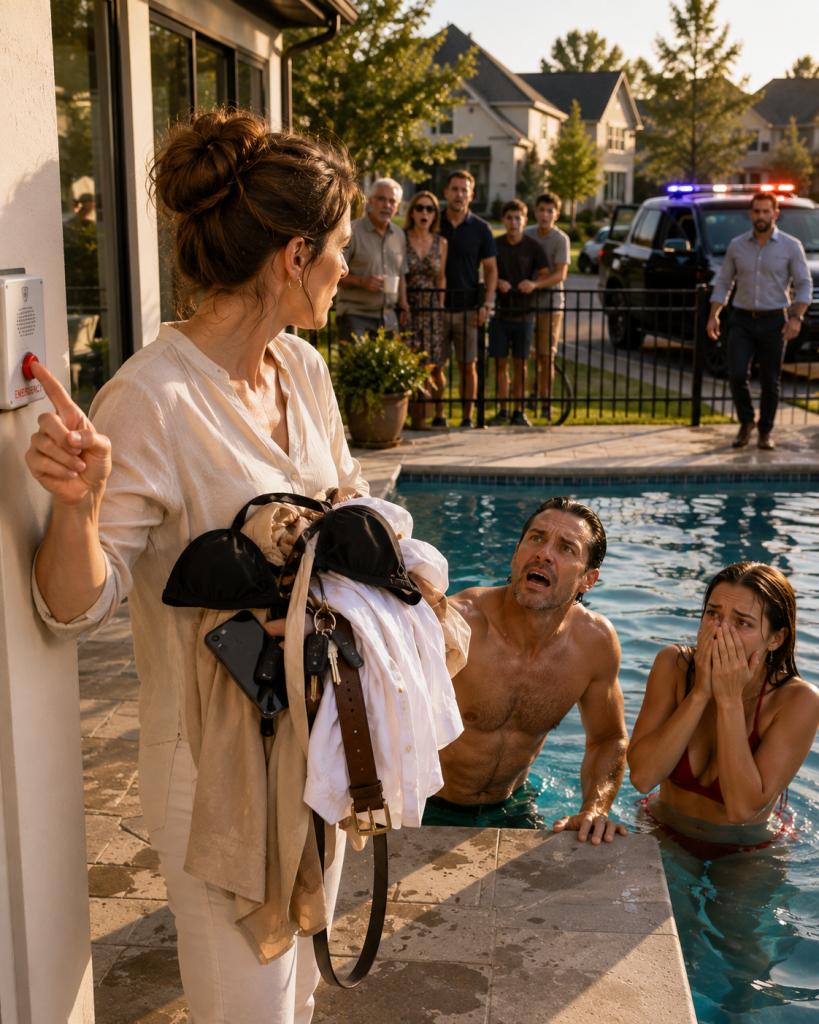
Red lights flashed on the panel beside my kitchen door. Dogs barked behind fences. Neighbors stood on sidewalks and porches pretending not to stare while staring harder than they ever had in their lives.
Caleb gripped the tile at the pool’s edge.
“Marissa, shut it off.”
I held his clothes over one arm.
His linen shirt.
His pants.
His belt.
The keys to the $64,000 truck he had purchased six weeks earlier after insisting our household budget was too tight for me to replace my eleven-year-old car.
The truck fob was already sinking toward the deep-end drain.
“No,” I said.
Vanessa covered herself with both arms.
Her red lipstick looked grotesquely bright against her pale face.
Elliot crossed the lawn without acknowledging the neighbors. His eyes moved over the patio chair, the bikini top, the wet footprints leading from my kitchen, and finally the two people in the water.
“Get out,” he said.
Vanessa lowered her voice.
“Elliot, please.”
“Not for me. For the cameras.”
Caleb’s head turned sharply toward the pool camera mounted beneath the second-floor balcony.
He had mocked me when I installed it.
He called the $2,700 security system an expensive monument to my anxiety.
I had paid for it after someone entered our side gate twice in one month and left it open. Caleb insisted it had probably been a delivery driver.
I remembered his exact words.
“No one is plotting against you, Marissa.”
At 5:42 p.m., the system he hated was uploading everything to an off-site server.
I folded Vanessa’s sundress over Caleb’s shirt and placed the pile on the outdoor counter.
“I’m going inside.”
Caleb slapped one hand against the pool edge.
“You’re not locking me out.”
“This house is mine.”
“We’re married.”
“Not for much longer.”
His expression changed.
There are moments when a sentence becomes physically real before the speaker finishes saying it.
The marriage ended between not and longer.
It did not matter that lawyers, filings, hearings, and signatures would follow.
Whatever I had been protecting was already gone.
A white patrol sedan turned onto the street with amber lights flashing. Behind it came a Ridge Hollow security vehicle and, seconds later, a police cruiser.
The subdivision app continued sending notifications.
Emergency alert active at 214 Ridge Hollow Lane.
Patrol responding.
Residents should remain clear of the property.
The neighborhood had a record.
The security company had a record.
The police dispatch system had a record.
Caleb could call me emotional later.
He could say I misunderstood.
He could tell friends I humiliated him during a private marital disagreement.
But he could not erase 5:42 p.m.
Elliot stopped beside me.
“Where is Vanessa’s phone?”
I pointed toward the lounge chair.
“Don’t touch it,” he said.
“I wasn’t planning to.”
The screen lit up.
A message preview appeared beneath three missed calls from Elliot.
CALEB: If she loses control, keep recording. The petition only needs one violent incident.
I stared at the words.
Elliot saw them too.
His jaw tightened.
The message vanished when the screen dimmed.
“What petition?” I asked.
Caleb lunged toward the pool ladder.
“Give me my clothes.”
I did not move.
A Ridge Hollow patrol officer entered through the open side gate, followed by two police officers.
The first officer, a woman named Dana Flores, looked from me to the pool.
“Who activated the emergency alarm?”
“I did.”
“Why?”
“I came home and found my husband in the pool with my neighbor. Then I saw a message suggesting they were recording me for some kind of petition.”
Caleb climbed onto the first ladder rung.
“This is a domestic disagreement. No one is in danger.”
Officer Flores raised one hand.
“Stay where you are until we understand the situation.”
“I’m naked.”
“You may cover yourself with a towel.”
I took two clean pool towels from the storage cabinet and placed them on the stone several feet from the ladder.
Vanessa climbed out first.
Water streamed from her hair and shoulders as she wrapped herself. She did not look at the neighbors.
She looked at her phone.
Caleb emerged behind her and tied the second towel around his waist.
“I want my property,” he said.
Officer Flores collected the clothing from the counter and handed it to a male officer.
“You can dress separately. No one is taking anything.”
“He threw my truck key into the pool,” I said.
Caleb turned.
“She did what?”
“I watched her do it,” Mrs. Palmer called from the other side of the fence.
Officer Flores looked at me.
“Did you?”
“Yes.”
“Was the vehicle key yours?”
“His.”
Caleb smiled as if the admission had rescued him.
“That’s destruction of property.”
“The key fob can likely be recovered,” the officer said. “We will document it.”
I nodded.
I did not regret dropping it.
But calm did not make every choice legally perfect.
That mattered.
I wanted the truth, not a fantasy in which my anger made me immune to consequences.
Caleb looked disappointed that the officer had not handcuffed me.
Elliot pointed toward Vanessa’s phone.
“There may be evidence of bank fraud on that device.”
Vanessa’s head snapped toward him.
“Elliot.”
Officer Flores looked at him.
“Explain.”
He removed his office badge from his belt.
First Meridian Bank — Chief Internal Risk Officer.
“I opened an internal investigation six weeks ago involving unauthorized access to a client account. My credentials were used after hours. The access came from our home network.”
Vanessa stared at him.
“You went through my computer?”
“The bank examined its own access logs.”
“What client?” I asked.
Elliot looked at me.
“You.”
The backyard seemed to become quieter despite the siren.
I almost laughed.
“I don’t bank with First Meridian.”
“Vale Infrastructure does.”
My father’s company.
The company Caleb had managed since Samuel Vale died four years earlier.
I still owned the controlling trust interest, but I had stayed out of daily operations. I worked as a compliance analyst for another corporation and told myself separating marriage from family business was healthy.
Caleb had encouraged that belief.
He said Vale Infrastructure needed his full-time focus and my interference would confuse employees.
I looked toward my husband.
“What did you access?”
Elliot answered.
“Loan records, title documents, trust certifications, and a pending commercial transfer for $9.8 million.”
I felt the patio stone beneath my bare feet as though it had suddenly become unstable.
“Whose transfer?”
“Vale Infrastructure’s.”
Caleb laughed.
“This is confidential company business.”
“It used Marissa’s electronic signature,” Elliot said.
My mouth went dry.
“I didn’t sign anything.”
Vanessa’s phone lit again.
This time, the message came from an unknown number.
Did the red plan work? We need the 72-hour order before Monday.
Officer Flores saw it.
She turned to Vanessa.
“Unlock the phone.”
Vanessa clutched the towel closed.
“No.”
“You are not required to consent. But the device may be secured while investigators seek a warrant if there is probable cause related to fraud.”
“You can’t take my phone because my husband is jealous.”
Elliot’s voice went flat.
“This stopped being about jealousy three weeks ago.”
Caleb stepped closer to me.
“Marissa, do not listen to him. Elliot has been trying to destroy me since the board rejected his investment proposal.”
“What petition?” I asked.
“There is no petition.”
“The message said there was.”
“Vanessa and I were discussing how to protect ourselves if you reacted violently.”
“You expected me to find you?”
His silence lasted a fraction too long.
That frightened me more than the affair.
Officer Flores separated us and asked each person to provide identification.
Caleb’s wallet was in his pants. Vanessa’s purse sat inside my kitchen.
That detail sharpened the scene.
She had not entered through the backyard in a swimsuit.
She had entered my home, removed her clothes, left her belongings near my kitchen, and walked outside as though she belonged there.
I noticed a portable scanner on the floor beneath the breakfast bar.
It was not mine.
A stack of papers protruded from its tray.
“Officer,” I said. “That scanner wasn’t there this morning.”
Caleb turned toward the kitchen.
Elliot saw it too.
Officer Flores instructed another officer to photograph the doorway and prevent anyone from entering.
Caleb raised his voice.
“You cannot treat my home like a crime scene.”
The house had been purchased by the Samuel Vale Residential Trust two years before I married him.
Caleb knew the trust existed.
He also knew most people assumed husbands owned the homes in which they spoke with confidence.
“I am the sole beneficiary,” I said. “He has occupancy through marriage, but no ownership.”
The words sounded strange.
For twelve years, I had said our house because I believed love made generosity safe.
Now accuracy mattered.
The patrol officer silenced the siren after confirming the camera system had preserved the event.
The sudden quiet felt louder than the alarm.
Neighbors remained outside.
Elliot’s black SUV blocked part of the street.
The police separated Caleb and Vanessa to take statements.
I stood near the outdoor counter with my arms wrapped around myself, staring at the avocado that had rolled from my grocery bag.
It rested beside the stainless-steel sink.
A completely ordinary green fruit in the middle of a life that no longer fit together.
Mrs. Palmer spoke through the fence.
“Marissa, do you need me to come over?”
“No. Thank you.”
“Your mother’s attorney is here,” the Ridge Hollow guard called from the side gate.
For one second, I thought he meant my mother.
Then I saw Rachel Kim, the trust attorney who had worked with my father for twenty-seven years.
She carried a laptop bag and wore running shoes beneath a navy suit.
I had not called her.
Elliot had.
Rachel entered, showed identification to the police, and came directly to me.
“Are you safe?”
“Yes.”
“Did Caleb access your office?”
“I don’t know.”
The security application could answer.
We reviewed the indoor activity log on my phone.
At 3:18 p.m., Caleb used his code to enter the house.
At 3:26, Vanessa entered through the side gate.
At 3:31, the office door opened.
At 3:58, the office camera went offline.
At 4:23, the pool camera recorded movement.
I had arrived at 4:56.
“They were in the office for almost an hour,” Rachel said.
Caleb told the police they had entered only to retrieve drinks.
The scanner contradicted him.
So did the electronic lock.
Rachel contacted the county financial-crimes unit.
An officer secured the scanner and Vanessa’s phone while warrants were requested.
Caleb changed tactics.
He approached me with his voice lowered.
“Let’s go inside and talk like adults.”
“No.”
“You’re creating evidence against yourself.”
“By standing in my yard?”
“By humiliating me publicly.”
“You were in the pool publicly.”
“This neighborhood loves gossip. You’ll never be comfortable here again.”
I looked toward Mrs. Palmer, the teenagers with their bicycles, the delivery driver, and the old man across the street.
Caleb believed shame belonged automatically to the betrayed person.
He thought I would fear their eyes more than his actions.
“I can survive being seen,” I said.
He stared at me.
For the first time, he looked uncertain about who I was.
Rachel asked police to escort Caleb off the property for the evening while she sought an emergency order protecting trust records.
He argued that it was his marital residence.
The police explained that they could not permanently evict him without a court order, but he agreed to leave voluntarily after Rachel warned that remaining near potential evidence could complicate the fraud investigation.
Caleb dressed inside the patrol car.
Vanessa used our downstairs bathroom under supervision.
Elliot stood alone beside his SUV.
When she emerged, she stopped several feet from him.
“I can explain.”
He looked at her with exhausted disgust.
“You used my credentials.”
“I was protecting us.”
“From what?”
“From losing the house.”
“Our house has no mortgage.”
Vanessa’s eyes flickered toward Caleb.
Elliot saw it.
“What did you sign?”
She said nothing.
The police allowed her to leave with him because she had no vehicle and Elliot said he would drive her to her sister’s house.
Before she entered the SUV, she looked at me.
“This is not what you think.”
I almost answered.
Then I realized the sentence was designed to make me ask questions she could control.
I said nothing.
Caleb left in a rideshare, dripping pool water onto the back seat while neighbors watched.
The subdivision slowly returned to its evening routines.
Garage doors closed.
Dogs stopped barking.
The delivery van drove away.
Mrs. Palmer disappeared behind her fence.
But the truth remained in cameras, messages, access logs, witnesses, and the scanner beneath my kitchen counter.
At 8:11 p.m., financial investigators executed a limited warrant covering my office, the portable scanner, and devices used during the suspected transaction.
Inside the scanner tray, they found copies of my driver’s license, passport, trust certification, and a document titled:
PETITION FOR EMERGENCY CONSERVATORSHIP OF MARISSA VALE CARTER.
A physician’s letter described me as paranoid, impulsive, and prone to “publicly destructive episodes.”
A draft affidavit claimed I had threatened Caleb and Vanessa with a weapon after discovering an “innocent misunderstanding.”
The event had been written before it happened.
Rachel read the final paragraph twice.
“The petitioner requests immediate seventy-two-hour authority over Mrs. Carter’s trust-controlled business interests due to the imminent risk that she will damage or conceal marital assets.”
I looked through the glass doors toward the pool.
“They expected me to attack them.”
“Yes.”
“They left their clothes where I would see them.”
“Yes.”
“The hidden camera?”
Investigators found it inside the basil planter.
Its lens was aimed at the lounge chairs and alarm panel.
The device had begun recording twelve minutes before I arrived.
My groceries had not delayed me.
Caleb knew I was coming.
He had access to the location service on my phone.
The entire scene was bait.
The affair was real.
But it had also been staged as a weapon.
Rachel touched my arm.
“They needed you angry.”
I thought of the key fob sinking into blue water.
“I gave them something.”
“A damaged key is not violent assault. And you admitted it immediately.”
“But they wanted more.”
“They needed more.”
Elliot called at 9:03.
His voice sounded hollow.
“Vanessa’s gone.”
“What do you mean?”
“She asked me to stop at her sister’s apartment. When I parked, she ran through the building and left through another exit.”
“Did she take anything?”
“One suitcase had already been delivered there.”
Rachel leaned closer to hear.
Elliot continued.
“I searched our shared cloud storage after the bank obtained authorization. There’s a folder called Ridge Hollow Exit.”
“What’s inside?”
“Passports. Offshore account instructions. Airline reservations for Monday.”
Monday was the day the Vale Infrastructure trust audit began.
“Where were they going?”
“Saint Lucia.”
I looked at the pool again.
“What else?”
Elliot was silent.
Then he said, “Photographs.”
“Of what?”
“Caleb and Vanessa together.”
“That isn’t surprising.”
“They’re dated eleven years ago.”
Caleb and I had been married for ten.
Vanessa and Elliot for nine.
The Harts had moved into the house next door three years earlier.
Elliot’s next sentence altered the meaning of every Tuesday sugar request, every backyard conversation, and every coincidence that had brought them into our lives.
“They were together before either of us met them.”
Part Two — The Marriage Built Next Door
The first photograph showed Caleb and Vanessa on a beach in Mexico.
He looked younger.
His hair was longer, and he wore the leather bracelet he told me had belonged to his brother.
Vanessa sat between his knees, smiling at the camera while he kissed her shoulder.
The date was April 14, eleven years earlier.
Six months before Caleb introduced himself to me at my father’s company gala.
The second photograph showed them inside an apartment with maps and financial reports spread across a table.
On the back, someone had written:
VALE — controlling trust after Samuel. HART — bank risk access.
My name was not beside Caleb’s because he loved me.
It was beside him because I was an assignment.
Rachel enlarged the image on her office monitor the next morning.
Elliot sat across from us looking as though he had not slept.
I wore yesterday’s clothes beneath a borrowed jacket. I had spent the night at a hotel under the name Rachel’s assistant used for emergency witnesses.
Caleb sent twenty-seven messages before the court approved a temporary no-contact order.
The first messages apologized.
The later ones warned that Elliot and Rachel were using me.
The final one said:
You have no idea what Vanessa is capable of. Come home before she destroys both of us.
Caleb had been removed from the house.
Yet he still called it home as if possession could be maintained through grammar.
Elliot opened the next file.
It contained property records for Ridge Hollow.
Three years earlier, a shell company called Blue Cedar Residential purchased the house next door for $910,000.
Vanessa and Elliot rented it under a long-term lease with an option to buy.
Elliot believed Vanessa had found the listing.
“She said the neighborhood was perfect,” he told me. “Close to my office. Quiet. Good investment.”
Blue Cedar Residential was controlled through another company registered to Caleb’s college roommate.
Caleb had arranged for Vanessa to live beside us.
The sugar was never about sugar.
It was a routine that gave her access to my kitchen, security panel, mail, conversations, and schedule.
“Why marry Elliot?” I asked.
The answer was already visible in the files.
Elliot became First Meridian’s chief internal risk officer two years before Vanessa met him.
He had access to audit systems, emergency approvals, fraud alerts, and the executives responsible for commercial lending.
Vanessa worked in private-client services at another branch.
She met him during a banking conference.
Caleb met me at my father’s gala.
Two targets.
Two marriages.
One plan.
I looked at Elliot.
“Did you love her?”
“Yes.”
The answer came without hesitation.
“That doesn’t mean she did,” he added.
We sat in silence for several seconds.
There is a specific humiliation in learning that tenderness was research.
Caleb knew I hated orchids because they reminded me of hospital waiting rooms.
He knew my father called me Rissa only when he was proud.
He knew I preferred quiet restaurants and became overwhelmed at loud parties.
I had mistaken careful preparation for attention.
“Why wait so long?” I asked.
Rachel answered.
“My father did not die until four years ago.”
Samuel Vale retained control of Vale Infrastructure throughout his life. My trust interest existed, but most voting powers remained with him.
Caleb began working in the company’s finance division after our marriage.
He presented himself as the husband willing to help an aging founder.
My father promoted him.
When Samuel developed pancreatic cancer, Caleb became acting chief executive.
After Dad died, the trust transferred fifty-one percent voting control to me.
I signed a temporary management authorization allowing Caleb to operate the company for three years.
It expired six weeks earlier.
The annual audit would reveal that the authorization was gone.
Caleb needed permanent control before Monday.
“What did they steal already?” I asked.
A forensic accountant named Priya Desai placed a report on the table.
The current confirmed amount was $14.6 million.
False vendors charged Vale Infrastructure for consulting, equipment inspections, software licensing, and land assessments.
Some companies connected to Vanessa.
Others connected to Caleb’s college roommate.
Money moved through First Meridian accounts using approvals issued under Elliot’s credentials.
Vanessa accessed his work laptop while he slept.
She copied his security token.
She scheduled transfers during hours when he was traveling.
Elliot had spent six weeks quietly investigating irregularities that appeared to implicate him.
“I thought someone inside the bank was trying to frame me,” he said.
“Someone was.”
“My wife.”
His voice broke on the final word.
The $9.8 million transfer discovered the previous day was their exit payment.
Caleb intended to sell two Vale Infrastructure divisions to a Caribbean holding company at less than half their value.
The holding company belonged to him and Vanessa.
Once the emergency conservatorship gave him authority over my trust vote, the transfer could close.
They would leave the country Monday night.
“What was supposed to happen to me after seventy-two hours?” I asked.
Priya looked toward Rachel.
The attorney opened another file.
A proposed psychiatric treatment plan recommended inpatient evaluation.
The physician’s signature belonged to Dr. Paul Ames, a psychiatrist I had seen twice after my father died.
Caleb selected him.
Dr. Ames told me grief had amplified my suspicion and encouraged me to let Caleb manage stressful decisions.
He had never diagnosed me with paranoia.
The letter claimed he had.
“Did he sign this?” I asked.
“We don’t know,” Rachel said. “Investigators are interviewing him.”
The document would have supported an emergency request to keep me in a private facility for up to ten days.
Ten days was enough time to close the company sale, transfer the house, and empty several accounts.
Caleb and Vanessa planned to provoke a visible breakdown.
The hidden camera would record my anger.
Vanessa would say she feared for her life.
Caleb would call police and present the prepared psychiatric letter.
They expected me to throw objects, strike someone, or threaten them.
Instead, I pressed a button.
The security alarm did more than summon patrol.
It activated Event Lock, a feature I had paid extra to include after the gate incidents.
Event Lock preserved the previous seventy-two hours of video from every connected camera and uploaded it to a server that household users could not delete.
Caleb knew about the cameras.
He did not know about the buffered archive.
He had dismissed the installation meeting halfway through and gone to play golf.
The previous seventy-two hours changed everything.
On Wednesday at 11:18 p.m., the office camera captured Caleb and Vanessa reviewing documents.
Vanessa sat in my chair.
Caleb stood behind her.
“She signs like this when she’s tired,” he said, tracing my name on a tablet.
Vanessa laughed.
“She won’t be signing anything after Friday.”
“Friday needs to look spontaneous.”
“She’ll lose her mind.”
“She threw a mug once.”
I remembered the mug.
Six months earlier, during an argument about my father’s watch, Caleb followed me from room to room while recording on his phone. He blocked the kitchen doorway. I threw the mug into the empty sink.
He later told Dr. Ames I had thrown it at him.
On the video, Vanessa opened a document.
“If she just cries?”
“Mention Samuel.”
My father.
Caleb knew grief could still unsteady me.
“If that doesn’t work?”
“Kiss me when she walks out.”
Vanessa leaned back.
“You make romance sound administrative.”
“It is until Monday.”
Then she kissed him.
Not with the awkwardness of people conducting a scheme.
With familiarity.
Eleven years had not ended between them.
They had maintained the relationship through both marriages.
The camera captured other meetings.
Vanessa borrowing sugar and scanning mail while I searched the pantry.
Caleb giving her my trust password.
The two of them laughing about Elliot’s habit of leaving his security token beside the bed.
At one point, Vanessa said, “We should have chosen dumber spouses.”
Caleb answered, “We chose trusting ones. Better.”
I stopped the recording.
“I don’t want to hear more.”
Rachel paused it.
The deepest damage was not learning that Caleb had lied.
It was hearing the contempt beneath the planning.
They did not consider trust a virtue.
They considered it evidence of inferior intelligence.
Elliot stood and walked toward the window.
I understood.
Sometimes remaining seated feels like agreeing to continue receiving pain.
The police found Vanessa that afternoon at a private airfield outside Columbus.
She carried two passports.
One was genuine.
The second identified her as Elena Ward.
She also had $84,000 in cash and a key to a storage unit.
Caleb was arrested at Vale Infrastructure headquarters while attempting to access the server room.
Both were charged initially with conspiracy, attempted wire fraud, identity theft, and evidence tampering.
More charges would follow.
The storage unit contained six burner phones, counterfeit seals, financial records, and a waterproof duffel bag.
Inside the bag were clothes, offshore banking cards, and a framed photograph of Caleb and Vanessa from the Mexican beach.
Behind the photograph was a handwritten agreement.
It had no legal validity.
It mattered anyway.
We enter separately. We leave together. Neither spouse keeps property acquired through the plan. If one defects, the complete archive releases.
Below were their signatures.
The date was three weeks before Caleb met me.
The complete archive referred to an encrypted account where each stored evidence against the other.
Mutual destruction had been the foundation of their partnership.
Investigators obtained access after Vanessa tried to negotiate a plea deal.
Caleb learned she was cooperating and activated what he believed was a deletion command.
Instead, the system released copies to three addresses.
One belonged to Vanessa.
One to Caleb.
The third belonged to Samuel Vale.
My father had been dead for four years.
His old email redirected trust-related messages to Rachel.
At 2:13 a.m., her office received the archive.
No one understood why Caleb and Vanessa’s blackmail system included my father.
The first file answered.
Six months before his death, Samuel had confronted Caleb about irregular vendor payments.
Caleb denied everything.
My father hired a private investigator.
The investigator found the old photographs of Caleb and Vanessa.
Samuel summoned Vanessa to his hospital room.
A hidden audio recorder captured their conversation.
“You married my daughter for her trust,” Dad said.
Vanessa answered, “Caleb married her.”
“You arranged it.”
A pause.
“What do you want?”
“My daughter left untouched.”
“You’re dying.”
“My death does not make her unprotected.”
Vanessa laughed quietly.
“Marissa doesn’t know enough to control Vale.”
“She knows enough to learn.”
“You should have taught her earlier.”
My father’s voice weakened.
“That is my failure.”
He offered Vanessa immunity from a civil claim if she provided evidence and left Caleb.
She refused.
But before leaving, she copied his email address into the mutual-destruction archive as an insurance recipient.
Why?
Because she no longer trusted Caleb.
If he betrayed her, Samuel would receive everything.
She did not know Dad would die before the plan matured.
She also did not know his email remained monitored through the trust.
The archive contained messages from the beginning.
Caleb and Vanessa did not meet by accident in college.
They met while working for a financial-recovery firm investigated for predatory acquisitions.
Their employer taught them how to identify family businesses with aging founders, inexperienced heirs, and weak internal controls.
When the firm collapsed, they built a private version of the model.
Vale Infrastructure was their largest target.
First Meridian was their access point.
Elliot and I were not unlucky spouses caught in an affair.
We were selected assets.
Yet the most devastating file was a message Caleb sent Vanessa after my father’s confrontation.
CALEB: Samuel knows.
VANESSA: Then move the timeline.
CALEB: Marissa will ask questions if he dies suddenly.
VANESSA: He is already dying.
CALEB: I won’t touch him.
VANESSA: Neither of us has to.
Attached was a medication schedule from my father’s hospice nurse.
For several days, I believed they had killed him.
Investigators examined medical records, medication logs, and preserved blood samples.
There was no evidence of poisoning.
Samuel’s cancer caused his death.
But Caleb had accessed his medical information and discussed using the timing.
He had stood beside me at the funeral, one hand against my back, while privately calculating what Dad’s death released.
That knowledge destroyed any remaining temptation to separate the husband I loved from the criminal I discovered.
They were the same man.
The archive also contained my father’s final message to Rachel.
He had written it two days before he lost consciousness.
Rachel had kept it sealed because it concerned an unfinished investigation and because Samuel asked her not to approach me without proof.
Marissa,
I believed giving Caleb responsibility would show whether he deserved trust. Instead, I gave him proximity to what he wanted.
Do not blame yourself for loving a man who studied how to be loved.
But do not let the sophistication of his deception become an excuse for preserving him once you know.
Your life is not a failed investment because someone entered it dishonestly.
I pressed the letter against the table.
My father apologized for not teaching me the company sooner.
He admitted he had praised Caleb’s confidence while treating my caution as reluctance.
He wrote that if fraud were proven, a dormant clause in the Vale Continuity Trust would activate.
Rachel explained it.
Caleb’s executive compensation included deferred profit shares worth approximately $6.2 million.
He believed those shares would vest after the Monday audit.
The trust clause said any officer who attempted to seize beneficiary control through coercion, incapacity fraud, or forged authority forfeited all deferred interests.
The forfeited value would transfer to an employee ownership fund.
Caleb did not merely lose the money he planned to steal.
He lost the only legitimate wealth he had accumulated.
Nearly eight hundred Vale Infrastructure employees would receive the shares.
The people he intended to abandon would own part of what remained.
That should have felt like the ending.
It was not.
Three weeks after the arrests, investigators recovered the truck key from the pool.
The fob no longer worked.
Inside its plastic casing, however, technicians found a microSD card wrapped in clear film.
Caleb had hidden it there.
He had not expected me to throw the key into the water.
The card contained a final contingency called BLUE EXIT.
It proved that even if the pool confrontation failed, Caleb intended to use the house one last time.
Part Three — The Scene They Could Not Rewrite
BLUE EXIT contained architectural plans, insurance records, and maintenance photographs of my backyard.
The $18,000 pool had been Caleb’s project.
He selected the contractor.
He approved the filtration system.
He insisted on a gas heater even though I said Ohio summers did not justify the expense.
I assumed the pool represented status.
It represented preparation.
A valve in the heater enclosure had been altered so carbon monoxide could accumulate inside the adjoining pool house if the ventilation fan was disabled.
The pool house contained a small bathroom and changing room.
Caleb’s plan was to invite me there after the company transfer.
There would be champagne.
An apology.
A private conversation beside the water.
Then he would ask me to retrieve towels from the pool house.
The insurance file classified accidental carbon-monoxide exposure as covered.
The $3 million policy on my life named Caleb beneficiary.
The card included a draft statement.
Marissa had been emotionally unstable after learning of my affair. She went outside alone. I found her unconscious.
The affair was meant to explain both my breakdown and my death.
Vanessa knew about BLUE EXIT.
Her messages argued they should leave me alive.
Not from mercy.
Because a suspicious death could delay the trust transfer.
Caleb insisted I remained a future threat.
VANESSA: We will be gone.
CALEB: She will follow.
VANESSA: Then let her.
CALEB: You don’t understand her.
The irony almost made me laugh.
He had studied me for eleven years and still misunderstood the most important thing.
I did not follow people who made it clear they wanted me destroyed.
I grieved.
I learned.
Then I closed the door.
The carbon-monoxide evidence elevated the criminal case.
Caleb faced attempted murder conspiracy, insurance fraud, and criminal preparation charges in addition to the financial counts.
Vanessa claimed she never agreed to the death plan.
The archive showed she purchased the altered valve through a shell company.
Elliot filed for divorce.
He moved out of Ridge Hollow before winter.
He said the house next door felt like a building Vanessa had rented inside his life rather than a home they created.
We remained in contact through attorneys and the case.
Our relationship never became romantic.
Pain does not automatically turn two betrayed people into the correct future for each other.
We became witnesses who did not need to explain certain silences.
That was enough.
I filed for divorce from Caleb the morning after BLUE EXIT was discovered.
He contested everything.
He claimed the Vale trust was marital property.
He demanded reimbursement for improvements to the house, including the pool.
Rachel answered with invoices showing Vale Infrastructure funds had secretly paid the contractor.
Caleb had used company money to construct the place where he planned my death.
The court denied his ownership claim.
Dr. Paul Ames was charged with falsifying the conservatorship letter after investigators proved Caleb paid his gambling debts through a shell vendor.
Ames insisted he believed I needed treatment.
His original notes described ordinary grief, work stress, and concern about marital control.
He altered them later.
The alteration dates matched payments from Caleb.
He accepted a plea agreement and surrendered his medical license.
The criminal trial began fourteen months after the alarm.
By then, the backyard looked different.
The pool remained empty under a safety cover.
I could not bring myself to swim there.
I could not yet bring myself to remove it.
The basil by the grill died that winter.
I did not replace it.
The courtroom filled with Vale employees, First Meridian executives, Ridge Hollow neighbors, reporters, and strangers drawn by the story of a cheating husband, a backyard alarm, and a conspiracy that had lasted more than a decade.
The prosecution did not begin with the money.
It began at 5:42 p.m.
They played the security footage.
I entered carrying groceries.
The avocado rolled across the counter.
Caleb’s hands left Vanessa’s waist.
He said, “Don’t make a scene.”
I gathered their clothes.
Vanessa offered to explain.
Caleb called me dramatic.
Then the camera captured me pressing the button.
The siren filled the courtroom.
Several jurors flinched despite expecting it.
Neighbors appeared beyond the fence.
Garage doors opened.
Elliot’s SUV arrived.
Vanessa whispered his name.
The prosecutor paused the video on Caleb’s face.
Fear had entered before police, before bank records, before he knew the archive existed.
He feared Elliot because Elliot represented the system access Vanessa had stolen.
He feared cameras because the plan required his version to become the only version.
He feared witnesses because manipulation works best in rooms where one person controls the story.
Mrs. Palmer testified that I did not threaten anyone.
The delivery driver testified that I remained beside the alarm panel.
The teenage cyclists testified that Caleb shouted for me to turn it off.
The Ridge Hollow patrol officer confirmed the timestamp.
The security company explained Event Lock.
The defense argued the footage proved only adultery and embarrassment.
Then prosecutors played the hidden planter camera.
Caleb and Vanessa stood on the patio twelve minutes before I arrived.
“Her office location says fifteen minutes,” Vanessa said.
Caleb adjusted the camera.
“Leave your phone faceup.”
“What if Elliot calls?”
“Better. She’ll see it.”
Vanessa dropped her sundress onto the chair.
“Do you think she’ll hit me?”
“If you laugh.”
“I’m not letting her break my nose.”
“She’ll throw something.”
“And if she doesn’t?”
Caleb smiled.
“Samuel.”
He planned to use my dead father’s name to break me.
The jury watched him climb into the pool with the woman who had helped select me.
The affair was not evidence of uncontrolled passion.
It was rehearsal.
Elliot testified for two days.
He described the bank access, copied credentials, false approvals, and moment he saw Vanessa’s location at my address.
“Why did you drive there?” the prosecutor asked.
“I believed she might be destroying evidence.”
“Did you suspect an affair?”
“Yes.”
“Which concerned you more?”
“At that moment? The bank fraud.”
A few people shifted.
He continued.
“Adultery could end my marriage. The transfers could destroy employees, clients, and innocent account holders while placing criminal liability on me.”
His restraint gave the betrayal scale.
Vanessa had not only cheated on him.
She designed him to become the person blamed when the scheme surfaced.
Priya explained the $14.6 million theft and the attempted $9.8 million exit transfer.
Rachel explained my trust.
Employees testified about vendors Caleb ordered them not to question.
My father’s audio recording played.
The courtroom heard Samuel offer Vanessa a way out.
They heard her refuse.
They heard him call his failure what it was.
Then the prosecution introduced the eleven-year-old photographs.
The beach.
The apartment.
The notes assigning targets.
I testified after Elliot.
I wore a dark green suit and no wedding ring.
The prosecutor asked what I believed when Vanessa moved next door.
“That she wanted sugar.”
A quiet, painful laugh moved through the courtroom.
“Did you consider her a friend?”
“Yes.”
“What did she know about you?”
“My work schedule. My father’s illness. My marriage. My trust in Caleb. The location of my office documents. The security code before I changed it.”
“Why did you provide the code?”
“She watered plants while we traveled.”
“Did you believe she was gathering information?”
“No.”
“Why not?”
“Because most decent people do not structure friendship as surveillance.”
The defense attorney approached.
“Mrs. Carter, you threw Mr. Carter’s truck key into the pool.”
“Yes.”
“You knew it would be damaged.”
“Yes.”
“You were angry.”
“Yes.”
“So the defendants were correct that you might destroy property.”
The prosecutor objected.
The judge allowed the question only as it related to my state of mind.
I looked at the jury.
“I made one impulsive decision after finding my husband with another woman.”
“Exactly.”
“I admitted it to police before anyone accused me.”
The attorney paused.
“You expected sympathy.”
“No. I expected documentation.”
“You activated a subdivision-wide alarm because of infidelity.”
“I activated it because Caleb told me not to make a scene while a hidden camera was recording me and fraudulent documents were inside my kitchen.”
“You didn’t know about the documents then.”
“I knew the situation felt wrong.”
“So you acted on paranoia.”
“No.”
I looked at Caleb.
“I acted on the sound of a sentence I had heard too many times.”
“What sentence?”
“Don’t make a scene.”
The attorney waited.
“It means the person harming you has already decided your response is the real offense.”
The courtroom became silent.
He changed direction.
“You continued living with Caleb despite concerns about finances.”
“I trusted my husband.”
“You allowed him to manage Vale Infrastructure.”
“Yes.”
“You signed broad authority.”
“Temporary authority.”
“Did you read it?”
“Yes.”
“Then didn’t your own decision give him the opportunity?”
“Opportunity is not permission.”
He asked whether my father had warned me.
“Not clearly enough.”
“So multiple men believed you could not manage your own assets.”
Caleb’s attorney intended the question to humiliate me.
Instead, it revealed the structure surrounding the crime.
“My father underestimated my readiness,” I said. “My husband exploited that. Those are different failures.”
The attorney displayed the pool key.
“You destroyed this device.”
“Yes.”
“Yet you now call the data inside evidence that saved you.”
“I didn’t know the data was there.”
“So the discovery was luck.”
“Yes.”
He smiled as if luck weakened truth.
I continued.
“But Caleb hid the plan inside something he believed I would never touch. He thought the truck represented his success. He thought I would be afraid to damage it.”
The smile disappeared.
“What does that prove?”
“That he misunderstood what became worthless to me at 5:42.”
The prosecution called Vanessa.
She had entered a cooperation agreement but still faced significant prison time.
She walked to the witness stand in a gray suit, her red lipstick gone.
Caleb did not look at her.
She described the original plan.
The marriages.
The house next door.
The sugar visits.
The bank access.
The staged confrontation.
She claimed Caleb designed BLUE EXIT without her consent.
The prosecutor displayed her purchase of the valve.
“I bought equipment he requested.”
“You used a shell company.”
“We used shell companies for everything.”
“Did you know the purpose?”
“Not initially.”
A message appeared.
VANESSA: Carbon monoxide is messy.
CALEB: Only if the scene is wrong.
VANESSA: Then make the scene right.
Her voice became smaller.
“I was talking about avoiding it.”
The prosecutor played a later message.
VANESSA: If Marissa dies before transfer, her trust may go into probate.
CALEB: After transfer.
VANESSA: Fine. But not in my house.
She had not objected to my death.
She objected to inconvenience.
On cross-examination, Caleb’s attorney exposed every lie Vanessa told investigators during the first week.
Then he asked why the jury should believe her now.
“They shouldn’t believe me,” she said.
The answer surprised everyone.
“They should believe the records.”
She looked at Caleb for the first time.
“We built the system because neither of us trusted the other.”
“Did you love him?”
“Yes.”
“Does that explain your decision to cooperate?”
“No.”
“What does?”
Vanessa looked toward Elliot.
“Caleb activated the deletion command.”
The mutual-destruction agreement said neither could erase the archive without releasing it.
“He chose himself,” she continued. “After eleven years, he believed I should take the blame.”
Caleb stared straight ahead.
Vanessa’s final illusion died in public.
Their partnership had survived two marriages because betrayal was directed outward.
The moment consequences entered, they became exactly what they had always been.
People who considered loyalty useful only while profitable.
Caleb testified against his attorneys’ advice.
He admitted the affair.
He admitted hiding assets.
He denied selecting me as a target.
He said the old notes were jokes created during a failed business idea.
He claimed Vanessa forged BLUE EXIT.
He described himself as a husband who made terrible financial decisions while falling in love with another woman.
The prosecutor approached with my father’s archive.
“Did you meet Marissa by accident?”
“Yes.”
She displayed the gala schedule Vanessa sent him.
“Did you know she would attend?”
“I knew.”
“Did you know she controlled the future Vale trust?”
“I suspected.”
“Did you love her?”
“Yes.”
“Before or after reading her father’s estate plan?”
Caleb’s face tightened.
“Love can begin for complicated reasons.”
The prosecutor nodded.
“Did it survive her becoming an obstacle?”
“She was never an obstacle.”
The conservatorship petition appeared.
The hidden camera.
The psychiatric letter.
The airline tickets.
The carbon-monoxide plans.
Each document filled the screen.
“What word would you prefer?” the prosecutor asked.
Caleb turned toward the judge.
“This is theatrical.”
“No,” she said. “The theater was in the backyard.”
The jury deliberated for two days.
Caleb was convicted of conspiracy, wire fraud, bank fraud, identity theft, forgery, attempted financial exploitation, evidence tampering, insurance fraud, and attempted murder.
Vanessa was convicted on most financial counts and conspiracy to commit attempted murder. Her cooperation reduced but did not erase her sentence.
Dr. Ames received five years and lost his license.
Caleb received thirty-four years.
Vanessa received nineteen.
At sentencing, Elliot spoke first.
He did not discuss the affair.
He spoke about the employees, customers, and colleagues Vanessa was willing to sacrifice.
Then he said, “I spent months trying to prove I was not the person using my credentials. The hardest part was learning the person framing me slept beside me each night and asked whether work was stressful.”
I spoke last.
Caleb watched me approach the lectern.
“I once believed the most humiliating moment of my life was standing beside my pool while the neighborhood saw my husband with another woman,” I began.
“It wasn’t.”
I looked toward the gallery.
“The humiliating part happened privately for years. It happened every time Caleb called caution paranoia. Every time he made control sound like competence. Every time he praised me for trusting him while treating that trust as proof that I deserved to be deceived.”
My voice remained steady.
“The alarm did not expose me. It exposed the people relying on my silence.”
Caleb lowered his eyes.
“You told me not to make a scene because the scene was already written. I was supposed to scream. Strike someone. Destroy enough property to become the unstable woman in your petition.”
I paused.
“I did damage one key.”
A faint sound moved through the courtroom.
“It was not my finest decision. But inside that key was the plan you believed no one would find.”
I looked at him.
“You hid the truth in a symbol of everything you thought mattered more to me than myself.”
His expensive truck.
His title.
His success.
His image.
“You were wrong.”
After the trial, Vale Infrastructure recovered most of the stolen funds through seized accounts, insurance, and restitution.
The $6.2 million Caleb forfeited transferred into an employee ownership plan.
I became chair of an independent board but did not run daily operations alone.
My father had been wrong to assume authority required confidence without support.
Caleb had been wrong to assume sharing authority meant surrendering it.
I hired people who knew what I did not.
We built controls that no marriage, friendship, or executive title could bypass.
Elliot left First Meridian after the bank investigation cleared him. He later joined a national fraud-prevention organization.
We exchanged holiday cards.
Nothing more was required.
I sold the Ridge Hollow house eighteen months after the trial.
Before listing it, I removed the pool.
The contractor asked whether I wanted another one installed.
“No.”
We filled the space with soil.
I planted a sunken garden with stone steps, lavender, rosemary, white roses, and basil.
For weeks, I hesitated over the basil.
Then I planted it beside the old grill.
Caleb had once said it made the patio feel like home.
He did not own the smell.
He did not own the word.
At the center of the garden, I installed a small metal plaque.
It did not mention Caleb or Vanessa.
It displayed only a time.
5:42 P.M.
The realtor asked what it meant.
“The moment the security system worked.”
That was true.
It was not the entire truth.
At 5:42, the whole subdivision heard an alarm.
But the loudest sound was internal.
It was the click of evidence.
The instant a marriage became a record.
The moment shame changed ownership.
I had believed making a scene meant losing control.
Caleb relied on that belief.
He forgot that sometimes a scene is simply the truth becoming impossible to keep private.
On the final evening before I handed the house to its new owners, I sat on the stone steps in the garden.
The neighborhood was quiet.
A dog barked behind the fence, then stopped.
A delivery truck passed.
The glass kitchen doors reflected the sunset.
I remembered the grocery bag cutting into my fingers.
The avocado rolling across the counter.
Vanessa sinking into blue water.
Caleb saying my name like a stain he could wipe away.
Then I remembered the siren.
The neighbors emerging.
The black SUV arriving.
The message glowing on Vanessa’s phone.
The entire plan beginning to collapse because I had pressed one button instead of performing the reaction they prepared.
I removed my old wedding ring from my coat pocket.
I had kept it through the investigation because attorneys sometimes needed photographs of the inscription.
The case was over.
The evidence had been cataloged.
The ring belonged only to memory now.
I did not throw it into the garden.
I did not bury it.
I placed it inside a plain envelope addressed to Caleb’s attorney with instructions that it could be added to his stored personal property.
The gesture felt almost disappointingly ordinary.
That was why it mattered.
Freedom did not require a dramatic final act.
It required no longer arranging my life around whether he witnessed it.
I walked inside, turned off the lights, and checked the security panel one final time.
The red emergency button remained beside the kitchen door.
I pressed the system’s shutdown command.
A message appeared.
ARE YOU SURE YOU WANT TO DISCONNECT THIS PROPERTY?
I selected yes.
The panel went dark.
I no longer needed a machine to prove what had happened there.
The witnesses remembered.
The courts remembered.
The company records remembered.
Most importantly, I remembered without doubting myself.
Caleb had ordered me not to make a scene.
So I let the siren speak.
It told the neighbors.
It called the patrol.
It preserved the cameras.
It summoned the husband whose identity they had stolen.
It carried the timestamp into a courtroom where neither Caleb nor Vanessa could rewrite the ending.
They planned the scene for eleven years.