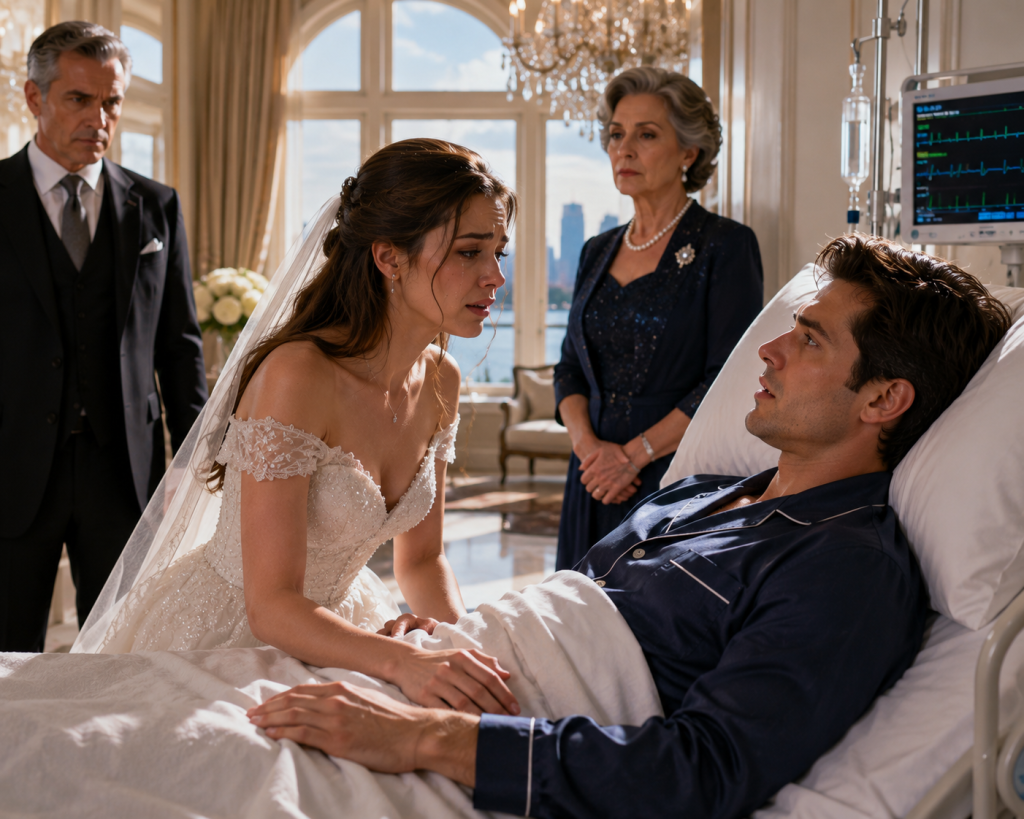
Ethan’s eyelids trembled as though the effort of opening them required every ounce of strength left in his body.
I stopped breathing.
For one suspended second, I wondered if grief, exhaustion, and fear had finally combined into something powerful enough to make me imagine miracles.
Then his eyes opened.
They were gray.
Not the pale, distant gray I had expected from a man lost somewhere beyond consciousness, but sharp, storm-colored eyes filled with confusion and pain.
They moved slowly across the ceiling.
Then toward the window.
Then, finally, toward me.
My chair scraped against the floor as I stood.
“Ethan?”
His gaze fixed on my face.
The heart monitor beside him began to beep faster.
I should have called the nurse immediately. I knew that. Every sensible thought in my mind shouted at me to run for help.
Instead, I remained frozen beside the bed.
His lips parted.
No sound came out.
“You’re awake,” I whispered.
His brow tightened.
He tried again to speak, but only a faint breath escaped.
I reached for the glass of water on the bedside table, then stopped. I had no idea whether he was allowed to drink. I had no idea whether moving him could hurt him.
“I’m going to get someone.”
His fingers shifted against the blanket.
The movement was weak, but deliberate.
His hand closed around my wrist.
I looked down at it.
His grip was barely more than the pressure of a child’s hand, yet it stopped me completely.
Ethan stared at me with sudden urgency.
“Don’t,” he breathed.
The word was so faint I almost missed it.
I leaned closer.
“What?”
His throat worked painfully.
“Don’t… call…”
The monitor continued to race.
Fear rushed through me.
“You need a doctor.”
His fingers tightened by a fraction.
His eyes moved toward the door.
Then back to me.
“Not yet.”
There was something in his expression that made the room feel colder.
It wasn’t confusion.
It was fear.
Before I could ask what he meant, the door opened.
The nurse entered carrying a tray of medication.
She glanced at me, then at the bed.
The tray slipped from her hands.
A glass vial struck the carpet and rolled beneath a chair.
“Mr. Thornton?”
Ethan’s fingers released my wrist.
His eyes closed.
The nurse rushed forward.
She checked the monitor, touched his neck, then lifted one of his eyelids.
“Mr. Thornton, can you hear me?”
No response.
He had gone perfectly still again.
But I knew what I had seen.
I knew what I had heard.
The nurse pressed the call button beside the bed.
Within minutes, the quiet bedroom became a blur of movement.
Two doctors arrived. Another nurse wheeled in equipment. I was pushed toward the wall while they examined him, speaking in short, urgent phrases that seemed both hopeful and cautious.
“Response to sound.”
“Possible purposeful movement.”
“Heart rate elevated.”
“Pupil reaction normal.”
One of the doctors turned toward me.
“What happened?”
I opened my mouth.
Then remembered Ethan’s face.
Don’t call.
Not yet.
“He opened his eyes,” I said carefully. “He looked at me.”
“Did he speak?”
The question hung in the air.
I looked past the doctor toward the bed.
Ethan’s face appeared peaceful again.
Too peaceful.
“No,” I lied. “I don’t think so.”
The doctor studied me for a moment, then nodded.
“What were you doing immediately before he responded?”
“Talking.”
“About anything in particular?”
“My mother. The wedding. My family.”
“Did you touch him?”
“I held his hand.”
The doctor turned to the nurse.
“Document everything. We’ll run additional scans.”
The bedroom door opened again.
Vivian Thornton entered first.
Jason followed close behind her.
The moment Vivian saw the doctors around Ethan’s bed, something changed in her expression. The cold authority vanished, replaced by a hope so raw that I felt ashamed for ever thinking she did not care about him.
“What happened?”
The nurse stepped aside.
“Mr. Thornton showed signs of consciousness.”
Vivian gripped the back of a chair.
“Did he wake?”
“Briefly.”
“Did he speak?”
The doctor glanced toward me.
“Mrs. Thornton says he did not.”
Jason’s gaze shifted to my face.
He smiled, but there was no warmth in it.
“What a remarkable coincidence.”
I looked at him.
“What is?”
“Nine months without a response,” he said. “Then he opens his eyes the day he gets married.”
Vivian turned sharply.
“Not now, Jason.”
“I’m only saying the timing is interesting.”
“Your cousin may be waking up.”
“And I’m delighted.”
His tone suggested otherwise.
The doctors prepared Ethan for transport to the private medical suite on the estate’s lower floor. As they wheeled him past us, I caught the slightest movement beneath his closed eyelids.
He was still aware.
Somehow, he was still listening.
Vivian watched until the elevator doors closed.
Then she turned to me.
“What exactly did you say to him?”
I repeated most of what I had told the doctor.
Vivian’s eyes remained fixed on mine.
“And then?”
“He moved his finger.”
“Nothing else?”
I hesitated.
Jason noticed.
His head tilted slightly.
“What aren’t you telling us?”
“Enough,” Vivian said.
“I’m asking a reasonable question.”
“You rarely do.”
Jason’s smile tightened.
He slipped his hands into his pockets and walked away, his footsteps fading down the corridor.
Vivian remained beside me.
For a long moment, neither of us spoke.
Then she said, “My grandson was not supposed to survive the first week.”
I looked at her.
“The doctors told us to prepare ourselves. But Ethan has always had a stubbornness that bordered on arrogance.”
Her gaze moved toward the elevator.
“He stayed. Month after month. Even when there seemed to be no reason for him to.”
Her voice softened.
“You may be the first new reason he has found.”
The words unsettled me.
“I didn’t do anything.”
“You spoke to him.”
“So have other people.”
“Not honestly.”
Vivian faced me again.
“In this house, honesty is considerably rarer than loyalty. And loyalty is nearly extinct.”
Before I could ask what she meant, she walked away.
That evening, the estate felt different.
The servants whispered behind half-closed doors. Calls were made from the library. A second car arrived carrying a neurologist from Manhattan. Even the air seemed to hold a charge, as though the mansion itself had been waiting for Ethan to move.
I was shown to a bedroom across the hall from his.
It was larger than the entire downstairs of my father’s rental house.
My suitcase looked absurdly small beside the carved wardrobe.
A row of dresses hung inside, all in my size.
I touched the sleeve of a dark blue gown.
Someone had chosen clothes for me before I arrived.
The thought was not comforting.
A knock sounded.
When I opened the door, my father stood in the hallway.
For a moment, relief crossed his face.
Then he stepped into the room and closed the door behind him.
“I heard.”
“That Ethan woke up?”
He nodded.
“What did he say?”
The question came too quickly.
I stared at him.
“The doctors said he didn’t speak.”
“I asked what he said to you.”
“He didn’t say anything.”
My father searched my face with the same expression he used when trying to decide whether a bill collector had believed his excuses.
“You’re lying.”
Anger rose inside me.
“You married me to a stranger this morning, and now you’re accusing me of lying?”
“I’m trying to protect you.”
“From what?”
He lowered his voice.
“This family is not what they seem.”
I laughed once, without humor.
“And you discovered that before or after accepting their money?”
His face tightened.
“The arrangement was supposed to be simple.”
“Nothing about this is simple.”
“You remain married until the trust transfers. The debts are settled. You have financial security. Ethan remains under medical care.”
“You talk about him like he’s a piece of paperwork.”
My father looked away.
“That is how the Thorntons explained it.”
“And now he might wake up.”
“Yes.”
The word carried more worry than joy.
I folded my arms.
“Why does that frighten you?”
“It doesn’t.”
“You asked what he said before you even asked if he was all right.”
My father walked to the window.
Outside, the last light stretched across the Hudson.
“I only know that powerful families protect themselves. When they panic, everyone around them becomes expendable.”
“What are you not telling me?”
He remained silent.
I stepped closer.
“Dad.”
His shoulders sagged.
“Years ago, I did some accounting work for one of the Thornton companies.”
I blinked.
“You never told me that.”
“It wasn’t important.”
“It seems important now.”
“It was temporary. Contract work. I barely knew anyone.”
“Did you know Ethan?”
“No.”
The answer was immediate.
Too immediate.
“What happened?”
“Nothing happened.”
“You lost your business. We lost the house. Mom spent the last year of her life worrying about bills. And now the same family you once worked for suddenly offers to erase every debt if I marry their unconscious heir.”
My father turned.
“The offer came through an attorney.”
“That isn’t an answer.”
“It’s the only one I have.”
For several seconds, we looked at each other.
I loved my father. That was what made his lies so painful.
When I was a child, he had taught me to ride a bicycle by running beside me until he tripped over the curb. He had built blanket forts in the living room and burned pancakes every Sunday morning. After my mother became ill, he had slept in hospital chairs and learned the names of every medication she took.
But grief had changed him.
Or perhaps it had only revealed the parts of him I had refused to see.
“Go home,” I said.
His expression hardened.
“This is not your home.”
“No,” I replied. “But you made sure I couldn’t return to mine.”
He flinched.
I opened the door.
For one moment, I thought he might finally tell me the truth.
Instead, he stepped into the hallway.
“Be careful what you believe in this house.”
I almost laughed.
“Right now, I don’t believe anyone.”
After he left, I sat on the edge of the enormous bed and stared at my wedding ring.
It was simple compared with everything else at the estate. A narrow band of platinum with a small row of diamonds.
Beautiful.
Cold.
Permanent.
A soft sound came from across the hall.
I stood.
Ethan’s bedroom door was partially open.
The medical team had finished their tests an hour earlier, and the corridor had been quiet since then.
I crossed the hall.
A lamp glowed beside the bed.
Ethan lay in the same position, his face turned slightly toward the window.
The nurse sat near the door reading from a tablet.
She looked up.
“Mrs. Thornton.”
“How is he?”
“Stable.”
“Did the tests show anything?”
“The doctor will discuss the results with the family tomorrow.”
I almost pointed out that I was his family now.
The words felt too strange to say.
“Can I sit with him?”
The nurse hesitated.
“Of course.”
I took the chair beside the bed.
For nearly twenty minutes, I said nothing.
The nurse returned to her reading.
The river beyond the windows reflected the moonlight in broken silver lines.
Finally, I leaned closer.
“I know you’re awake.”
No movement.
“I saw you close your eyes when the nurse came in.”
His breathing remained even.
“You told me not to call anyone.”
Nothing.
I glanced toward the nurse. Her attention was on the tablet.
“If you’re pretending, you’re making this very difficult.”
Ethan’s little finger moved.
Once.
Relief and fear struck me at the same time.
I lowered my voice.
“Can you understand me?”
His finger moved again.
One tap.
“Yes?”
Another tap.
I swallowed.
“Can you open your eyes?”
Nothing happened.
I waited.
Then his eyelids lifted slowly.
He looked exhausted.
His gaze drifted toward the nurse.
“She can’t see,” I whispered. “Not from where she’s sitting.”
His lips moved.
I leaned close enough to hear the breath of his words.
“Name.”
“My name?”
A slight blink.
“I’m Clara.”
He stared at me.
“Clara Bennett. Or Thornton now, apparently.”
The corner of his mouth moved.
It was not quite a smile, but it came close.
“You know we’re married?” I asked.
His eyes closed briefly.
When they opened again, he looked toward my ring.
“So that’s a yes.”
His throat tightened as he tried to speak.
I poured a little water onto a sponge swab from the bedside tray and touched it carefully to his lips.
He seemed grateful.
“Why can’t I call the doctor?”
His eyes moved toward the nurse again.
Then toward the security camera in the upper corner of the room.
I followed his gaze.
The small black lens pointed directly at the bed.
“You think someone is watching?”
One tap of his finger.
“Yes.”
“Who?”
His lips formed a word.
I could not understand it.
“What?”
He tried again.
“Don’t… know.”
The effort left him breathing harder.
I waited until the monitor slowed.
“Were you in an accident?”
His face changed.
The official story had been repeated in newspapers for months: Ethan Thornton had lost control of his car during heavy rain and struck a barrier on a private mountain road.
One tap.
Yes.
“Do you remember it?”
His finger remained still.
Then moved twice.
I decided two taps meant no.
“Do you remember anything before it?”
One tap.
“Yes.”
His eyes sharpened.
“Was someone with you?”
He hesitated.
Then one tap.
My skin prickled.
“The reports said you were alone.”
His hand shifted beneath the blanket.
His fingers trembled with frustration.
“Paper,” he whispered.
I looked around.
The nurse was still reading, though I could not tell whether she was listening.
I reached into my purse and found a receipt and a pen.
I placed the paper beneath Ethan’s hand.
His fingers could barely close around the pen.
The first line he drew was nothing more than a faint scratch.
He tried again.
A letter appeared.
M.
Then another.
A.
His hand slipped.
I steadied the paper.
He continued.
MARA.
I stared at the name.
“Who is Mara?”
The monitor changed rhythm.
Ethan’s eyes widened.
Behind me, the nurse stood.
“Mrs. Thornton, I’m afraid he needs rest.”
I folded the receipt into my palm before turning.
“He opened his eyes.”
The nurse came closer.
“Mr. Thornton?”
Ethan was motionless again.
She checked his pulse.
“His heart rate is elevated. You should leave.”
“But he was awake.”
“He may be experiencing brief periods of partial consciousness. Too much stimulation could set back his recovery.”
There was nothing unkind in her voice, yet something about the timing troubled me.
I stood.
As I reached the door, she called after me.
“Mrs. Thornton?”
I turned.
Her gaze lowered toward my closed hand.
“You dropped something.”
The pen lay beside the chair.
I picked it up.
The folded receipt remained hidden in my palm.
Back in my bedroom, I locked the door.
Then I unfolded the paper.
MARA.
The name meant nothing to me.
I searched my phone.
There were dozens of women named Mara connected to Thornton companies, charities, and social events. None stood out.
Then I searched old articles about Ethan’s accident.
Most repeated the same details. His car had been found against a stone barrier shortly after midnight. He had suffered a head injury and remained unconscious after emergency surgery.
One article included a photograph from a charity gala held three weeks before the crash.
Ethan stood beside Jason and Vivian.
On Ethan’s other side was a woman with dark red hair.
The caption identified her as Dr. Mara Ellis, director of the Thornton Foundation’s medical research program.
I enlarged the image.
She appeared to be in her early thirties. Composed. Intelligent. Her hand rested lightly on Ethan’s arm.
I opened another article.
This one was dated two months after the accident.
DR. MARA ELLIS RESIGNS FROM THORNTON FOUNDATION.
The article said she had stepped down for personal reasons and relocated overseas.
No interview.
No farewell statement.
Nothing after that.
A knock sounded at my door.
I quickly slipped the receipt beneath my phone.
“Who is it?”
“Vivian.”
I unlocked the door.
She entered carrying two cups of tea.
“I thought you might still be awake.”
“You bring tea to all the strangers who marry your unconscious grandson?”
“Only the ones who make him open his eyes.”
She handed me a cup and sat near the fireplace.
I remained standing.
“Who is Mara Ellis?”
Vivian’s hand paused halfway to her cup.
The reaction was slight.
But unmistakable.
“Where did you hear that name?”
“An article.”
“Which article?”
“One about the foundation.”
Vivian set her tea down.
“Mara was a physician and researcher.”
“Was she close to Ethan?”
“They worked together.”
“That isn’t what I asked.”
Her gaze became cool again.
“You have known my grandson for less than a day.”
“And I am already being warned not to trust anyone.”
“By whom?”
I did not answer.
Vivian rose.
“Mara Ellis left the foundation after Ethan’s accident.”
“Why?”
“She said the work had become too demanding.”
“Did you believe her?”
Vivian walked toward the window.
“Belief has little to do with legal resignation papers.”
I studied her reflection in the glass.
“Was she with Ethan the night of the crash?”
Vivian turned.
“What makes you ask that?”
“The reports said he was alone, but there are gaps in the timeline. His car left a dinner in the city at ten. The accident wasn’t reported until after midnight. The drive should take less than an hour.”
For the first time, Vivian looked impressed.
Then her expression closed again.
“You should not begin your marriage by investigating your husband.”
“I didn’t exactly begin it by dating him.”
A faint smile crossed her face and disappeared.
“Mara and Ethan had disagreements about the foundation’s research budget. There were rumors they were personally involved, but Ethan never discussed such things with me.”
“Did she visit after the accident?”
“Once.”
“What happened?”
“Nothing.”
It was the same answer my father had given.
Nothing happened.
The phrase people used when something had happened but they had agreed not to speak of it.
Vivian walked to the door.
“Get some sleep.”
“Did you choose me?”
She stopped.
“For the marriage.”
“I approved the arrangement.”
“Why?”
“Your family met the necessary conditions.”
“What conditions?”
Vivian’s hand rested on the doorknob.
“You were unmarried. You had no criminal history. You were not connected to the press or any competing business interests.”
“That describes thousands of people.”
“Yes.”
“So why me?”
Her eyes held mine.
“Because Ethan had seen you before.”
The room seemed to tilt.
“What?”
“Three years ago, the Thornton Foundation funded a community health center in Queens. You volunteered there.”
I remembered the center.
My mother had received treatment there during the first months of her illness. I helped at the reception desk to reduce some of the costs.
“Ethan visited once,” Vivian continued. “You spoke to him.”
“I don’t remember.”
“He did.”
“How do you know?”
“Because later that evening, he asked one of his assistants to find your name.”
My mouth went dry.
“Why?”
“He never told me.”
“That doesn’t make sense.”
“Very little does at the moment.”
Vivian opened the door.
“Your selection was not as random as your father allowed you to believe.”
She left me standing beside the cold fireplace.
I did not sleep.
By dawn, I had replayed every memory of the health center.
Doctors passing through.
Donors touring the building.
Men in dark suits shaking hands.
I could not remember Ethan.
Perhaps we had spoken for thirty seconds.
Perhaps I had handed him a visitor badge.
Why would he remember me three years later?
At breakfast, Jason was waiting in the dining room.
He sat at the end of a table long enough for twenty people, reading the financial pages on a tablet.
“Good morning, cousin-in-law.”
I poured coffee.
“Is that what you plan to call me?”
“Until I think of something more accurate.”
I sat across from him.
“Where is Vivian?”
“Meeting the neurologist.”
“And Ethan?”
“Still trapped in the dramatic space between miracle and medical uncertainty.”
I looked at him.
“You don’t seem happy that he may recover.”
Jason lowered the tablet.
“I am thrilled.”
“You have an unusual way of showing it.”
“You have known me less than twenty-four hours.”
“That seems to be everyone’s favorite defense.”
A servant placed toast between us and left.
Jason leaned back.
“Ethan waking changes things.”
“The company?”
“The trust.”
“So you do lose control.”
His expression sharpened.
“I never had control. I had responsibility. There is a difference.”
“Is there?”
“When my cousin crashed his car, thousands of employees did not stop needing salaries. Decisions still had to be made. Contracts still had to be signed. Vivian refused to accept that Ethan might never return, so she kept everything suspended.”
“And the marriage prevents you from taking his place.”
“The marriage keeps the trust from appointing a new permanent chair.”
“Which would have been you.”
“Possibly.”
His honesty surprised me.
“You think I married him for money.”
“Didn’t you?”
I looked down at my coffee.
Jason’s tone softened slightly.
“That was not an insult.”
“It felt like one.”
“Most truths do when spoken too early.”
I stood.
“You should be careful. One day, someone may decide to tell the truth about you.”
For the first time, his confidence faltered.
Then he smiled again.
“You might be more interesting than Vivian expected.”
As I walked toward the door, he said, “Ask your father about Northbridge Holdings.”
I turned.
“What is that?”
Jason lifted his tablet again.
“He’ll know.”
My father did know.
When I called him, there was a long silence.
“Who told you that name?”
“Jason.”
“You should stay away from him.”
“What is Northbridge Holdings?”
“An investment company.”
“Were you employed by them?”
“Briefly.”
“You said you worked for a Thornton company.”
“It was partially owned by the Thornton group.”
“What did you do there?”
“Clara, this is not a conversation for the phone.”
“Then come back.”
“No.”
The answer was quiet but firm.
“Why?”
“Because Vivian made it clear my role ended after the wedding.”
“My role didn’t.”
“I know.”
There was pain in his voice.
I closed my eyes.
“Was Ethan involved with Northbridge?”
“Yes.”
“What happened?”
My father exhaled.
“I found irregularities in several accounts. Money moving through shell companies. Payments authorized under Ethan’s name.”
“Were they illegal?”
“I didn’t know. That was the problem.”
“Did you tell anyone?”
“I contacted Ethan’s office.”
“And?”
“I received a response asking me to prepare a full report.”
“Did you?”
“Yes.”
“What happened to it?”
Another silence.
“I gave it to the person who came to collect it.”
“Who?”
“I never learned her full name.”
My grip tightened around the phone.
“Was it Mara?”
“I don’t know.”
“What did she look like?”
“Red hair. Early thirties. She said she worked directly for Ethan.”
The room suddenly felt too small.
“Dad, when was this?”
“About three weeks before his accident.”
“And after you gave her the report?”
“My contract was terminated. Northbridge collapsed six months later. I was blamed for missing funds.”
“That’s why we lost everything.”
“Yes.”
“Why didn’t you tell me?”
“Your mother was dying.”
“So you let me believe it was just bad business decisions?”
“They were my decisions. I trusted the wrong people.”
“And now you trusted them again.”
“No,” he said. “I thought the marriage would put you beyond their reach.”
I almost dropped the phone.
“You married me into the family to protect me from the family?”
“You would have Ethan’s name. His legal protections. A settlement secured independently from the company.”
“He was unconscious.”
“That was why the arrangement seemed safe.”
The truth settled over me with terrifying clarity.
“You didn’t expect him to wake up.”
“No one did.”
“But he did.”
My father’s voice broke.
“Clara, listen to me. Do not ask Ethan about Northbridge until you know who is in the room.”
The line went silent.
He had ended the call.
I turned and found Vivian standing in the doorway.
I had not heard her enter.
“How much did you hear?” I asked.
“Enough.”
“Did you know my father worked for Northbridge?”
“Yes.”
“Did you know about the missing money?”
“Yes.”
“Did Ethan?”
“I believe that is what he was trying to discover before the accident.”
I stared at her.
“Then why choose me?”
Vivian closed the door.
“Because six months ago, an envelope was delivered to my attorney.”
She crossed the room and removed a small key from her pocket.
“It contained a handwritten instruction signed by Ethan.”
“What instruction?”
“To proceed with his marriage arrangement if he remained incapacitated near his thirtieth birthday.”
My heartbeat quickened.
“He planned this?”
“He planned for the possibility.”
“With me?”
Vivian looked toward the windows.
“He named you.”
Every question I had multiplied at once.
“That’s impossible.”
“I had the signature authenticated.”
“But I barely knew him.”
“Perhaps he knew more about you than you knew about him.”
“Why didn’t you tell me?”
“Because I did not know whether the letter was genuine until last week. And because I wanted to see whether your father would tell you the truth.”
“He didn’t.”
“No.”
“What else was in the envelope?”
“This key.”
She placed it in my palm.
It was small and brass, with the number 314 engraved along one side.
“What does it open?”
“I don’t know.”
“You expect me to believe that?”
“I have spent six months trying to find out.”
“Why give it to me?”
“Because the letter said the key belonged to Ethan’s wife.”
A knock interrupted us.
The neurologist entered.
His face was serious but not grim.
“Mrs. Thornton, Mr. Thornton is awake again.”
We hurried across the hall.
This time, Ethan’s eyes remained open when we entered.
The doctor asked him to blink once for yes and twice for no. Ethan followed every instruction.
“Do you know your name?”
One blink.
“Do you know where you are?”
One blink.
“Do you recognize your grandmother?”
One blink.
Vivian gripped the bed rail.
The doctor stepped aside so I could approach.
Ethan looked at me.
There was recognition in his eyes.
Not the uncertain awareness of a stranger.
Recognition.
“Do you know Clara?” the doctor asked.
One blink.
My throat tightened.
“How?” I whispered.
Ethan moved his hand.
The doctor placed a writing board across his lap.
It took several attempts before Ethan managed to control the pen.
Slowly, shakily, he wrote three words.
SHE HAS IT.
Everyone looked at me.
“Has what?” the doctor asked.
Ethan’s eyes fixed on my closed hand.
I opened my fingers.
The brass key rested in my palm.
The heart monitor accelerated.
Vivian went pale.
“You know what this opens,” I said.
Ethan blinked once.
“Where?”
His hand moved again.
The letters were uneven, but legible.
CENTRAL STATION.
“Grand Central?” I asked.
One blink.
“A locker?”
Another blink.
“Number 314?”
One blink.
The doctor placed a hand on the writing board.
“That is enough for now.”
Ethan resisted weakly.
His pen scratched across the surface.
One final word appeared.
MARA.
Vivian looked toward the doctor.
“We should let him rest.”
But Ethan’s hand shifted toward me.
I took it.
His fingers closed around mine.
“What about Mara?” I asked.
His lips moved.
This time, the sound was clearer.
“She… lied.”
“About what?”
His eyes drifted toward Vivian.
Then toward the open doorway.
Jason stood there.
No one had heard him arrive.
Ethan’s hand tightened.
He looked at me with sudden urgency.
“The crash,” he whispered. “It wasn’t meant for me.”
The room went silent.
Jason’s face lost all color.
Ethan struggled to draw another breath.
“Clara…”
“I’m here.”
His eyes held mine.
“The car was yours.”
PART 3 — FINAL PART
Ethan’s words seemed to remain suspended in the room long after his voice failed.
“The car was yours.”
No one moved.
The quiet was broken only by the soft pulse of the monitor beside his bed.
I stared at him, trying to understand how a car belonging to me could have been involved in an accident three years before I entered the Thornton estate.
“That’s impossible,” I whispered. “I didn’t own a car then.”
Ethan’s eyes remained fixed on mine.
His fingers shifted weakly inside my hand.
Jason stepped farther into the room. The color had not returned to his face.
“What exactly does he mean?” he asked.
Vivian turned toward him.
“That is what we are trying to determine.”
The neurologist adjusted the writing board on Ethan’s lap.
“Mr. Thornton needs rest. His recovery is encouraging, but he should not be pressured.”
Ethan’s hand tightened around the pen.
With visible effort, he wrote another word.
CENTER.
I leaned closer.
“The health center?”
One blink.
The community health center in Queens.
The place where my mother had first received treatment.
The place where Vivian said Ethan had seen me.
A memory surfaced—not of Ethan, but of a small silver car parked behind the clinic. It belonged to the center, not to me. Volunteers used it to deliver medication and transport patients who could not afford taxis.
I had driven it several times.
My mouth went dry.
“The center had a car,” I said. “A silver hatchback.”
Ethan blinked once.
“That was the car?”
Another blink.
Jason’s expression hardened.
“The police report identified Ethan’s vehicle.”
Vivian looked at him.
“Did you read the complete report?”
“I was managing the company while the family dealt with the hospital.”
“That was not my question.”
Jason’s jaw tightened.
“No. I read the official summary.”
Ethan’s pen moved again.
SWITCHED.
The word leaned downward across the board.
“You were not driving your own car?” I asked.
One blink.
“Were you driving the health center’s car?”
One blink.
The room seemed to narrow around us.
Three weeks before the crash, my father had uncovered suspicious accounts connected to Northbridge Holdings. He had handed his report to a red-haired woman who claimed to work for Ethan.
Around the same time, Ethan had visited the health center where I volunteered.
Then, on the night of the accident, he had been driving a vehicle associated with that center.
A vehicle I often used.
“The accident wasn’t meant for you,” I said slowly. “You already told us that.”
Ethan’s eyes filled with urgency.
His pen dragged across the board.
REPORT.
“Northbridge?”
One blink.
“My father’s report?”
One blink.
Vivian gripped the bed rail.
“Ethan, who was supposed to be in the car?”
His gaze returned to me.
The answer was already there.
I felt it before he wrote anything.
ME.
A cold heaviness settled in my chest.
I had spent years believing my family’s collapse was the result of debt, illness, and my father’s mistakes. Now I was being told that someone might once have tried to frighten—or harm—me because of a financial report I had never seen.
Jason shook his head.
“This is speculation from a man who has been unconscious for nine months.”
Ethan’s eyes moved toward him.
Something passed between the cousins.
Not accusation.
Recognition.
The neurologist stepped forward.
“That is enough.”
Ethan resisted when the writing board was removed, but his strength was fading. His eyelids lowered. The monitor showed the effort his body had already spent.
Before I released his hand, his fingers traced a faint pattern against my palm.
Three.
One.
Four.
The key.
Grand Central.
Locker 314.
I slipped the brass key into my pocket.
Vivian noticed.
So did Jason.
Neither said a word.
The neurologist ushered us into the corridor. Once the door closed, Jason turned to me.
“You cannot go rushing into Grand Central with a mysterious key based on fragments from Ethan’s damaged memory.”
“Why not?”
“Because if someone concealed evidence there, they may still be watching it.”
“Then we involve the police.”
“And tell them what?” Jason asked. “That your husband woke from a coma and wrote the name of a train station?”
“He also said the crash was intended for Clara,” Vivian replied.
Jason looked at her.
“You believe that?”
“I believe Ethan.”
“That has always been your weakness.”
The words landed harder than he appeared to intend.
Vivian’s face became still.
“My weakness?”
“You have spent your life assuming Ethan is the only person in this family capable of doing the right thing.”
For the first time, the bitterness beneath Jason’s polished manners became visible.
He looked toward Ethan’s door.
“When he was reckless, you called him brave. When he ignored procedure, you called him principled. When I held the company together after his accident, you treated me like a temporary inconvenience.”
Vivian said nothing.
Jason laughed quietly, though there was no amusement in it.
“Now he opens his eyes, and suddenly every choice I made is suspicious.”
“Were any of them?” I asked.
His gaze snapped toward me.
“Suspicious?”
“Were any of your choices connected to Northbridge?”
His face closed.
“No.”
“Did you know my father?”
“I knew his name.”
“Before the wedding?”
“Yes.”
The admission surprised me.
“Why didn’t you say so?”
“Because Vivian forbade any discussion of Northbridge until Ethan recovered.”
I turned to her.
“Is that true?”
Vivian’s silence answered.
Anger flared inside me.
“You gave me the key. You told me my father had been involved. But you still expected me to walk through this house blind.”
“I was trying to determine whom I could trust.”
“You keep saying trust as though it is something other people owe you.”
Vivian flinched.
I stepped away from both of them.
“I’m going to Grand Central.”
Jason moved in front of me.
“That would be foolish.”
“So was marrying a stranger. It seems to be a family tradition.”
“This is not a game, Clara.”
“I know.”
My voice shook, but I did not lower it.
“My mother spent her last year worrying that her treatment had ruined us. My father lost everything after trying to report missing money. Ethan nearly died. And someone may have used a car connected to me because they believed I had information I didn’t even know existed.”
I placed my hand over the key in my pocket.
“I am finished waiting for other people to decide which parts of my life I am allowed to understand.”
Jason studied me.
Then his posture changed.
“Fine.”
“What?”
“I’m coming with you.”
Vivian took a step forward.
“No.”
Jason did not look at her.
“You need someone who knows the company records. Clara needs someone who can identify whatever is in that locker.”
“You expect us to trust you?” Vivian asked.
“No,” he said. “I expect you to judge what I do next.”
The answer silenced her.
I looked toward Ethan’s room.
He had trusted the key to his future wife before he knew whether he would ever wake again.
Somehow, that wife had been me.
“I want my father there,” I said.
Jason gave a short nod.
“And an attorney,” Vivian added. “One independent of the Thornton companies.”
For once, no one argued.
Two hours later, the four of us stood beneath the painted constellations of Grand Central Terminal.
Morning light poured through the tall windows, turning dust into gold. Commuters hurried across the marble floor, carrying coffee, briefcases, flowers, and ordinary concerns.
Our secret felt almost absurd in such a public place.
My father arrived wearing the same suit he had worn to my wedding. He looked as though he had not slept.
When he saw Jason, his expression changed.
“You.”
Jason stopped.
“You remember me?”
My father’s eyes narrowed.
“You came to Northbridge after I submitted the report.”
Vivian looked sharply at Jason.
He remained calm, but his fingers curled at his side.
“I was sent to review the accounts.”
“You told me there was no evidence of theft.”
“There wasn’t. Not in the records you gave us.”
“You called my report careless.”
“I called it incomplete.”
“You destroyed my credibility.”
Jason’s voice lowered.
“I was wrong.”
My father stared at him.
The apology did not erase anything, but it altered the air between them.
Jason looked at me.
“At the time, the transfers appeared to have Ethan’s authorization. I believed your father was trying to hide his own mistakes by accusing senior management.”
“And later?” I asked.
“Later, I found duplicate ledgers.”
“Why didn’t you clear his name?”
“Because the duplicate ledgers disappeared before I could prove they existed.”
My father gave a bitter laugh.
“How convenient.”
“Yes,” Jason said. “It was.”
The directness of the answer seemed to unsettle him more than any defense would have.
Vivian introduced the independent attorney, a calm woman named Helen Shaw, who carried a document case and seemed unimpressed by everyone.
“If this locker contains evidence of a crime,” she said, “no one removes or alters anything without documentation. We photograph the contents, establish custody, and contact the appropriate authorities.”
My father looked at me.
“You should not be here.”
“I have heard that from almost everyone in the last two days.”
“I mean this time.”
“So do I.”
He lowered his eyes.
We found the lockers near a lower concourse Ethan must have known well. Number 314 was set into a row of dark metal doors, ordinary enough to be overlooked by thousands of people.
The brass key slid into the lock.
For one terrible second, it would not turn.
Then I pushed harder.
A click.
The door opened.
Inside sat a weathered leather satchel.
Nothing else.
Helen photographed it before removing it with gloved hands. She placed it on a nearby bench and opened the buckles.
The first item was a stack of financial records.
My father leaned over them.
“These are the original transfer schedules.”
Jason examined the top page.
“They have Ethan’s digital authorization.”
“But not his signature,” my father said.
Jason turned several pages.
“You’re right.”
Helen lifted a small recording device from the satchel.
Beneath it lay a sealed envelope.
My name was written across the front.
CLARA BENNETT.
My father stopped breathing.
I recognized the handwriting.
My mother’s.
For a moment, the station vanished.
I saw her at the kitchen table, wrapped in a blue cardigan even in summer because treatment always left her cold. I saw the way she wrote grocery lists in neat capital letters. I remembered finding notes in my lunch bag long after I was old enough to pack it myself.
Be brave today.
Call me when you arrive.
I’m proud of you.
My fingers trembled as I reached for the envelope.
“Why would my mother have written to me?”
No one answered.
The seal had never been broken.
Inside was a single sheet of paper and a photograph.
The photograph showed my mother standing outside the community health center beside Ethan and Mara Ellis.
Ethan appeared younger, though only by a few years. Mara’s red hair was pulled back. My mother looked tired but happy.
On the back, she had written a date.
Three weeks before Ethan’s accident.
I unfolded the letter.
My dearest Clara,
If you are reading this, then something has gone wrong, and I am sorry that another burden has found its way to you.
You believe I met Ethan Thornton only once, during a donor visit. The truth is that I met him several times.
He came to the center because one of the foundation’s medical programs was being charged for equipment that never arrived. I noticed because the same equipment appeared on my treatment statements.
At first, I assumed it was an error. Then your father told me he had found unusual payments connected to Northbridge Holdings.
We did not know our discoveries were related until Ethan spoke to us privately.
Clara, your father did not lose our future through carelessness. He tried to protect people. I asked him not to tell you because you were already carrying too much.
That was my mistake.
Silence can look like protection when it is really only another kind of fear.
Ethan believed someone inside his family’s companies was using charity programs to move money. Dr. Mara Ellis offered to help him collect proof. We trusted her.
Then Ethan learned Mara had copied your father’s report before delivering it.
He became afraid that you might be used to pressure us.
The night of his accident, he borrowed the health center car because he believed his own vehicle was being followed. He planned to meet Mara and recover the copied records. I was supposed to go with him, but my treatment left me too weak.
You were scheduled to drive the center car the next morning.
Ethan worried that whoever was watching would believe you had the report.
He took the car to draw attention away from you.
If Ethan gives you this letter, it means he succeeded in protecting you long enough to uncover the truth.
Please do not hate your father for keeping this from you. I made him promise.
And do not think Ethan chose you because he pitied us.
He remembered you from the first day he visited the center. You were arguing with the pharmacy over an elderly patient’s prescription. You refused to leave the counter until they found a way to help her.
Later, Ethan told me that most people changed their voice when speaking to someone powerful. You did not even notice he was standing behind you.
He admired that.
So did I.
Whatever happens, remember this: our lives are not defined only by what was taken from us. They are also defined by what we choose to return to others.
All my love,
Mom
I reached the final word and could no longer see the page.
My father placed a hand over his mouth.
“She wrote that?” he asked.
I nodded.
He turned away, shoulders shaking.
All the anger I had carried toward him did not disappear. But it changed shape.
He had lied.
He had made choices for me that were not his to make.
Yet inside those choices had been a promise to the woman he loved, made while both of them were frightened and losing hope.
I crossed the small space between us.
When I touched his arm, he turned.
“I should have told you,” he said.
“Yes.”
“I kept waiting for the right time.”
“There wasn’t one.”
“No.”
His eyes filled.
“I thought if I could fix the debts, it would make the silence worthwhile. Then the marriage offer came, and I convinced myself it was what your mother had wanted.”
“She wanted me to know the truth.”
“I know that now.”
For a moment, we simply stood there.
Then I embraced him.
Not because everything was forgiven.
Because forgiveness had to begin somewhere.
Helen cleared her throat gently.
“There is more.”
She had connected the recording device to her phone.
A woman’s voice emerged through the speaker.
Mara.
“If you are hearing this, Ethan, then I was not able to meet you.”
Her voice was composed, but strain trembled beneath it.
“I need you to understand that I did not begin this willingly. The transfers started as a way to keep the foundation’s research division operating after the board froze our funding. I moved money from dormant accounts, intending to replace it when the grants arrived.”
Jason closed his eyes.
Mara continued.
“Then Leonard Vale discovered what I had done.”
The name meant nothing to me.
It meant something to Vivian.
Her face went still.
“Leonard was the Thornton group’s chief legal officer,” she said. “For twenty-two years.”
The recording played on.
“He threatened to expose me unless I helped expand the transfers through Northbridge. By then, the amounts were too large. The money was no longer supporting research. It was moving into private accounts controlled by Vale and two outside partners.”
Mara took a shaky breath.
“When Daniel Bennett found the irregularities, I copied his report and gave the original to Vale. I told myself I was protecting the foundation. The truth is that I was protecting myself.”
My father sat heavily on the bench.
“After Ethan confronted me, I agreed to return the copy and identify Vale. We arranged to meet near the mountain road. I did not know Vale had learned which car Ethan would drive.”
A pause followed.
Then her voice broke.
“The crash was supposed to frighten Clara Bennett. Vale believed she had received her father’s records and planned to expose them. He ordered someone to force the center car off the road, not knowing Ethan had taken it.”
My stomach tightened.
“He told me Ethan was dead. When I learned he had survived, I wanted to go to the police, but Vale threatened the patients enrolled in my research program. He had access to their records, their immigration status, their insurance claims.”
The next words came quietly.
“I left the country because I was afraid. That is not an excuse.”
There was movement on the recording, as though she had shifted closer.
“Ethan, Locker 314 contains the original transfer schedules and a copy of Vale’s instructions. It also contains a letter from Evelyn Bennett. She gave it to me the night before your accident and asked me to keep it safe.”
I gripped my mother’s letter.
“If you wake, do not trust the company’s internal attorneys. Do not trust anyone who insists the family must handle this privately.”
Jason looked toward Vivian.
She did not defend herself.
Mara’s final words were almost a whisper.
“And do not assume Jason knew. He was investigating Northbridge too. Vale used his access credentials to make it appear that Jason approved several transfers. Jason was not helping him.”
Jason sat motionless.
For the first time since I had met him, he seemed stripped of every defense.
The recording ended.
The noise of the station returned around us.
Announcements echoed above the concourse.
A child laughed nearby.
A train arrived somewhere beyond the walls.
Vivian looked at Jason.
“You knew there were duplicate ledgers.”
“Yes.”
“You said nothing.”
“I tried to find proof.”
“You allowed me to suspect you.”
His expression sharpened.
“You never asked whether I was innocent. You only asked whether I could prove it.”
Pain crossed Vivian’s face.
Jason stood.
“I spent nine months keeping the company alive while every decision I made was compared with the choices Ethan might have made. I thought if I found Vale’s records myself, perhaps for once you would believe I belonged in this family for reasons other than being useful.”
Vivian’s voice softened.
“You always belonged.”
“No,” Jason said. “Ethan belonged. I performed.”
The truth of it seemed to reach her at last.
She took a step toward him.
“I failed you.”
Jason looked almost angry at the apology.
Then his face changed.
Not into forgiveness.
But into the possibility of it.
Helen gathered the documents.
“We contact federal investigators now.”
Vivian nodded.
“No private settlement. No internal review.”
Jason looked at her.
She held his gaze.
“Proper channels,” she said. “All of it.”
By afternoon, the contents of Locker 314 had been transferred into official custody.
Leonard Vale was located before midnight at a private airport outside New York. The financial records, Mara’s recording, and archived security communications were enough to prevent his departure.
Mara Ellis was found two days later in Lisbon.
Through her attorney, she agreed to return voluntarily and cooperate.
Her testimony revealed that Vale had used the confusion after Ethan’s accident to erase records, discredit my father, and pressure the Thornton board into expanding his authority.
The driver who had forced the silver car from the road had been paid to cause a minor collision and retrieve a document bag. He had not known Ethan was inside or that the road barrier would fail.
The truth was neither a grand conspiracy nor a single act of evil.
It was a chain of fear, ambition, silence, and people convincing themselves that the next compromise would be the last.
That made it more believable.
And, somehow, more painful.
My father’s name was publicly cleared.
Northbridge issued a formal correction. The missing funds were traced, and restitution proceedings began for the charities and medical programs affected.
Jason voluntarily stepped down from temporary control of the company while investigators reviewed his credentials. When the review confirmed he had not authorized the transfers, the board asked him to return.
He declined the position of permanent chair.
Instead, he proposed something no one expected.
He asked the board to divide authority among an independent leadership council, employee representatives, and outside ethics officers.
“No more dynasties pretending blood is a qualification,” he said during the meeting.
Vivian supported him.
It cost her three longtime board allies.
She did not hesitate.
Ethan’s recovery was slower than the headlines wanted.
Newspapers spoke of miraculous awakenings, secret marriages, and financial scandal. They did not show the mornings when he could not lift a spoon, the afternoons when speech therapy left him trembling, or the nights when fragments of the crash returned in dreams.
I remained at the estate.
At first, I told myself it was because investigators needed me nearby.
Then because Ethan’s doctors asked me to help with memory exercises.
Eventually, I stopped inventing reasons.
One evening, nearly six weeks after he woke, I found him in the conservatory.
He sat in a wheelchair beside the glass wall, watching rain collect on the garden leaves. A physical therapist had left a walking frame nearby.
“You escaped,” I said.
“Temporarily.”
His voice was still quiet, but each word came more easily now.
“Should I alert security?”
“They know.”
“That ruins the drama.”
His mouth curved.
It was the first full smile I had seen from him.
I sat beside him.
For several minutes, we listened to the rain.
Then he said, “You read the letter.”
“Yes.”
“I didn’t know what it said.”
“You carried it anyway.”
“Mara gave me the satchel before we separated that night. I put it in the locker because I realized I was being followed.”
“Why did you take the health center car?”
“Your mother told me you were scheduled to use it the next day.”
I looked at him.
“You believed someone would come after me.”
“I believed Vale thought your father had given you copies.”
“So you made yourself the target.”
“I planned to leave the car at the station and meet a security officer.”
“But Mara changed the meeting place.”
He nodded.
“She said she had proof Vale was tracking the trains. I believed her.”
“Did she betray you?”
Ethan watched the rain.
“I think she panicked. She sent me toward the mountain road, then tried to warn me after she discovered Vale had hired someone to follow the car.”
“Do you forgive her?”
His fingers rested against the blanket over his knees.
“I don’t know yet.”
It was the most honest answer he could have given.
He looked at me.
“Do you forgive your father?”
“Not all at once.”
“That sounds wise.”
“It feels messy.”
“Most wise things do.”
I smiled.
Then the question I had been avoiding rose between us.
“Why did you name me in the marriage arrangement?”
He looked away.
For the first time, Ethan Thornton appeared nervous.
“The letter was only supposed to be delivered if I remained incapacitated near my thirtieth birthday.”
“That does not answer the question.”
“No.”
He drew a slow breath.
“After I met you at the health center, I asked who you were.”
“So Vivian told me.”
“You were arguing with a pharmacist.”
“I was not arguing.”
“You threatened to call three state agencies.”
“The prescription had been approved.”
“You were terrifying.”
I tried not to smile.
He continued.
“Later, your mother told me about you. Not the dramatic things. Small things. That you took the longest route home because you liked passing a bakery that gave leftover bread to the shelter. That you pretended not to notice when your father burned breakfast because he looked proud of making it.”
My throat tightened.
“She told you that?”
“She loved talking about you.”
He turned toward the rain again.
“When I created the contingency plan, I needed someone outside the company. Someone Vale would not control. Someone Vivian could not intimidate.”
“I am not sure the last part has been proven.”
“It has.”
A laugh escaped me.
Then Ethan’s expression became serious.
“I knew the arrangement was unfair.”
“You were unconscious.”
“I made it possible before that.”
“Yes.”
“I gave instructions that you could refuse. That you would receive financial protection regardless of whether the ceremony happened.”
“My father did not mention that.”
“I know.”
He looked down at his hands.
“I am sorry, Clara.”
The apology contained no request.
No expectation that I comfort him.
Only responsibility.
I studied the man I had first met while he lay silent beneath white sheets. The man who had chosen a dangerous road to draw attention away from someone he barely knew. The man who had built a marriage contingency out of trust, calculation, and perhaps a hope he had never expected to confess.
“What happens now?” I asked.
“That should be your decision.”
“And what do you want?”
His eyes met mine.
“A chance to meet my wife.”
The words were gentle.
Not clever.
Not demanding.
My heart moved before I could stop it.
“You have already met her.”
“No. I met a volunteer in Queens. Then I woke beside a woman who lied to a doctor because I asked her to.”
“You remembered that?”
“Every second.”
“You could barely speak.”
“I was still impressed.”
I looked away, suddenly aware of the ring on my hand.
Ethan touched it lightly.
“You are free to leave,” he said. “The trust has been amended. Your father’s debts are resolved through restitution, not through our marriage. You owe this family nothing.”
“And if I stay?”
His voice lowered.
“Then we begin again.”
A week later, Ethan walked twelve steps.
The entire family gathered in the rehabilitation room, though he had asked them not to.
Vivian stood near the wall pretending she had come to speak with the doctor. Jason leaned against the doorway with his arms folded. My father held a paper cup of coffee he never drank.
Ethan gripped the walking frame.
His therapist stood beside him.
“One step at a time,” she said.
He moved his right foot.
Then his left.
The third step made his shoulders shake.
By the seventh, sweat had gathered at his temples.
At the tenth, everyone stopped breathing.
He reached twelve and lowered himself into the chair.
Vivian turned toward the window, wiping her eyes before anyone could see.
Jason walked forward.
“You always did enjoy an audience.”
Ethan looked up at him.
“You came.”
“Only to confirm the rumors of your terrible technique.”
For a moment, the cousins regarded each other across everything that had happened.
Then Ethan held out his hand.
Jason stared at it.
“You knew I was investigating Northbridge,” he said.
“I suspected.”
“You never trusted me enough to tell me about the locker.”
“I did not trust anyone enough.”
Jason’s expression tightened.
“That is not better.”
“No.”
Ethan kept his hand extended.
“I’m sorry.”
Jason looked toward Vivian.
Then toward me.
Finally, he took Ethan’s hand.
“Your grip is weak.”
“I was unconscious for nine months.”
“Excuses already.”
But he did not let go immediately.
Three months later, the Thornton Foundation reopened the Queens health center under a new charter.
No family member held sole authority over its funds.
My father joined its financial oversight committee, working alongside outside auditors and patient advocates. He accepted the role only after I told him that clearing his name did not mean returning to the man he had been.
“You have to become someone who tells the truth before he is cornered,” I said.
He nodded.
“I’m learning.”
So was I.
Mara returned to New York and entered a cooperation agreement. She faced professional consequences and a long legal process, but her testimony protected dozens of patients whose records Vale had used as leverage.
Before her first hearing, she asked to meet me.
We sat in a small conference room with our attorneys present.
She looked older than the woman in the gala photographs.
“I have rehearsed an apology a hundred times,” she said.
“Then don’t rehearse it now.”
Her hands folded tightly on the table.
“I was afraid.”
“I know.”
“I told myself Vale would ruin the research. Then I told myself he would hurt the patients. Every time I helped him, I found a reason that made me feel less responsible.”
She looked at me.
“Your mother saw through me.”
“What did she say?”
“That courage does not arrive before the choice. It arrives because of it.”
That sounded like my mother.
Mara slid a small object across the table.
A visitor badge from the health center.
My name was printed beneath a faded photograph.
“Ethan kept this after his first visit,” she said. “It was in his office. I found it when I collected the Northbridge files.”
I picked it up.
“He kept my badge?”
“He said it reminded him that stubbornness could be useful.”
Despite myself, I laughed.
Mara’s eyes filled.
“I am sorry, Clara.”
I could not tell her everything was all right.
It wasn’t.
But I could give her something honest.
“I hope what you do next becomes larger than what you did then.”
She nodded, tears slipping down her face.
It was not absolution.
It was a door.
By spring, Ethan could walk without assistance.
On the anniversary of the day he opened his eyes, he asked me to meet him in the health center courtyard.
The garden had been restored with benches, flowering trees, and a narrow brick path winding between raised beds. Patients and families filled the windows above us.
Ethan waited beneath a young magnolia tree.
He wore a dark suit but no tie.
“You look suspicious,” I said.
“I have been told that is a family trait.”
“What have you done?”
“Something reckless.”
“That is definitely a family trait.”
He held out his hand.
I placed mine in it.
He led me toward the center of the courtyard, where a small plaque had been set into the brick path.
EVELYN BENNETT GARDEN
For Every Person Who Chose Courage Before They Felt Ready
My breath caught.
“You did this?”
“Not alone.”
My father stepped from behind the magnolia tree.
Vivian followed, carrying flowers.
Jason appeared beside them, looking annoyed at being included in anything sentimental.
Around the courtyard stood doctors, nurses, volunteers, patients, and former employees of the foundation.
Ethan turned to me.
“One year ago, a legal document declared us married.”
A murmur of laughter passed through the crowd.
He continued.
“It was practical, complicated, and completely backward.”
“That is generous.”
“I thought we could correct the order.”
He reached into his pocket.
Instead of a new ring, he removed the same simple platinum band I had worn since the first ceremony.
I looked at my empty hand.
I had taken it off that morning before work because the clasp on my bracelet had caught against it.
Or so I had thought.
“You stole my wedding ring.”
“I borrowed it with assistance.”
My father looked innocent.
Jason did not.
Ethan held the ring between us.
“Clara Bennett, I cannot promise you a life without secrets. People are too imperfect for that.”
The courtyard became quiet.
“But I promise I will never call silence protection when it is really fear. I will ask instead of assume. I will tell you the truth even when it changes how you see me.”
His voice trembled slightly.
“And I will spend every day being grateful that the first voice I heard when I returned to the world was yours.”
My vision blurred.
He lowered himself carefully onto one knee.
The movement was still difficult.
I reached for him.
“Ethan, your therapist will be furious.”
“She is standing behind you.”
I glanced back.
The therapist smiled.
“He practiced.”
When I turned again, Ethan was holding up the ring.
“Will you marry me?”
“We are already married.”
“Will you do it on purpose this time?”
Laughter broke through my tears.
I looked at my father, who was crying openly now.
At Vivian, whose hand rested on Jason’s arm.
At the garden carrying my mother’s name.
At the health center where so many lives had crossed without understanding how deeply they would one day connect.
Then I looked at Ethan.
“Yes.”
He smiled.
Not the faint almost-smile from the hospital bed.
A full, bright, astonished smile.
“Yes?” he repeated.
“Yes.”
He slid the ring onto my finger.
The courtyard erupted in applause.
But beneath the sound, I heard my mother’s words from the letter.
Our lives are not defined only by what was taken from us. They are also defined by what we choose to return to others.
Later, after the small ceremony and the photographs and Jason’s unexpectedly moving toast, I found Vivian standing alone beside the plaque.
“You knew my mother,” I said.
“A little.”
“Why didn’t you tell me?”
Vivian looked down at the flowers.
“Because she asked me not to interfere unless Ethan failed.”
“Failed at what?”
“At finding his way back.”
I stared at her.
“She knew about the marriage plan?”
“Not the details. But Ethan told her he intended to protect you if the investigation became dangerous.”
Vivian reached into her handbag and removed a folded piece of paper.
“There was one more note.”
My mother’s handwriting covered the outside.
For Vivian.
“I kept it because I did not understand it,” she said.
I opened the note.
Vivian,
Ethan believes he is protecting Clara because she reminds him that good people exist outside the world he knows.
He is mistaken.
He is protecting her because she reminds him of the person he still hopes to become.
Should he ever forget that, please return him to her.
I read the words twice.
Then I looked across the courtyard.
Ethan stood with my father, listening intently as he described plans for a patient transportation fund. Jason was beside them, correcting every third number. Mara’s visitor badge rested inside the pocket of my dress, not as a symbol of what had gone wrong, but as proof that the smallest moments could travel farther than anyone imagined.
Ethan glanced up.
Across the crowd, his eyes found mine.
He excused himself and walked toward me.
No chair.
No frame.
No one holding his arm.
Just Ethan, moving carefully but confidently through the sunlight.
“What did she give you?” he asked.
I folded the note and placed it over his heart.
“Directions.”
“To where?”
I took his hand.
“Home.”
Behind us, the magnolia blossoms stirred in the spring wind. The clinic doors opened, and a family stepped into the garden together.
Ethan looked at our joined hands.
Then at the ring.
“Do you still think the marriage was a terrible idea?”
“The first one?”
“Yes.”
“Absolutely.”
“And the second?”
I leaned closer.
“Ask me again in fifty years.”
He smiled.
“I will.”
And for the first time in a life shaped by secrets, neither of us was afraid of what the future might reveal.
THE END