There is a specific, suffocating exhaustion that comes not from building an empire, but from pretending you aren’t the only one carrying its weight. For Sarah, the founder and CEO of one of the Southeast’s most formidable commercial real estate firms, success was a mathematics of sheer will. She had clawed her way up from nothing, transforming a modest start-up into a multi-billion-dollar portfolio of steel, glass, and skyline. She was brilliant, relentless, and unapologetically self-made. But behind the closed doors of her sprawling, five-bedroom Nashville estate—a fortress of limestone and manicured oak she had purchased in cash—Sarah spent her life quietly shrinking herself to fit into the fragile parameters of her husband’s ego.
Mark was a man constructed entirely of polished veneers. Outwardly charismatic, handsome, and armed with a smile that could disarm a boardroom, he managed a minor, largely superficial division within Sarah’s company. He was a passenger who desperately needed the world to believe he was driving the car. And Sarah, blinded by a profound, aching desire for a traditional family to share her kingdom with, enabled the illusion. She routed easy victories his way, credited him for ideas he never had, and coddled his masculine insecurities with the precision of a bomb technician.
But as her pregnancy advanced into the third trimester, the delicate equilibrium of their marriage began to rot from the inside out.
It started with subtle, chilling anomalies. Mark became increasingly secretive with his devices, his phone permanently locked and perpetually facedown. He took sudden, poorly explained “business trips” to Atlanta and Miami, returning smelling faintly of expensive hotel lobbies and a sharp, unfamiliar citrus cologne. More disturbing was his profound detachment from the impending birth. He didn’t paint the nursery; he didn’t assemble the crib. He viewed the growing life inside Sarah not with the anxiety of an expectant father, but with a cold, calculated disinterest, as if he were waiting for a timer to run out.
It was three weeks before the due date. The Nashville estate felt heavy, saturated with the silent tension of an approaching storm. Sarah, heavily pregnant, her ankles swollen and her lower back screaming with chronic pain, was sitting at the massive marble kitchen island. She was finalizing the legal framework for a multi-million-dollar acquisition, her fingers flying across the laptop keyboard.
Mark walked in. He didn’t ask how she was feeling. He didn’t place a hand on her stomach. He simply walked to the wet bar, poured two fingers of an expensive scotch Sarah had bought him, and leaned against the counter. He watched her work with an unreadable, almost predatory expression.
“You’re transferring the main holding company into a new trust?” he asked casually, though his eyes darted hungrily to the glowing screen of her laptop.
Sarah nodded, pausing to rub a soothing circle over her swollen belly. “Just standard asset protection before Lily arrives. Rachel is setting it up so the business is ring-fenced for the baby. It’s the smart play, just in case.”
Mark’s jaw tightened imperceptibly. A muscle feathered in his cheek. “Right. For the baby,” he murmured, a cold, derisive edge clipping the ends of his words.
Later that evening, the illusion shattered entirely, though Sarah wouldn’t realize it until much later. While Mark was in the shower, the water running loudly through the pipes, his phone vibrated aggressively on the nightstand. Sarah, lying in bed and simply looking for the time, glanced at the glowing screen.
A text message from an unsaved number sat naked on the lock screen. It read: “Did you talk to the lawyer yet? You promised it would be done before she gives birth.”
Before Sarah’s exhausted brain could even begin to process the anomaly—before she could ask who the lawyer was or what was supposed to be done—a brutal, tearing contraction ripped through her lower abdomen. It was a pain so absolute and blinding it drove her to her knees on the hardwood floor. The mystery of the text message was instantly swallowed by the terrifying, primal panic of early labor.
As the ambulance doors slammed shut an hour later, the sirens wailing into the humid Nashville night, Sarah gripped Mark’s hand in the back of the rig. She was terrified, vulnerable, and completely unaware that the man whose fingers she was squeezing so desperately was not praying for her safe delivery. He was simply sitting in the strobe of the ambulance lights, mentally calculating the exact dollar amount he was about to steal the moment she was heavily medicated.
Chapter 2: The Desecration of the Sacred
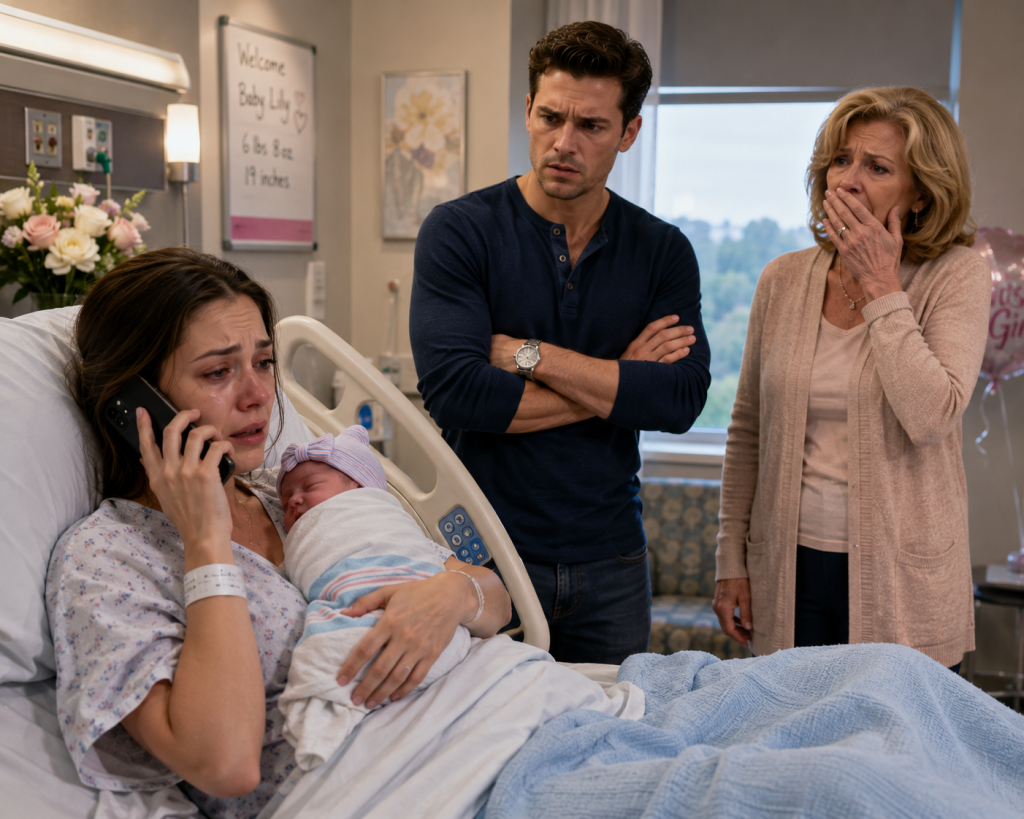
But against her chest, wrapped in a thin, striped hospital blanket, was Lily. A tiny, fragile, perfect weight.
Sarah looked down at her daughter, tears of profound, overwhelming relief blurring her vision. She felt a tectonic shift in her soul, an immediate, ferocious biological imperative to protect this child at all costs. She looked up, expecting to meet her husband’s eyes. She expected Mark to cry. She expected him to walk over, collapse into the bedside chair, and touch the impossibly small hand of the life they had created.
Instead, Mark stood rigid at the foot of the hospital bed.
He had his arms crossed tightly over his designer cashmere sweater. He wasn’t looking at the baby with awe; he was staring at her tiny face like she was evidence in a crime scene. His posture was rehearsed, his expression a mask of manufactured grief that didn’t quite reach his cold, calculating eyes.
Nurse Dana, a veteran of the ward, was quietly adjusting the IV drip, offering a soft, congratulatory smile. Mark’s mother, Carol—a sharp, observant woman who had always favored Sarah’s genuine warmth over her own son’s superficiality—was sitting in the corner armchair, holding a cup of lukewarm coffee, waiting for the invitation to come closer.
The room was quiet. And then, Mark struck.
He pitched his voice loudly, clearly projecting so that the nurses stationed in the hallway outside the open door could hear him.
“I want a DNA test,” Mark said, his voice dripping with an artificial, victimized sorrow. “That baby might not be mine.”
The silence that followed was so absolute, so dense, it felt as though all the oxygen had been violently sucked out of the room. Nurse Dana froze, her hand hovering paralyzed over the IV line, her eyes wide with secondary trauma.
“I deserve to know the truth, Sarah,” Mark continued, taking a step back, playing to his invisible audience. “I’m not raising another man’s mistake.”
For three seconds, Sarah’s heart stopped beating. The cruelty of the accusation, delivered in the absolute peak of her physical and emotional vulnerability, was a psychological knife to the throat. It was the ultimate desecration of a sacred moment.
She looked down at Lily. She traced the curve of the newborn’s ear, which was undeniably, identically shaped to Mark’s. She felt the tears welling up—a natural, biological response to profound trauma. But then, she looked back at Mark.
She saw the smug tilt of his chin. She saw the utter lack of genuine heartbreak in his posture. He wasn’t a devastated husband whose world had just collapsed; he was a man executing a hostile takeover. He was setting a narrative.
In that exact fraction of a second, the love Sarah held for Mark did not slowly fade. It was violently, permanently severed, as if a guillotine had dropped inside her chest. The tears vanished, evaporating into a cold, terrifying, metallic clarity. She refused to be a hysterical victim in his pathetic play.
Without breaking eye contact with him, Sarah reached out with a trembling, IV-bruised hand and picked up her phone from the bedside table. She unlocked it and dialed Rachel Bennett, her ruthless corporate attorney. She put the phone on speaker.
“Rachel,” Sarah said, her voice devoid of any tremor, ringing with the icy authority of a CEO.
“Sarah? Good god, did you have the baby?” Rachel’s voice crackled through the speaker.
“I did. Now listen to me closely,” Sarah commanded. “Initiate Protocol Omega on the primary trust. Revoke Mark’s access to all corporate accounts immediately. Cancel his company credit lines, void his building keycards, and prepare the divorce papers. Ground for filing: irreconcilable breach of trust. Have the courier bring them to my hospital bed in one hour.”
Mark’s smug expression shattered. The color drained from his face so rapidly he looked sickly, his carefully constructed facade crumbling into genuine, wide-eyed panic. He hadn’t expected her to go nuclear. He expected her to beg, to cry, to defend her honor while he dictated the terms of their separation.
He lunged forward to grab the phone from the bed, but Nurse Dana fiercely stepped between them, hitting the blue code button on the wall to summon hospital security.
From the corner of the room, the sound of a paper coffee cup hitting the linoleum floor echoed loudly.
Carol, Mark’s mother, was standing up. Her face was paler than her son’s. She was gripping the armrest of the chair, staring at Mark with a mixture of absolute terror and profound disgust.
Then, she whispered into the tense, sterile air.
“Oh God… he doesn’t know.”
Chapter 3: The Architecture of Ruin
The transition from a hospital bed to a war room requires a specific kind of psychological compartmentalization. Sarah did not cry for her dead marriage. She saved her tears for the quiet, sacred moments in the dead of night when she nursed Lily, mourning only that her daughter’s father was a monster. During the day, she was a ghost haunting her own life, playing dead while she meticulously rigged the explosives.
Mark, operating under the delusion that he still held the upper hand, launched a vicious, scorched-earth smear campaign. Banned from the estate and entirely locked out of the company’s financial infrastructure, he moved into a luxury leased apartment downtown—paid for on high-interest credit lines—and began his assault.
He took to social media, posting vague, heartbroken updates about “betrayal” and “starting over after ultimate deception.” He weaponized their high-society friends, planting whispers at country clubs and galas that Sarah had been having an affair with a rival developer. Through his hired, aggressive lawyers, he sent formal demands: he would sign a quiet, non-disclosure-bound divorce and walk away without further tarnishing her “corporate brand,” provided she handed over fifty percent of her holding company and a massive alimony settlement.
He was attempting to blackmail her with a phantom infidelity.
Sarah ignored him completely. She agreed to the court-ordered DNA test without a single objection, ensuring the strictest chain of custody was maintained by the state. She let Mark believe she was backed into a corner, too humiliated to fight.
Two days after being discharged from the hospital, the mystery of Carol’s horrifying whisper was finally solved.
Sarah was sitting in the darkened, mahogany-paneled study of the estate, gently rocking a sleeping Lily, when Carol slipped through the back door. The older woman looked aged, haggard, and terrified. She sat in the leather chair across from Sarah’s massive desk and placed a thin manila envelope on the polished wood.
“He thinks he’s sterile, Sarah,” Carol whispered, tears spilling over her mascara, her hands trembling violently.
Sarah stopped rocking. The silence in the study grew heavy. “Explain.”
Carol pointed a shaking finger at the envelope. “Three years ago, Mark paid a private, out-of-network clinic in Atlanta for a vasectomy. He told you he was going on a weekend hunting trip with the boys. He wanted to eventually divorce you and take his cut of the company, but he knew having children would complicate the settlement and tie him to you permanently. So, he took matters into his own hands.”
Sarah felt a cold wave of revulsion wash over her. Three years ago, she had been undergoing painful, exhausting fertility treatments, sobbing in bathrooms over negative pregnancy tests, entirely unaware her husband had surgically ensured her despair.
“But why did you say he doesn’t know?” Sarah asked, her voice dangerously quiet.
“Because a year after the surgery, his doctor called the house line trying to reach him with follow-up lab results,” Carol confessed, burying her face in her hands. “I answered. The doctor thought I was his wife. He told me the procedure had failed. It’s rare, but it happens. Spontaneous recanalization. The tubes reconnected. The doctor said Mark had a perfectly normal, highly active sperm count.”
Sarah stared at her mother-in-law, the sheer magnitude of the revelation locking her lungs. “And you didn’t tell him?”
Carol shook her head, thoroughly ashamed. “I… I wanted a grandchild, Sarah. I knew you would be an incredible mother. And I knew if Mark thought he was sterile, he’d eventually stop taking his ‘precautions’ with you. He’s arrogant. He never went back for his follow-up checks. I thought… I thought a baby would fix him. I thought it would make him a real man.”
A dark, terrifying laugh bubbled up in Sarah’s throat, sharp as broken glass.
Mark’s entire grand strategy—the hospital ambush, the demands for half her empire, the public humiliation, the utter conviction of her infidelity—was built on the arrogant, false assumption that he was physically incapable of being a father. He firmly believed Lily was the biological proof of Sarah’s cheating. He was using a biological impossibility that didn’t exist to frame her, specifically to bypass the infidelity clauses in their airtight prenuptial agreement.
He had strapped a bomb to his own chest and was proudly holding the detonator in the air, demanding a ransom.
Sarah picked up her phone and dialed Rachel Bennett.
“Rachel,” Sarah said, looking at the sleeping child in her arms. “Expedite the court-ordered DNA results. Do whatever it takes to get them back by Friday. Let Mark think he has me entirely cornered.”
“And the other matter?” Rachel asked, her tone razor-sharp.
“Yes,” Sarah replied. “Tell your private investigators to finalize the financial deep-dive on Mark’s assistant, Chloe. He’s not doing this just to be cruel. He needs capital. I want to know exactly how much of my company’s money he’s been funneling into offshore accounts to fund his new life with a twenty-four-year-old.”
“We’re already inside his shell LLC,” Rachel confirmed, a predatory satisfaction in her voice. “Sarah… it’s bad. He didn’t just hide marital assets. He embezzled from the corporate client escrow accounts. It crosses the threshold into federal wire fraud.”
Sarah looked at Carol, who was weeping quietly into her hands.
“Good,” Sarah said softly, hanging up the phone. The trap was fully set.
The mediation room at Rachel Bennett’s law firm was designed to be sterile, intimidating, and devoid of comfort. Positioned on the forty-second floor overlooking the Nashville skyline, the room was dominated by a massive, polished oak table and surrounded by soundproof glass.
Mark arrived twenty minutes late, an intentional power play. He strode into the room flanked by two aggressive, overly-caffeinated litigators he had hired on the promise of a massive future payout. Mark was wearing a bespoke suit, his hair perfectly styled, exuding an obnoxious, almost euphoric confidence. He genuinely believed he was about to walk out a multi-millionaire, free of a wife he resented and a child he abhorred.
Sarah sat perfectly still at the opposite end of the table. She wore a tailored black suit, her hair pulled back into a severe, elegant knot. She did not look at Mark. She emanated a terrifying, absolute calm. Rachel Bennett sat beside her, two thick, sealed binders resting on the wood in front of her.
“Let’s stop wasting everyone’s time, Sarah,” Mark sneered, dropping into his leather chair and leaning back, lacing his fingers together behind his head. “I have a press conference scheduled for noon to discuss the ‘mutual dissolution’ of our marriage. Open the DNA results. Admit on the record that you cheated, hand over my fifty percent of the holding company, void the pre-nup, and I’ll walk away quietly. I won’t even demand a paternity test from the real father.”
His lawyers nodded smugly, opening their legal pads, ready to draft the surrender.
Sarah didn’t say a single word. She simply blinked, her face an unreadable mask of ice, and nodded to Rachel.
Rachel picked up a sealed, tamper-proof envelope bearing the seal of the state-mandated genetic testing facility. She slid it smoothly across the polished oak table. It came to rest inches from Mark’s hands.
“The results of the court-ordered paternity test,” Rachel stated clinically.
Mark laughed, a sharp, condescending sound. He ripped the top of the envelope off, pulled out the single sheet of thick paper, and scanned down to the bolded, capitalized conclusion at the bottom of the page. He was expecting a 0% probability. He was expecting his golden ticket.
Instead, the black ink screamed up at him:
PROBABILITY OF PATERNITY: 99.99%.
The color drained from Mark’s face so violently he looked like a corpse. The smug smile slid off his jaw, replaced by a slack, horrified expression. He gasped, dropping the paper onto the table as if the edges were burning his fingers.
“This… this is fake!” Mark stammered, his voice cracking, looking wildly at his own lawyers, who were now leaning forward to read the document, their brows furrowing in confusion. “This is a forged document! It has to be! I had a vasectomy three years ago in Atlanta! I’m completely sterile!”
The confession hung in the freezing air of the mediation room.
Sarah finally leaned forward. She rested her elbows on the table, her dark eyes locking onto his terrified, crumbling soul.
“No, Mark,” Sarah said, her voice dropping into a register that sent chills through the room. “You had a botched vasectomy that naturally reversed itself a year later. Your mother intercepted the follow-up call. She knew. And now, the court knows. You are the father of the child you abandoned in a hospital room.”
Mark’s mouth opened and closed silently. The biological impossibility he had anchored his entire reality to had just vaporized.
Before he could even begin to process the magnitude of his error, Rachel slid the first of the two thick binders across the table. It hit Mark’s hands with a heavy, definitive thud.
“Furthermore,” Rachel stated coldly, her voice ringing like a gavel striking wood. “Since you have just formally admitted, on the legal record with your own counsel present, to undergoing a clandestine medical procedure to deceive your wife regarding fertility, you are in direct violation of the moral turpitude and good-faith clauses of your prenuptial agreement.”
Rachel opened the binder, revealing hundreds of pages of highlighted bank statements, wire transfers, and offshore shell company structures.
“But that is the least of your concerns,” Rachel continued. “Our forensic accountants have successfully breached the firewall of your Cayman LLC. We have the bank records proving you embezzled $1.2 million from the firm’s client escrow accounts to fund luxury leases, jewelry, and cash transfers to your twenty-four-year-old assistant, Chloe. You didn’t just cheat on your wife, Mark. You stole from federal clients.”
Mark was hyperventilating now, his hands gripping the edge of the table so tightly his knuckles were stark white. He looked at Sarah, his eyes wide, pleading, silently begging for the mercy he had denied her thirty minutes after she gave birth.
“You get nothing,” Sarah said, delivering the coup de grâce with chilling finality. “In fact, if you do not sign a full, unconditional surrender of all marital assets, relinquish all parental rights to Lily, and sign a confession of the embezzlement today, right now, we will hand these ledgers over to the FBI for wire fraud.”
Mark looked at his aggressive, expensive lawyers. The lead litigator, realizing he was representing a man who had just admitted to a massive federal crime on the record and who possessed zero assets to pay his legal fees, quietly closed his notepad. Without a word, he stood up, packed his briefcase, and walked out of the room, leaving Mark entirely alone.
Mark collapsed forward, burying his face in his hands, a pathetic, broken sob echoing in the soundproof room. He was completely unaware that down in the lobby, standing by the elevator banks, a pair of federal agents were already waiting with a warrant for his arrest. Sarah hadn’t given him a choice; she had already sent the files to the SEC that morning.
Chapter 5: The Debris and the Dawn
Six months later, Mark sat in the visiting room of a minimum-security federal penitentiary in Florida. He wore a faded, ill-fitting khaki jumpsuit, his hair thinning from the stress, his charismatic veneer entirely stripped away to reveal the hollow man beneath. He stared blankly at the telephone receiver on the glass partition, listening to the automated voice inform him that the number he was trying to call had been disconnected.
Chloe, the twenty-four-year-old assistant for whom he had risked everything, had vanished like smoke the exact afternoon the SEC froze his assets and seized the leased luxury apartment. She had left him a single text message: “I can’t be involved in a federal investigation. Don’t contact me.”
Mark had nothing. No money, no corporate title, no family, and no legacy. He was a ghost trapped in an 8×10 cell, left with nothing but the suffocating memory of his own colossal hubris.
The collateral damage, however, extended beyond Mark.
Carol had tried to visit the estate shortly after Mark’s indictment, bringing a handmade blanket for Lily, weeping and begging for forgiveness, claiming she had only kept the secret out of love. Sarah had met her at the iron gates, flanked by security.
“You watched my husband mentally torture me in a hospital room, accusing me of a whore’s betrayal, while I was holding your newborn granddaughter,” Sarah had said, her voice devoid of anger, filled only with absolute, impenetrable boundaries. “And you said nothing to stop it because you wanted to protect him. Complicity is betrayal, Carol. Protecting this child means excising the rot at the root.”
Sarah had turned and walked away, leaving Carol to face the reality that her silence had cost her the only family she had left.
Hundreds of miles away from the sterile prison visiting room, the Nashville estate was bathed in warm, golden afternoon light.
Sarah was sitting on the thick, plush rug of the nursery. The room was no longer a symbol of Mark’s neglect; it had been painted a vibrant, glowing yellow, filled with sunlight and the soft melodies of a lullaby playing from a speaker. Lily, now a thriving, impossibly happy six-month-old infant, was pulling herself up on the edge of a mahogany bookshelf, giggling as she reached for a brightly colored wooden block.
Sarah watched her daughter, feeling a profound, overwhelming wave of peace wash over her chest. The phantom anxiety that used to haunt her marriage—the constant, exhausting need to shrink herself, to manage Mark’s moods, to ignore her instincts—was entirely gone.
She did not miss Mark. She realized she was only mourning the illusion of the man she thought she had married. She celebrated his absence. Her home was finally a sanctuary.
Her phone buzzed on the rocking chair next to her. It was a secure email from Rachel Bennett. The subject line read: Final Decrees.
Sarah opened the attachment. It was the final dissolution of the marriage and the court-stamped documentation of the successful transfer of sole legal and physical custody of Lily to Sarah. Mark had signed away his parental rights without a fight, a desperate, ultimately failed bid to garner sympathy from the federal judge for a reduced sentence.
Sarah locked her phone and set it aside. She crawled across the rug, picked up her smiling daughter, and pressed a kiss to Lily’s warm forehead.
“It’s just you and me, little bird,” Sarah whispered into the baby’s soft hair, breathing in the scent of milk and lavender. “And we have an empire to run.”
As Sarah rocked Lily to sleep in the fading light, the heavy iron gates at the entrance of her estate silently swung shut, the electronic deadbolts sliding into place with a heavy, definitive clack. It was a physical manifestation of the impenetrable boundaries she had built to ensure that no one who sought to diminish her light would ever be allowed inside her sanctuary again.
Chapter 6: The Unbreakable Foundation
Five years later, the world looked remarkably different from the height of a glass-walled skyscraper in Manhattan.
Sarah stood on the expansive, wind-swept balcony of her new corporate headquarters, holding a crystal flute of sparkling water. The New York skyline stretched out beneath her in a glittering mosaic of ambition and light. It was a testament to the latest multi-billion-dollar international merger her firm had just closed, elevating her from a regional powerhouse to a global titan in commercial real estate.
Inside the penthouse suite behind her, a string quartet was playing a lively concerto. Her closest friends, loyal colleagues, and Rachel Bennett were celebrating, the room filled with the warm, genuine laughter of people who respected her, rather than leached off her.
The glass doors slid open, and Lily came running out onto the balcony.
She was a vibrant, impossibly bright five-year-old, wearing a designer dress that matched her mother’s elegance, but with a wild, untamed joy in her step. She had Sarah’s fierce, intelligent, dark eyes—eyes that knew nothing of the darkness, betrayal, or the desperate hospital room that surrounded her birth.
“Look at the lights, Mommy!” Lily cheered, throwing her small arms around Sarah’s legs, pointing a tiny finger at the Empire State Building glowing in the distance.
Sarah smiled, a genuine, radiant expression that reached deep into her soul. She set her glass down on a high-top table and lifted her daughter effortlessly onto her hip, holding her up so she could see the vast, glittering expanse of the city.
Earlier that morning, down in the executive suites, Sarah’s assistant had handed her a stack of mail. Slipped through the high-level security filters was a piece of junk mail—a cheap, crumpled, handwritten envelope bearing a return address from a halfway house in Florida. It was from Mark.
He had apparently been released on parole. The brief, pathetic scrawl on the back of the envelope begged for a meeting, claiming he had “found God,” that he had “changed,” and that he simply wanted to see “his” daughter just once.
Five years ago, holding that envelope would have made Sarah’s hands shake. It would have triggered a trauma response, a spike of adrenaline and fear.
Today, Sarah had simply looked at the handwriting, felt absolutely nothing—not anger, not pity, not even a lingering ghost of sorrow—and dropped the unopened letter directly into the industrial cross-cut shredder by her desk without breaking her stride or interrupting her morning conference call.
She had achieved the true opposite of love: absolute, cold, impenetrable indifference.
Sarah looked out over the city, holding the daughter that Mark had tried to use as a weapon to destroy her. He had tried to break her at her absolute weakest moment, orchestrating what he believed was a flawless assassination of her character.
But in doing so, he had fundamentally misunderstood the material she was made of. The pressure he applied didn’t crush her; it forged her into something entirely unbreakable.
Sarah held Lily tightly against the cool evening wind, listening to her daughter’s melodic laughter. She looked out over the empire she had built, protected, and expanded, finally understanding the profound truth of her journey. The day Mark stood at the foot of her hospital bed and demanded a DNA test wasn’t the day her family fell apart.
If you want more stories like this, or if you’d like to share your thoughts about what you would have done in my situation, I’d love to hear from you. Your perspective helps these stories reach more people, so don’t be shy about commenting or sharing.