Part 2
The monitor beside the bed screamed in sharp, uneven beeps, each one reminding all of us that whatever power Domenico Lucchese held beyond these walls, his body was obeying a far older authority.
Blood loss.
Shock.
Time.
At last, Domenico spoke.
“Then do it.”
Two words.
Rough. Bitter. Reluctant.
But they were enough.
I didn’t let myself breathe in relief. Not yet. Relief was for people who had the luxury of believing danger had passed.
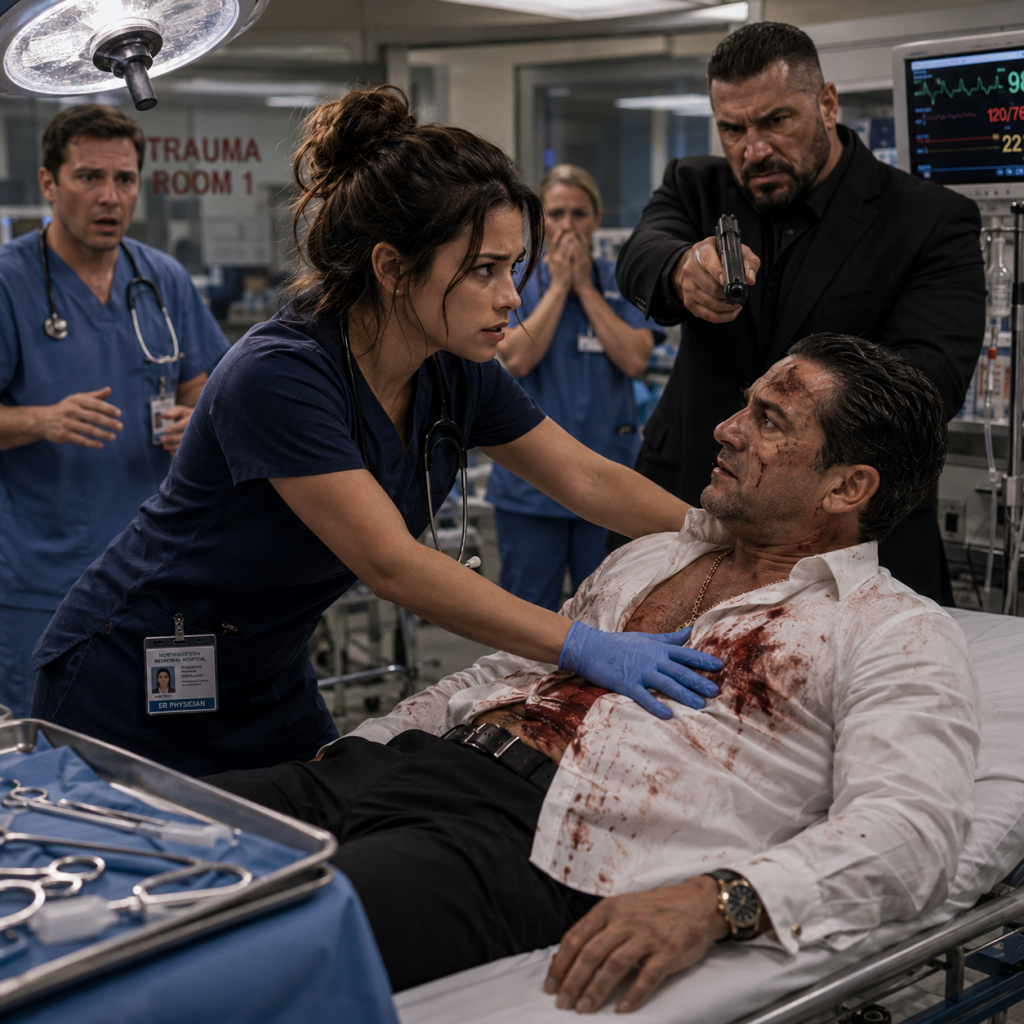
I turned my head just enough to address the bodyguard without taking my hands off my patient.
“Lower the weapon.”
Leo did not move.
His face was built from hard angles and old scars, his eyes narrow and unreadable. He was the sort of man who made a room feel smaller just by standing in it. But the tremor in his jaw gave him away.
He was not only protecting Domenico.
He was terrified of losing him.
Domenico shifted his gaze to him. “Leo.”
The pistol lowered slowly.
Not away. Not holstered. But no longer pointed at my head.
I accepted that as progress.
“Good,” I said. “Now everyone who doesn’t have a medical degree or a job in this room takes three steps back.”
No one moved.
I finally looked at Leo. “He is bleeding internally. If you crowd this bed, you slow us down. If you slow us down, he dies. Choose what matters.”
That landed.
Leo stepped back first. The others followed his lead, reluctant but obedient, like wolves backing from a fire.
The moment the space opened, the trauma team remembered how to move.
“Nurse Albright, two large-bore IVs. Type and cross for six units. Page vascular and general surgery. Peter, I need you present or out of the way.”
Peter blinked at me, as though I had slapped him awake.
“I’m present,” he said quickly.
“Then act like it.”
To his credit, he did.
The next minutes became a storm of practiced hands and clipped voices. Scissors cut through Domenico’s ruined shirt. Blood pressure cuff tightened around his arm. Someone pressed gauze over the wound near his collarbone. Another nurse prepared the rapid infuser. The room filled with the sterile smell of antiseptic and the copper scent of blood.
Domenico did not cry out. Not when we rolled him. Not when pressure was applied. Not when I palpated the rigid line of his abdomen and felt the sickening truth beneath my fingers.
The bullet was deep.
Too deep.
And his body was running out of time.
“His pressure is dropping,” someone said.
“I can see that.”
The numbers on the monitor slipped lower.
Eighty systolic.
Seventy-six.
Seventy-two.
His skin had gone pale beneath the olive tone, sweat gathering at his hairline. His jaw remained clenched, but his eyelids flickered for the first time.
I leaned closer.
“Domenico.”
His eyes moved to mine.
“You agreed to listen. I need you to keep that promise for the next ten seconds.”
His mouth tightened, but he gave the smallest nod.
“We’re taking you upstairs now. You need anesthesia. You need surgery. You need blood. If there is anything medically relevant you are not telling me, now is the time.”
Peter shot me a look as if I’d lost my mind.
Domenico’s gaze sharpened.
“Medically relevant?”
“Allergies. Medications. Blood disorders. Anything that will make us kill you while trying to save you.”
A ghost of something almost like amusement crossed his face.
Almost.
“Penicillin,” he rasped.
“Noted.”
“And…”
His breath hitched.
The monitor stuttered.
“And?” I pressed.
His eyes slid toward Leo, then back to me.
“No police.”
“That is not medically relevant.”
“It is tonight.”
The words were quiet, but something in them chilled the air more effectively than any threat could have.
Before I could answer, the trauma bay doors swung open again and Dr. Miriam Voss strode in, hair clipped tightly back, surgical cap in one hand, expression already set for war. She was the best trauma surgeon in the hospital and the only person I had ever seen make a room of attending physicians stand straighter without raising her voice.
She took in the blood, the armed men, Peter’s pallor, and me standing at the head of the bed.
“Tell me.”
“Male, late fifties,” I said, moving with the stretcher as we started toward the elevators. “Two gunshot wounds. One left clavicular region, likely fracture and vascular concern but bleeding controlled for now. One abdominal entry, no exit, worsening distention, hypotensive, responsive but declining. Penicillin allergy. Refused anesthesia initially, now consenting.”
Miriam glanced down at Domenico. “How generous of him.”
His eyes opened halfway. “Doctor.”
“Save your charm. You’re low on blood.”
Leo moved to follow into the elevator.
Miriam held up one hand.
“No.”
Leo’s face darkened. “I go where he goes.”
“And I go where sterile technique goes,” Miriam said. “You are not coming into my operating room with street clothes, rainwater, and whatever else is under that jacket.”
“Doctor—”
“Do you want him alive or do you want to win an argument?”
Leo’s eyes flashed. For a second, I thought the tension might snap again.
Then Domenico lifted two fingers from the blanket.
A command.
Leo stopped.
But as the elevator doors began to close, Domenico’s hand shot out and caught my sleeve.
His grip was weak, but determined.
“You,” he said.
I looked down. “What?”
“You stay.”
Miriam’s eyebrows rose.
Peter made a small sound of protest behind us. “Leora isn’t surgical staff.”
“No,” Domenico said, his voice barely above a breath. “Her.”
The elevator doors slid shut around us, sealing out the bodyguards, the rain, and the stunned faces of the emergency department.
For two seconds, the elevator was too quiet.
Then Miriam looked at me. “Congratulations. You’ve made an impression.”
“I didn’t ask to.”
“No one ever does.”
Domenico’s fingers loosened from my sleeve. His head turned slightly, eyes finding mine again.
“You’re not afraid.”
“That’s not true,” I said.
Something in his expression changed.
It may have been the blood loss, or the sterile brightness of the elevator, or the thin thread of honesty hanging between us, but for the first time he looked less like the myth Chicago whispered about and more like a man whose body had finally betrayed him.
“I am afraid,” I continued. “I’m just not letting it make the decisions.”
His eyelids lowered.
“A useful skill.”
The elevator doors opened.
The operating floor swallowed us in white light.
After that, time stopped being measured in minutes and began being measured in clamps, sutures, suction canisters, and blood bags.
I should not have been in that room.
Technically, Peter had been right. I was an emergency physician, not scrubbed surgical staff. But Miriam had known me for seven years, and she had never cared for technicalities when someone useful was already standing nearby.
“Scrub in,” she said.
So I did.
There was no room for fear once the operation began. Fear was clumsy. Fear wasted motion. In surgery, the world narrowed until it became hands and instruments, bleeding and pressure, questions and answers given before anyone had time to explain why they mattered.
Domenico had been lucky in the way only the unlucky can be. The abdominal bullet had missed the hepatic artery by less than an inch, but it had torn through enough tissue to flood his abdomen with blood. The clavicle wound had shattered bone but spared the major vessels. Barely.
Barely became the word of the night.
Barely stable.
Barely enough blood.
Barely time.
At one point, his pressure fell so sharply that the anesthesiologist’s voice went flat.
“We’re losing him.”
Miriam did not look up. “Not yet.”
I stood across from her, hands steady because they had to be, and for one irrational moment I thought of Domenico’s fingers on my sleeve.
You stay.
Why me?
The question kept returning every time the suction cleared and fresh blood rose. It returned when Miriam finally removed the bullet and dropped it with a soft metallic clink into a sterile tray. It returned when the room exhaled as the bleeding slowed. It returned when the monitor, stubborn and miraculous, began to climb back toward life.
At 5:42 in the morning, Dr. Miriam Voss tied off the last suture, stepped back, and said, “He has terrible manners, but he’ll live.”
No one cheered. Hospitals rarely allow celebration in full voice. But the relief moved through the room all the same, quiet as sunrise.
By the time we transferred Domenico to a private intensive care room under an alias that administration would later pretend was standard protocol, the sky outside had turned the pale gray-blue of a city trying to wake from bad dreams.
His men had taken over the hallway.
Not loudly. That would have drawn attention.
They stood in pairs near the elevators, beside the nurses’ station, at every corner that offered a line of sight. Their suits had dried, leaving dark watermarks at the hems. Their faces had not softened.
Leo was waiting outside the ICU doors.
The moment he saw me, he straightened.
“He alive?”
“Yes.”
His shoulders dropped by a fraction.
It was the only sign of emotion he allowed himself.
“He’ll be sedated for a while,” I said. “He needs rest, monitoring, and absolutely no visitors until cleared.”
Leo looked past me toward the closed door. “I’m not a visitor.”
“In this hospital, you are.”
His eyes returned to mine. “You always talk like that to men with guns?”
“Only when they point them at me before breakfast.”
For the first time, his expression shifted. Not a smile. Not quite. More like surprise had cracked the stone.
“I had orders.”
“I had a patient.”
We stood there in the fluorescent hush of the ICU corridor, neither of us willing to apologize first.
Finally, Leo looked down.
“My name is Leonardo Bellini,” he said. “People call me Leo.”
“I know what people call you.”
“Then you know I don’t make mistakes often.”
“You made one tonight.”
His jaw tightened, but he nodded once. “I did.”
The apology was not in the words. It was in the way he said them.
I accepted it with a small nod of my own, because in hospitals, forgiveness can be a form of efficiency. We had all survived the night. That would have to be enough.
I was washing blood from beneath my fingernails in the staff bathroom when my hands finally started shaking.
It always happened after.
Never during.
During, I was useful. After, I was human.
The water ran pink, then clear. I stared at my reflection in the mirror above the sink and barely recognized the woman looking back. My curls had escaped their tie. There was a faint smear of blood near my collarbone that I had missed. My eyes looked older than they had at the beginning of the shift.
Leora Sayegh, attending emergency physician, thirty-four years old, daughter of a retired school librarian and a father who had disappeared before I was old enough to form a clean memory of him.
That was what the personnel file said.
That was what I had always believed.
Mostly.
A knock came at the door.
“Leora?”
It was Peter.
I dried my hands and opened it.
He stood in the hallway with two cups of coffee, his face still pale but no longer ghostly.
“I brought peace offerings,” he said.
“Hospital coffee?”
“Peace is relative.”
I took one because my hands needed something warm to hold.
For a moment, neither of us spoke.
Then Peter said, “You could have been killed tonight.”
“Yes.”
“You say that like I told you the vending machine ate my dollar.”
“It did that too, last week.”
He did not laugh.
“Leora.”
I looked away first.
Peter and I had known each other since residency. He was careful where I was impulsive, polished where I was blunt, traditional where I had always found rules negotiable when a patient was dying. We had dated for seven months three years earlier, then parted with the quiet sadness of two people who respected each other too much to keep pretending love could survive on almost.
Since then, he had been my colleague, my friend, and occasionally the person most determined to remind me I was not invincible.
“I wasn’t trying to be brave,” I said.
“I know. That’s what worries me.”
The comment landed more softly than I expected.
Before I could answer, my phone buzzed in my pocket.
Unknown number.
I stared at it.
Peter saw my expression. “Don’t answer.”
Of course, I answered.
For a moment, there was only breathing on the other end.
Then a woman’s voice said, “Dr. Sayegh?”
I froze.
The voice was low and controlled, older than mine, brushed with an accent I couldn’t place immediately. Italian, perhaps, but softened by years elsewhere.
“Who is this?”
“You saved him.”
My grip tightened around the phone. Peter mouthed, Who?
I shook my head.
“How did you get this number?” I asked.
“That matters less than what I am about to tell you.”
“No, it matters quite a lot.”
A pause.
Then, quietly: “The man who shot Domenico Lucchese did not miss by accident.”
My pulse changed.
The hallway seemed to tilt toward silence.
“What does that mean?”
“It means the first bullet was to make him fall. The second was to make sure he was taken to Northwestern.”
My skin went cold.
I looked down the hallway toward the ICU, where Leo stood outside Domenico’s door with his arms folded and his eyes on everything.
“Why would anyone care which hospital he came to?”
Another pause.
When the woman spoke again, her voice had dropped even lower.
“Because you were there.”
The line went dead.
I kept the phone at my ear long after the call ended.
Peter’s voice sounded distant. “Leora?”
I lowered the phone.
The screen showed no number. No call record. Nothing.
For a rational woman, I had spent much of my life tolerating one irrational wound.
My father.
When I was a child, my mother told me he was gone. Not dead. Not alive. Gone. It was a word with no shape, a word that could mean anything and therefore haunted everything. When I asked questions, she answered the way adults answer when they are frightened of their own memories.
He loved you.
He couldn’t stay.
It wasn’t your fault.
By the time I was twelve, I had stopped asking.
By sixteen, I had decided not knowing was easier than wanting to know.
By thirty-four, I had become very good at treating other people’s emergencies and very bad at opening sealed rooms inside myself.
But the woman on the phone had found one.
Because you were there.
“Leora,” Peter said again.
“I need to check on the patient.”
“That’s not an answer.”
“It’s the only one I have.”
I left him standing with two coffees in the hall.
Domenico was still sedated when I entered the ICU room. The machines beside him breathed and counted and pulsed. Without his tailored suit, his sharp commands, his circle of obedient men, he looked almost ordinary.
Almost.
Power leaves traces even when the body is unconscious. It lived in the tension around his mouth. The old scars along his knuckles. The way nurses lowered their voices when they passed his door.
I stood beside the bed and studied him with a strange, unwanted attention.
Why would someone shoot him to reach me?
There was no possible answer that made sense.
I had no connection to Domenico Lucchese.
I treated gunshot wounds, heart attacks, allergic reactions, fevers, broken wrists, panic attacks, and the occasional tourist who underestimated Chicago ice. I paid my bills. I forgot to water my plants. I sent my mother articles about blood pressure that she ignored. I had not crossed paths with a crime family.
Not knowingly.
Domenico’s hand moved.
At first, I thought it was a reflex.
Then his fingers curled weakly around the edge of the blanket.
His eyes opened.
The sedation should have kept him deeper under, but men like him probably learned early to claw their way back from darkness.
“Don’t try to speak,” I said.
He tried anyway.
No sound came.
I reached for a cup with a straw and dampened his lips. “Slowly. You just came out of major surgery.”
His eyes found mine.
This close, they were not black. They were a deep brown, almost warm in the morning light, though nothing about his expression invited comfort.
He breathed once, twice.
“Leo?”
“Outside.”
His gaze flickered toward the door. “Good.”
“Someone called me.”
That got his attention.
The monitor ticked faster.
I watched his face carefully. “A woman. She said the shooting was meant to bring you here. To me.”
No drug in his system could disguise the reaction.
It passed in less than a second, but I saw it.
He knew.
“You want to tell me why?” I asked.
His eyes closed.
For a moment, I thought he had drifted off.
Then he whispered, “No.”
It was such an absurd answer that I almost laughed.
“No?”
“Not here.”
“I had a gun pointed at my head because of you. I think here is fine.”
His eyelids lifted. “No. It is not.”
There was none of the arrogance from earlier. The refusal sounded different now. He was not protecting his pride.
He was protecting something else.
Or someone.
I folded my arms. “Does this have anything to do with my father?”
The monitor changed again.
That was all the answer I needed.
My breath caught so sharply it hurt.
For years, I had imagined this moment in childish ways. A letter. A photograph. A stranger at the door. My mother finally sitting me down with shaking hands and a truth she could no longer hold.
I had never imagined asking a half-sedated mafia boss in an ICU whether he knew the man who had vanished from my life.
Domenico stared at me.
“Who told you?” he asked.
“No one.”
His gaze sharpened.
“You guessed.”
“I observed.”
A fragile silence settled over us.
Outside the room, someone murmured near the nurses’ station. A cart rolled by. Somewhere down the hall, a patient laughed at something a nurse said. Life continued with insulting normality.
“What was his name?” Domenico asked.
The question struck me harder than an answer would have.
“You tell me.”
His face changed.
Not much. Just enough.
Regret, I realized.
Domenico Lucchese, feared by half the city, was looking at me with regret.
Before he could speak, the door opened.
Leo stepped inside, followed by Miriam Voss.
Miriam took one look at Domenico’s open eyes and scowled. “Absolutely not.”
Domenico shifted his gaze to her.
“You are supposed to be unconscious,” she said.
“I’ve disappointed many people.”
“Not as many as you will if you tear my sutures.”
Leo’s eyes moved between us. “Everything all right?”
“No,” Miriam and I said at the same time.
Domenico’s mouth twitched.
Miriam checked his vitals, adjusted his medication, and gave him instructions he did not enjoy receiving. No visitors. No business. No arguments. No leaving against medical advice unless he wanted to meet her again under less pleasant circumstances.
He listened with the expression of a man permitting thunder to pass.
When she was done, she looked at me. “You need sleep.”
“I’m fine.”
“You look like a haunted broomstick.”
“Thank you.”
“That wasn’t a compliment.”
She left before I could respond, and Leo lingered near the door.
Domenico looked at him. “Out.”
Leo stiffened. “Dom—”
“Out.”
For the first time, I saw the cost of obedience on Leo’s face. He did not like leaving him alone with me. But after a moment, he nodded and stepped back into the hall.
The door closed.
Domenico turned his head toward me slowly.
“Your father,” he said, “was named Elias Haddad.”
The room seemed to drop beneath me.
Not because I recognized the name.
Because I didn’t.
“My father’s name was Samir Sayegh,” I said. “That’s what my mother told me.”
Domenico closed his eyes briefly.
“Your mother lied to keep you alive.”
The words were soft.
They still struck like a blow.
I gripped the rail of the bed. “Be very careful with what you say next.”
“I knew Elias,” he said. “He was not family, not by blood. But he was closer than most men who shared my name.”
“My father was involved with you?”
“No.”
That answer came quickly.
Too quickly.
“He worked for people who collected secrets,” Domenico continued. “Accountants, lawyers, judges, businessmen. Men who believed they were too respectable to be criminals and too clever to be caught. Elias built records no one was meant to see.”
A memory rose, unwanted and faint.
My mother at the kitchen table when I was six, burning papers in a metal pot while snow tapped softly against the windows.
I had thought she was making a game of it.
I had asked if we were camping.
She had cried when she thought I wasn’t looking.
Domenico watched me as if he could see the memory crossing my face.
“What happened to him?” I asked.
His fingers flexed against the blanket.
“He disappeared.”
“I know that part.”
“No,” Domenico said. “You know the child’s version. He did not leave because he wanted to. He vanished the night he tried to hand me something that would have broken half the city open.”
My heart beat once, hard.
“What something?”
“A ledger.”
The word seemed too small for the weight he gave it.
“Names,” he said. “Payments. Judges. Police. Contractors. Charities that were not charities. Businesses that were only doors. Everyone owned a piece of someone else. Elias had proof.”
“And he gave it to you?”
“He tried.”
“But?”
Domenico’s gaze moved toward the window. Morning had come fully now, pale light spreading over the city, turning the glass towers silver.
“But we were betrayed.”
The machines breathed in measured rhythm.
I waited.
He did not continue.
“By whom?”
His mouth tightened. “That is what I have been trying to learn for twenty-eight years.”
Twenty-eight.
The number fit too neatly.
I was six when my father disappeared.
The floor felt unsteady.
I reached for the chair beside the bed and sat before my knees could embarrass me.
“My mother knew?”
“She knew enough to run.”
“From you?”
Pain crossed his face, there and gone.
“From everyone.”
I thought of my mother’s careful life. Her locked filing cabinet. Her refusal to let me sleep over at friends’ houses until she had met every adult in the home twice. The way she watched unfamiliar cars from behind the curtains. The way she kept a packed envelope of cash in the freezer beneath a bag of peas.
I had spent years calling it anxiety.
Maybe it had been vigilance.
“Why didn’t you find us?” I asked.
“I did.”
My head snapped up.
Domenico’s voice was thin but steady. “Once. When you were nine. Your mother begged me to stay away.”
I couldn’t speak.
“She said every man who came looking for Elias brought danger behind him. She was right.”
Anger rose because it was easier than grief.
“So you watched from a distance?”
“For a while.”
“How comforting.”
His eyes returned to mine. “You lived.”
The anger faltered.
It should not have. I wanted it to stay. I wanted the clean fire of blame because it gave me somewhere to put my hands, my voice, my shaking breath.
But nothing about this was clean.
“Why now?” I asked.
“Because someone else found you.”
The phone call.
The shooting.
The woman’s voice.
I stood abruptly and walked to the window. The city below looked ordinary. Cars moved through wet streets. People carried umbrellas. Somewhere, someone was buying a bagel, answering email, hailing a cab, unaware that my life had split open in a room eleven floors above them.
“Who called me?” I asked.
Domenico said nothing.
I turned.
“Who was she?”
His eyes had closed again, whether from exhaustion or refusal, I could not tell.
“Domenico.”
No answer.
For one alarming second, I thought he had lost consciousness. I checked the monitor, then his pupils, then his pulse. Stable, though exhausted.
I should have been relieved.
Instead, I felt locked out of my own life.
Outside the room, Leo stood when I emerged.
“What did he tell you?” he asked.
I looked at him, really looked this time.
He was perhaps a few years younger than Domenico, broad-shouldered, watchful, his dark hair touched with gray at the temples. There was a scar near his left eyebrow, pale and old. His hands hung loose at his sides, but he missed nothing.
“You already know,” I said.
His silence confirmed it.
“How long?”
He looked away.
“How long have you known who I am?” I demanded.
Leo’s gaze returned to mine. “Since you were a child.”
The hallway seemed to narrow.
A nurse glanced over from the station. I lowered my voice.
“You pointed a gun at me.”
His face tightened. “I did not know it was you.”
That stopped me.
“What?”
“When we came in, you were a doctor in scrubs. Blood. Hair tied back. Years change people.” His throat moved. “I did not recognize you until you stood up to him.”
A strange, humorless laugh escaped me. “That was the clue?”
“Your mother had the same eyes when she told Domenico never to come near you again.”
My mother.
The world tilted again.
I leaned against the wall.
Leo took half a step forward, then stopped himself. “Dr. Sayegh—”
“Don’t.”
He nodded and stepped back.
I needed air. Not hospital air, recycled and antiseptic. Real air. Cold air. Something that had not passed through vents and filters and hallways full of secrets.
But I was still on duty.
That was the cruelty of hospitals. Lives could collapse, and there would still be charts to sign.
For the next two hours, I worked like a machine with a crack down the center. I discharged a teenager with a sprained ankle. I reassured a frightened grandmother whose chest pain turned out to be reflux. I stitched a construction worker’s palm while he told me about his daughter’s college applications. Normal emergencies. Manageable emergencies. The kind that ended with instructions printed in twelve-point font.
All the while, my phone sat heavy in my pocket.
At 8:15, I called my mother.
She answered on the third ring, voice warm and sleepy.
“Leora? You finished?”
I closed my eyes.
For a moment, I let myself be six years old again, curled under a yellow blanket while she hummed in the kitchen. Before fear had a name. Before absence became a family member.
“Mom,” I said. “Who was Elias Haddad?”
Silence.
Not confusion.
Not surprise.
Silence like a door closing.
When she finally spoke, her voice was no longer sleepy.
“Where did you hear that name?”
My chest tightened. “So he was real.”
“Leora.”
“Was he my father?”
Another silence.
This one broke something.
“I wanted to tell you,” she whispered.
I pressed a hand to my mouth and turned away from the nurses’ station.
All those years. All those careful half-answers. All those birthdays where I pretended not to wonder whether a man somewhere remembered the date.
“You told me his name was Samir.”
“It was safer.”
“For who?”
“For you.”
The same answer Domenico had given.
I hated how much I wanted to believe it.
“Are you at home?” I asked.
“Yes.”
“Lock the doors.”
“They are locked.”
“Mom.”
“They are always locked.”
That small sentence undid me more than any confession could have.
I heard movement on her end. A drawer opening. Something metallic clicking.
“Listen to me carefully,” she said. “Do not trust Domenico completely.”
“I don’t trust anyone completely right now.”
“Good.”
I almost smiled despite everything. Almost.
“A woman called me,” I said. “She knew about the shooting. She said it happened because I was here.”
My mother inhaled sharply.
“You need to leave the hospital.”
“I have patients.”
“You are my daughter first.”
“And I’m a doctor second. I’m not abandoning—”
“Leora, please.”
I had never heard that tone from her.
Not when I broke my arm at ten. Not when I almost failed organic chemistry. Not when a drunk patient threw a tray at me during residency. My mother was gentle, but never fragile.
Now she sounded afraid in a way that reached across the years and put me back in that kitchen, watching papers burn.
“Who was the woman?” I asked.
My mother did not answer.
“Mom.”
“I hoped she was dead,” she said.
Cold moved through me.
“Who?”
Before she could respond, a sound came through the phone.
Not from my end.
From hers.
A knock.
Three slow taps.
My mother stopped breathing.
“Mom?”
Another three taps.
Then a woman’s voice, faint through the line, said, “Nadia. It has been a long time.”
The call cut off.
For one second, I could not move.
Then everything in me became motion.
I grabbed my coat from the staff room, ignored Peter calling my name from the desk, and headed for the ambulance bay doors at a run.
Leo stepped into my path before I reached them.
“Where are you going?”
“Move.”
“No.”
I didn’t have time to be afraid of him. “My mother is in danger.”
His expression changed instantly.
“How do you know?”
“Because the woman who called me is at her door.”
Leo pulled out his phone. “Address.”
I hesitated.
His eyes hardened. “Dr. Sayegh, if they found her, they already have it.”
He was right.
I gave it to him.
He spoke rapidly in Italian to someone on the other end, then ended the call and looked at me. “My men are closer than police.”
“I’m calling police too.”
“Good.”
That surprised me enough to look at him.
He read the question on my face. “You wanted believable, not stupid.”
Under other circumstances, I might have laughed.
I called 911 with hands that did not feel like mine. I gave the dispatcher my mother’s address, reported a possible intruder, and gave enough details to make the call urgent without sounding like I was reciting a crime novel.
Then I tried to leave again.
Leo blocked me.
“You cannot go there alone.”
“I’m not asking permission.”
“Domenico will have my head if I let you walk into this blind.”
“Domenico is sedated.”
“Not enough.”
I stepped closer. “My mother is seventy-one years old, five foot three, and probably holding a letter opener like it’s a sword. I am going.”
Something moved in his face at that. A memory, perhaps.
Then he nodded once. “With me.”
I should have refused.
I didn’t.
We took the service elevator down to the private exit used for patient transfers and staff who smoked where they weren’t supposed to. A black SUV idled at the curb, engine running, windshield stippled with rain. The city smelled of wet pavement and diesel.
As we pulled away from Northwestern, my phone buzzed.
A text from an unknown number.
No words.
Only a photograph.
My mother’s kitchen table.
On it lay a worn leather notebook, dark with age, its strap cracked but intact. Beside it sat a Polaroid I had never seen before.
A young woman who was unmistakably my mother stood in front of Lake Michigan, hair whipping across her face, smiling like she had not yet learned what fear could take from her.
Beside her stood a man with kind eyes and one hand raised against the sun.
In his other arm, he held a baby.
Me.
On the back of the Polaroid, written in faded ink, were four words.
For Leora, when necessary.
I stared at the image until it blurred.
Leo glanced over. “What is it?”
I turned the phone toward him.
The color drained from his face.
“That notebook,” he said quietly.
“You recognize it?”
He did not answer.
The SUV moved fast through the waking city, past storefronts and bus stops and people with coffee cups who had no idea that my entire past was sitting on my mother’s kitchen table.
“Leo.”
His hands tightened on the steering wheel.
“That is not the ledger Elias tried to give Domenico,” he said.
“Then what is it?”
He looked at me once, and whatever he saw in my face made him tell the truth.
“It is the one he kept for himself.”
My phone buzzed again.
Another message.
This time, a single sentence appeared beneath the photograph.
Ask Domenico why your father died using his name.
I read it once.
Then again.
The words did not change.
My father had died?
Using Domenico’s name?
Before I could ask Leo what it meant, another message arrived.
It was a live photo.
My mother’s front door stood open.
And in the shadowed hallway beyond it, a woman’s hand rested gently on the frame, wearing a gold ring shaped like a serpent biting its own tail.
Leo whispered something under his breath.
Not a curse.
A name.
“Serafina.”
END OF PART 2 – LIKE, SHARE AND COMMENT “THE ENTIRE STORY” IF YOU WANT TO READ THE FULL STORY