Olivia woke to the sound of Parker screaming.
Not crying.
Screaming.
That thin, newborn sound cut through the dark nursery like a knife, dragging her back from a place that felt far away and cold. For one terrifying second, she did not know where she was. The ceiling above her blurred in and out. The carpet beneath her cheek felt stiff and damp. Her body was heavy, as if someone had poured stone into her bones.
Then she remembered.
Tyler leaving.
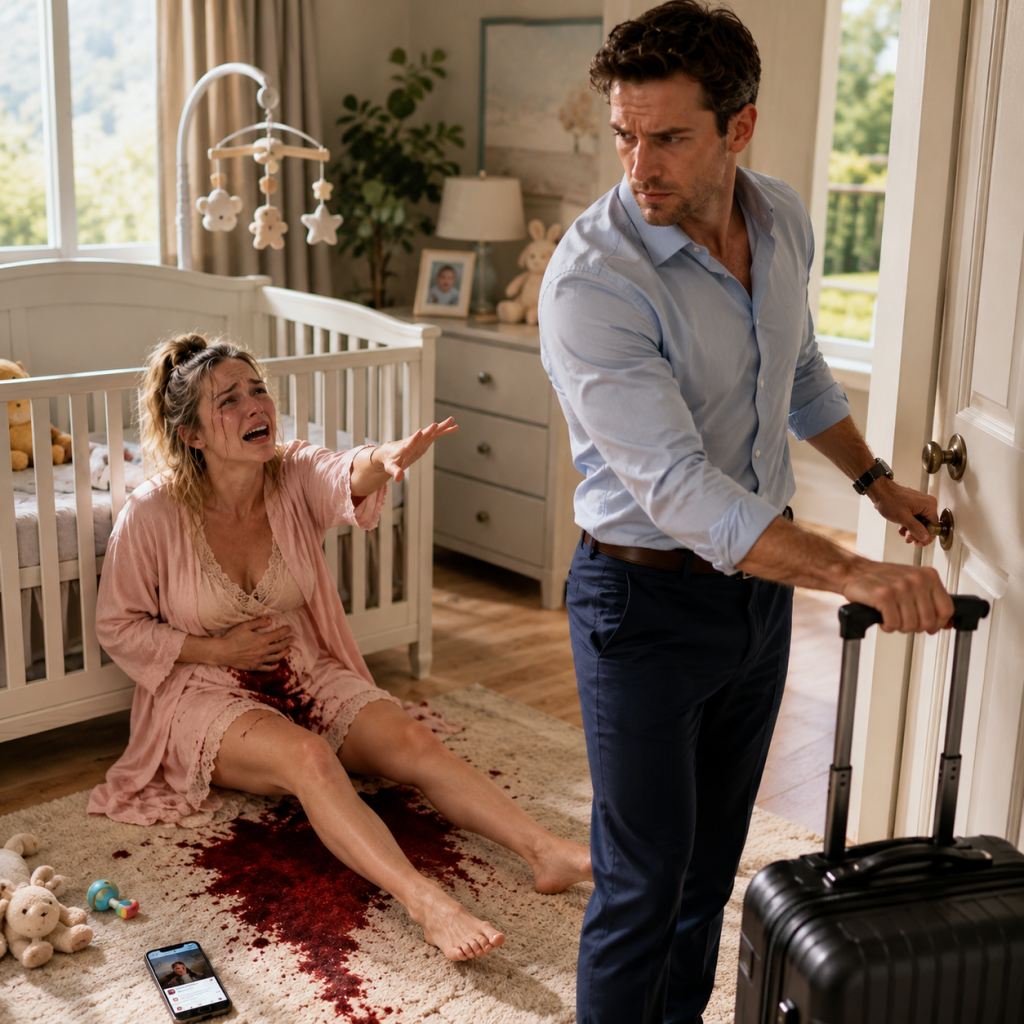
The blood.
The phone glowing on the floor.
Parker alone in his bassinet.
“Baby,” she whispered, but the word barely left her mouth.
Her hand twitched against the carpet. Pain flashed through her abdomen, sharp enough to steal what little breath she had. She tried to push herself up, but her arms trembled and collapsed beneath her. The room spun. The soft blue walls Tyler’s mother had chosen seemed to bend inward, like the nursery itself was closing around her.
Parker’s cries grew hoarser.
Olivia turned her head inch by inch. Her phone lay less than two feet away. The screen had gone black. Two feet might as well have been two miles.
She dragged her fingers forward.
The carpet scratched her skin. Her nails caught in the fibers. Her body screamed at her to stop, but Parker’s cries gave her something stronger than strength.
One inch.
Then another.
Her fingertips touched the phone.
She pulled it closer with a sob that sounded almost animal.
The screen lit up when she tapped it.
Twenty percent battery.
Tyler’s story was still open.
“On the way to Blue Ridge. Meat, whiskey, friends, and zero drama.”
Olivia stared at those words while blood cooled beneath her.
Zero drama.
Her thumb shook so badly she opened the wrong app twice. At last, she hit emergency call. The ringing seemed to last forever.
“Nine-one-one, what is your emergency?”
Olivia tried to answer, but only a broken breath came out.
“Ma’am? Can you hear me?”
“My baby,” Olivia whispered. “I’m eight days postpartum. I’m bleeding. I can’t move.”
The dispatcher’s voice sharpened. “Are you alone?”
“Yes.”
“Is your baby breathing?”
“He’s crying.”
“That’s good. Stay with me. What’s your address?”
Olivia gave it in pieces, stopping between words as pain rolled through her body. The dispatcher kept talking, steady and calm, as if her voice were the only rope between Olivia and the dark.
“Help is coming. Do not try to stand. Keep pressure where you can. Keep talking to me.”
“My husband left,” Olivia whispered.
There was a pause.
Then the dispatcher said gently, “We’re going to take care of you and your baby.”
That was the last thing Olivia heard before the nursery door exploded open.
For one wild second, she thought Tyler had come back.
But it was not Tyler.
It was Mrs. Langley from next door, still wearing gardening gloves, her gray hair pinned badly under a sunhat. Behind her stood a teenage boy Olivia barely recognized from the neighborhood, holding a metal baseball bat like he had come ready to fight.
“Oh my God,” Mrs. Langley gasped.
Parker screamed from the bassinet.
Olivia tried to lift her head. “Please,” she breathed. “My baby.”
Mrs. Langley moved faster than Olivia would have believed possible. She crossed the room, scooped Parker into her arms, and pressed him against her chest.
“He’s here, honey. He’s safe. He’s safe.”
The teenage boy stood frozen in the doorway, his face white.
“Call them again,” Mrs. Langley snapped at him. “Tell them she’s losing a lot of blood.”
“They’re already coming,” Olivia whispered.
Mrs. Langley dropped to her knees beside her. Her eyes moved over the carpet, the robe, the stain spreading beneath Olivia’s body. Something in her face changed. Horror became fury.
“Where is your husband?”
Olivia’s lips trembled.
“Birthday trip.”
Mrs. Langley went completely still.
Then, very softly, she said, “Of course he is.”
The ambulance arrived seven minutes later.
Olivia remembered pieces of it afterward: red lights flashing across the nursery walls, boots pounding through the hallway, a paramedic asking her name again and again, someone wrapping Parker in a blanket, Mrs. Langley saying, “I’m coming with the baby,” as if anyone had the power to stop her.
She remembered one paramedic asking, “How long has she been down?”
Mrs. Langley answered, “Long enough for her husband to leave town.”
Then everything dissolved into sirens.
At the hospital, the world became white lights and urgent voices.
Postpartum hemorrhage.
Possible retained tissue.
Severe blood loss.
Blood pressure dropping.
Olivia heard the words as if they belonged to someone else. She tried asking for Parker, but an oxygen mask covered her face. A nurse squeezed her hand and told her he was safe. Another nurse asked for Tyler’s number.
Olivia turned her head away.
Still, they called him.
Once.
Twice.
Three times.
His phone went straight to voicemail.
Airplane mode.
The fourth call came from a number Tyler did not recognize.
He answered that one.
Olivia found out later what he said.
The nurse introduced herself and told him his wife had been admitted in critical condition after a postpartum emergency.
Tyler’s first response was not, “Is she alive?”
It was not, “Where is my son?”
It was: “Can this wait until morning?”
The nurse documented it.
Every word.
By the time Tyler reached the Blue Ridge cabin, Olivia was in surgery.
By the time he opened his first bottle of whiskey, doctors were fighting to save her uterus and her life.
By the time his friends sang happy birthday beside the jacuzzi, Olivia’s mother was on a plane from Oregon, sobbing so hard the flight attendant moved her to an empty row.
And by the time Tyler posted his second story—sunburned, laughing, arm around a friend, captioned “Best birthday reset ever”—a hospital social worker had already written the first line of the report that would destroy him.
Olivia woke the next morning to the sound of a monitor beeping.
Her throat felt raw. Her body felt hollowed out. She blinked against the fluorescent light until a face appeared above her.
Her mother.
Evelyn Hart looked as if ten years had been ripped from her sleep. Her silver-streaked hair was loose around her shoulders, her eyes red, her hands trembling as they cupped Olivia’s face.
“My baby,” Evelyn whispered. “Oh, my baby.”
Olivia tried to speak.
“Parker?” she rasped.
“He’s safe. He’s perfect. He’s with the nurses. Mrs. Langley stayed until I got here.”
Olivia closed her eyes. One tear slid into her hair.
“Tyler?”
Her mother’s expression hardened.
“He is still in the mountains.”
The room went quiet except for the machine beside the bed.
Olivia stared at her mother.
“He knows?”
Evelyn’s mouth tightened.
“He knows.”
Something inside Olivia broke then, but it did not break loudly. It did not shatter. It simply went cold.
For years, Tyler had trained her to excuse him.
He was tired.
He was stressed.
His mother interfered too much.
He did not mean it that way.
He loved her, just badly.
But there was no soft version of leaving your bleeding wife on the nursery floor.
No misunderstanding.
No stress.
No apology large enough to cover the shape of his absence.
Evelyn sat beside the bed and took Olivia’s hand.
“Listen to me carefully,” she said. “The doctor said you are lucky to be alive. The social worker is involved. The police may want to speak with you. You do not have to protect him.”
Olivia looked toward the window. Morning light spilled over the hospital floor, pale and clean, so different from the red stain in the nursery.
“I don’t think I can protect him anymore,” she whispered.
Her mother’s face crumpled, but only for a second.
Then Evelyn nodded.
“Good.”
Tyler came home Sunday evening.
Sunburned.
Hungover.
Carrying a duffel bag and wearing the same expensive watch from his story.
He expected silence, maybe a fight, maybe Olivia crying in bed and accusing him of being selfish. He had prepared for that. He had spent the drive rehearsing irritation, not remorse.
But the house was not silent.
It was locked.
His key did not work.
At first, he laughed in disbelief. Then he tried again, harder. The deadbolt held firm.
“What the hell?” he muttered.
He rang the doorbell.
No answer.
He knocked.
Then pounded.
Finally, the porch light flicked on.
Not from inside the house.
From across the street.
Mrs. Langley stood on her porch with her arms crossed.
Tyler turned. “Do you know where my wife is?”
Mrs. Langley looked at him the way one looks at something spoiled in the fridge.
“At the hospital. Where you should have taken her.”
His face twitched.
“She’s still there?”
“She almost died.”
Tyler looked away, jaw tight.
“She always makes things bigger than they are.”
Mrs. Langley stepped down from her porch.
“Say that again.”
Something in her tone made him stop.
At that moment, a police cruiser turned onto the street.
Then another.
Tyler’s anger shifted into confusion.
Two officers stepped out.
“Tyler Bennett?”
He straightened. “Yeah?”
“We need to speak with you about an incident involving your wife and newborn child.”
His face went pale.
“Incident? I wasn’t even here.”
Mrs. Langley’s laugh was quiet and merciless.
“That’s the point.”
Tyler was not arrested that night.
Not yet.
But he was questioned. He was told not to contact Olivia directly. He was informed that a temporary protective order was being requested. He was told Child Protective Services had opened an inquiry—not against Olivia, but regarding the circumstances under which Parker had been left without an able caregiver while his mother was medically incapacitated.
That was when Tyler finally started calling.
Fifteen missed calls.
Then twenty-three.
Then texts.
Liv, answer me.
You’re making this look bad.
My mom says you can’t keep Parker from me.
I didn’t know it was serious.
Why didn’t you call sooner?
You’re really going to ruin my life over one mistake?
Olivia read every message from her hospital bed.
She did not answer one.
On Monday morning, Tyler’s mother arrived.
Diane Bennett entered the hospital room with pearls at her throat and outrage in her eyes, as if the entire building had personally insulted her. She carried a designer handbag in one hand and a vase of white lilies in the other.
Olivia hated lilies.
Diane knew that.
“Well,” Diane said, setting the flowers down without asking, “this has gotten completely out of control.”
Evelyn rose from the chair beside Olivia’s bed.
Diane glanced at her. “And you are?”
“Her mother.”
“Wonderful. Then maybe you can talk sense into her.”
Olivia’s fingers tightened around the blanket.
Diane turned toward the bed, her voice smooth and sharp.
“Tyler is devastated.”
Olivia stared at her.
Diane continued, “He made a mistake. Men panic around blood. That doesn’t make him a criminal. You need to stop this before it damages his career.”
Evelyn took one step forward.
“His career?”
Diane ignored her.
“You have a newborn. You need stability. Do you really want your son growing up with his father dragged through court because you got emotional after childbirth?”
The old Olivia would have cried.
The old Olivia would have explained.
The old Olivia would have tried to make Diane understand.
But something had changed on the nursery floor.
Olivia reached slowly for the nurse call button.
Diane frowned. “What are you doing?”
Olivia pressed it.
A nurse entered within seconds.
Olivia did not raise her voice.
“I don’t want this woman in my room.”
Diane’s mouth fell open.
The nurse turned to Diane with professional calm.
“Ma’am, you’ll need to leave.”
“I am the baby’s grandmother.”
“You are not the patient’s approved visitor.”
Diane’s face flushed. “This is ridiculous. Olivia, tell her.”
Olivia looked at her mother-in-law for a long moment.
Then she said, “Goodbye, Diane.”
That was the first time Olivia understood power did not always feel like shouting.
Sometimes it sounded like a door closing.
The petition was filed the next day.
Emergency custody.
Protective order.
Medical neglect documentation.
Police report.
Hospital records.
Dispatcher audio.
Neighbor statement.
Screenshots of Tyler’s posts.
Screenshots of his messages.
And the nurse’s note from the phone call where Tyler had asked if his wife’s critical condition could wait until morning.
Tyler hired an attorney immediately.
Diane hired a better one.
Their strategy was simple: Olivia was unstable, postpartum, emotional, possibly exaggerating. Tyler had not understood the seriousness of the bleeding. He had believed she was recovering normally. He had gone on a pre-planned birthday trip and returned as soon as he knew the truth.
It might have worked if not for the carpet.
Evelyn had refused to let anyone clean the nursery.
The police photographed it.
So did the investigator.
The stain was not a metaphor.
It was evidence.
Dark.
Wide.
Undeniable.
The hearing was set for Friday.
Five days after Tyler returned sunburned.
Nine days after he left Olivia on the floor.
Olivia was discharged from the hospital the morning of court. Against her doctor’s preference, but with clearance if she used a wheelchair and went straight home afterward. Evelyn dressed her carefully in a soft navy dress that hid the medical bandages and made her look less fragile than she felt.
Parker wore a white onesie and slept against Evelyn’s chest.
When they arrived at the courthouse, Tyler was already there.
So was Diane.
Tyler looked polished in a gray suit, his hair styled, his face arranged into wounded concern. He stood when Olivia entered, as if performing husbandly devotion for the hallway.
“Liv,” he said softly.
Her attorney stepped in front of her wheelchair.
“Do not speak to my client.”
Tyler’s mask slipped.
Only for a second.
But Olivia saw it.
The same flash of anger from the nursery doorway.
Inside the courtroom, Tyler’s attorney spoke first.
He painted Tyler as overwhelmed but loving. A new father confused by postpartum recovery. A man who made a poor judgment call but never intended harm.
Then Olivia’s attorney played the 911 call.
The courtroom listened to Olivia whispering her address.
Listened to Parker screaming in the background.
Listened to the dispatcher saying, “Stay with me.”
Tyler stared at the table.
Diane dabbed her eyes, but no tears came.
Then came the hospital records.
Then Mrs. Langley.
The neighbor walked to the stand in a plain blue cardigan, raised her right hand, and told the truth.
She described hearing the baby cry for too long.
Described finding the front door unlocked.
Described Olivia on the floor, pale and barely conscious.
Described Parker alone in the bassinet.
Then Tyler’s attorney stood.
“Mrs. Langley, isn’t it true you have never liked Mr. Bennett?”
She looked at him calmly.
“I didn’t know him well enough to dislike him before that day.”
A few people in the courtroom shifted.
The attorney tried again. “You are not a medical professional.”
“No.”
“So you cannot say whether Mrs. Bennett’s condition appeared life-threatening.”
Mrs. Langley leaned toward the microphone.
“I can say there was enough blood on that carpet that no decent husband would have stepped over it to go drink whiskey in a cabin.”
Silence fell.
Even the judge looked down for a moment.
Then came the phone records.
Tyler’s phone had indeed been placed on airplane mode shortly after he left the house. It remained unreachable for hours. But his social media activity continued whenever he connected to Wi-Fi at the cabin.
Photos.
Videos.
Comments.
Laughing emojis.
Zero drama.
Tyler’s attorney objected to the relevance.
The judge allowed it.
By the time the nurse testified about the call, Tyler’s confident expression was gone.
“He asked,” the nurse said carefully, reading from her own note, “whether it could wait until morning.”
Tyler shook his head. “That’s not what I meant.”
The judge looked at him over her glasses.
“You will have your turn.”
When he finally took the stand, Tyler tried to cry.
He said he loved Olivia.
He said he loved Parker.
He said he had been under pressure.
He said Olivia had complained often after the birth, and he did not know which complaints were serious.
He said his mother told him postpartum bleeding was normal.
He said he was sorry.
Olivia listened without moving.
Then her attorney stood.
“Mr. Bennett, when your wife said she might not make it until tomorrow, what did you do?”
Tyler swallowed.
“I thought she was being dramatic.”
“You saw blood on the carpet?”
“I saw some.”
“Some?”
He said nothing.
Her attorney placed the enlarged photo of the nursery carpet on the screen.
Several people gasped.
Tyler looked away.
“Did you call a doctor?”
“No.”
“Did you call an ambulance?”
“No.”
“Did you call a neighbor?”
“No.”
“Did you take your newborn son with you?”
“No.”
“Did you ensure another adult was present before leaving your wife unable to stand?”
Tyler’s mouth opened.
Closed.
“No.”
The attorney paused.
Then asked, “What did you do?”
Tyler’s voice dropped.
“I left.”
Those two words hung in the room longer than any accusation could have.
The judge ruled before lunch.
Temporary sole physical custody to Olivia.
Supervised visitation only, pending further investigation.
No direct contact except through attorneys or approved parenting communication.
Tyler was ordered to leave the marital home until further notice.
Diane made a sound of outrage.
The judge looked straight at her.
“Another interruption and you will be removed.”
Diane sat down.
Olivia closed her eyes.
For the first time in days, she breathed without feeling like the room was stealing air from her.
But the surprise came when everyone stood to leave.
A court clerk approached Olivia’s attorney with a sealed envelope.
The attorney frowned, opened it, and read quickly.
Then her face changed.
“Olivia,” she said softly, “you need to see this.”
Across the room, Tyler noticed.
So did Diane.
Olivia took the paper with trembling fingers.
It was not from the court.
It was from a private investigator Evelyn had hired the night Olivia was admitted to the hospital.
At the top was a photo.
Tyler at the Blue Ridge cabin.
Not with friends.
With a woman.
Young.
Blonde.
Wearing Olivia’s missing emerald necklace.
Olivia stared at the image until the edges blurred.
Then she read the name beneath it.
Megan Vale.
Diane’s assistant.
The woman who had helped plan Tyler’s “birthday weekend.”
The woman standing beside Tyler in the photo was visibly pregnant.
And according to the note clipped behind it, she had just filed paperwork naming Tyler Bennett as the father of her unborn child.
Olivia looked up.
Tyler was watching her from across the courtroom.
For once, he looked truly afraid.
Not because he had almost lost his wife.
Not because he had endangered his son.
But because Olivia now knew the birthday trip had never been about peace.
It had been about another family.
Diane saw the photograph in Olivia’s hand.
Her face turned gray.
And in that instant, Olivia understood something even worse.
Diane had known.
…If you want to know what happened next, please type “YES” and like for more.